
 CALL NOW
316 stainless steel wins on the waterfront. Every time. If your rooftop sits within roughly two miles of Upper New York Bay, Newark Bay, or the Hudson River, the molybdenum in 316 is what keeps chloride pitting from eating your seams. 304 stainless steel is fine inland—Secaucus warehouses, Kearny industrial parks, North Bergen mid-rises—where aerosol loading drops off and your maintenance crew actually washes the roof once a year. Epoxy powder coated galvanized steel? Cost-optimized fallback for low-exposure decks. Not a Bayonne peninsula answer.
I’ve watched Bayonne property managers order G-90 galvanized on peninsula rooftops because the number looked better on the estimate. Five years later they’re patching pinholes and paying for it twice.
Hudson County concentrates salt spray in ways inland contractors underestimate. Bayonne sits pinched between Newark Bay and Upper New York Bay. Hoboken catches wind-driven aerosol off the river head-on. Jersey City’s waterfront towers get it from two directions depending on which way the breeze runs off the Statue of Liberty.
The mechanism is electrochemical, not mysterious. Chloride ions punch through the passive oxide layer on galvanized steel. Pitting starts. G-90 rooftop duct in the Bayonne-Jersey City band typically shows rust bloom and seam separation inside 5 to 8 years. Once pinholes open, static pressure drops, fans run harder, and conditioned air bleeds into the sky.
Freeze-thaw cycles drive the chloride deeper into TDC/TDF flanges every winter. That’s the part nobody puts in the pro forma.
304 stainless steel earns its spot on rooftops set back from the direct spray band. Think Secaucus distribution hubs off the Turnpike Eastern Spur, Kearny facilities along Route 7, buildings shielded by adjacent structures or the Palisades ridge.
Where 304 fails: kitchen exhaust in salt-exposed zones, waterfront piers, and any Port Jersey industrial park rooftop where forklifts and container ships share the same breeze. Fabricate it welded per SMACNA at 2″ and 4″ w.g. classes. Continuous longitudinal weld. Companion flanges at equipment. Nothing exotic, just done right.
316 stainless carries 2–3% molybdenum. That’s the whole game against chloride pitting. It’s why marine engineers and pharma cleanrooms specify it. Same principle applies to your rooftop plenum on Sinatra Drive.
Where 316 is mandatory across Hudson County:
One rule nobody breaks in my shop: 316 duct gets 316 fasteners. Mix metals on a waterfront curb and you’ve engineered your own galvanic cell. I’ve seen contractors save $40 on hardware and lose a $12,000 roof curb inside three years.
Reference our approach to stainless steel HVAC ductwork fabrication for gauge and reinforcement per SMACNA duct construction standards at 4″ w.g. commercial rooftop pressure.
Epoxy powder coated galvanized steel sits between bare G-90 and full stainless. It works. Sometimes.
It belongs on inland rooftops with moderate exposure. Union City, West New York, parts of North Bergen on the Palisades ridge where the aerosol has already dropped out. Budget-constrained retrofits where 304 stainless is off the table.
The coating’s only as good as the prep. Field cuts and weld touch-ups have to use compatible epoxy or you’ve built a corrosion initiation site into your own duct. Which happens more than fabricators admit.
Does epoxy powder coated galvanized steel survive on the Bayonne waterfront? No. Not for long. The coating breaks down under UV plus chloride cycling, and once the substrate is exposed you’re back to G-90 failure timelines. Save it for inland work.
Quick one. Cathodic protection applies to buried or submerged metal—underground utility runs, waterfront foundation piles. Atmospheric corrosion on a rooftop plenum doesn’t fit that model. If a vendor is selling you cathodic protection for a rooftop duct, walk away. Specify the right alloy instead.
SMACNA duct construction standards drive gauge, reinforcement spacing, tie rods, seam type. For Hudson County waterfront rooftops, SMACNA’s own material guidance points toward stainless in high-chloride environments. Not a suggestion.
Then there’s Local Law 97 compliance. It’s an NYC regulation on paper. In practice, every Class A property manager in Jersey City and Hoboken is benchmarking against it because their tenants ask about it, their lenders ask about it, and their insurance carriers are starting to ask about it too.
How does corroded rooftop duct blow up your emissions numbers? Leaking seams drop static pressure. Fans compensate. Energy use climbs. Suddenly your building underperforms its efficiency target and your capital committee wants to know why. Sealed, corrosion-resistant duct isn’t a green talking point. It’s how you protect the numbers on your energy report.
Our double-wall insulated duct systems layer thermal performance on top of the stainless corrosion story.
Fabricating a 316 stainless plenum is half the job. Getting it on a Hoboken roof between 4 AM and 7 AM before the loading dock manager loses patience is the other half.
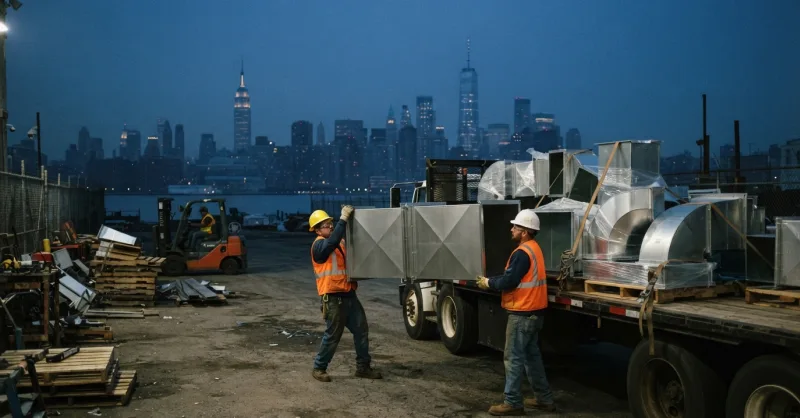
Our fleet runs early. I-95, Route 1&9, Route 3, Route 7, Route 440—the corridor’s ours before most contractors have their coffee. Nighttime crane lifts get coordinated around Holland and Lincoln Tunnel windows because you can’t rig a 20-foot stainless section across a Hoboken avenue at 8:30 AM on a Tuesday. The city won’t let you and honestly neither would I.
I’ve seen contractors bleed thousands of billable hours waiting for a competitor’s truck stuck at the Pulaski Skyway approach. It’s why our shop at 181-183 Garfield Ave, Kearny, NJ 07032 sits where it does. Fifteen minutes to Jersey City. Twenty to Bayonne on a good morning.
How often should a Bayonne property manager actually walk the roof to catch salt corrosion before it turns into a leak? Annually, minimum. Biannually if you’ve got epoxy coated galvanized in play. Add a post-winter walkthrough for freeze-thaw and de-icing salt damage, and a post-storm check after anything with sustained coastal winds.
Washdowns help. So does upgrading exposed fasteners to 316 when you find galvanic bleed. Sealant replacement at companion flanges is the boring maintenance nobody budgets for until a tenant calls about a ceiling stain.
316 stainless is the low-maintenance play. Pay upfront, forget about it. That’s the math waterfront owners eventually run once they’ve replaced a G-90 system twice.
Active leak. Rusted-through section. Failed roof curb on a Jersey City tower with tenant complaints stacking up. We run rapid field measurement, digital takeoff, and priority fabrication of 316 stainless duct, curbs, and plenums—coordinated crane picks along the Turnpike corridor to hit your window.
What’s the fastest realistic turnaround on a custom stainless roof curb adapter for a Secaucus warehouse RTU swap? 72 hours from measurement to delivery when the drawings are clean. Our custom curb adapter program handles legacy-to-new RTU transitions weekly.
Do you handle Port Jersey industrial park exhaust stack replacements on weekend outage windows? Yes. Phased delivery, night rigging, done before Monday shift.
Book a corrosion assessment. Get the material matrix. Stop patching what should have been stainless from day one.
316 stainless steel is the correct specification for rooftops within roughly two miles of Upper New York Bay, Newark Bay, or the Hudson River. Its molybdenum content resists chloride pitting that 304 cannot handle in Bayonne, Jersey City waterfront, and Hoboken exposure zones. Specify 304 only for inland Hudson County properties.
Leaking seams drop static pressure, forcing fans to run longer and harder. Energy consumption climbs and emissions rise, undermining the efficiency benchmarks Hudson County property managers use to align with Local Law 97 compliance frameworks referenced across the river in NYC.
Annual visual inspection minimum, biannually for epoxy powder coated galvanized systems. Add a post-winter walkthrough for freeze-thaw and de-icing salt accumulation, plus a post-storm check after sustained coastal wind events.
72 hours from field measurement to job site delivery when drawings are clean, including priority fabrication of 316 stainless components and coordinated crane pick windows along the New Jersey Turnpike corridor.
Yes. Phased delivery and nighttime rigging are coordinated around Holland Tunnel and waterfront arterial traffic windows so exhaust stack retrofits complete within a single weekend outage, ready for Monday shift operations.
Written by: Arthur Dabrowski
HVAC Metals, LLC
(201) 991-2206