
 CALL NOW
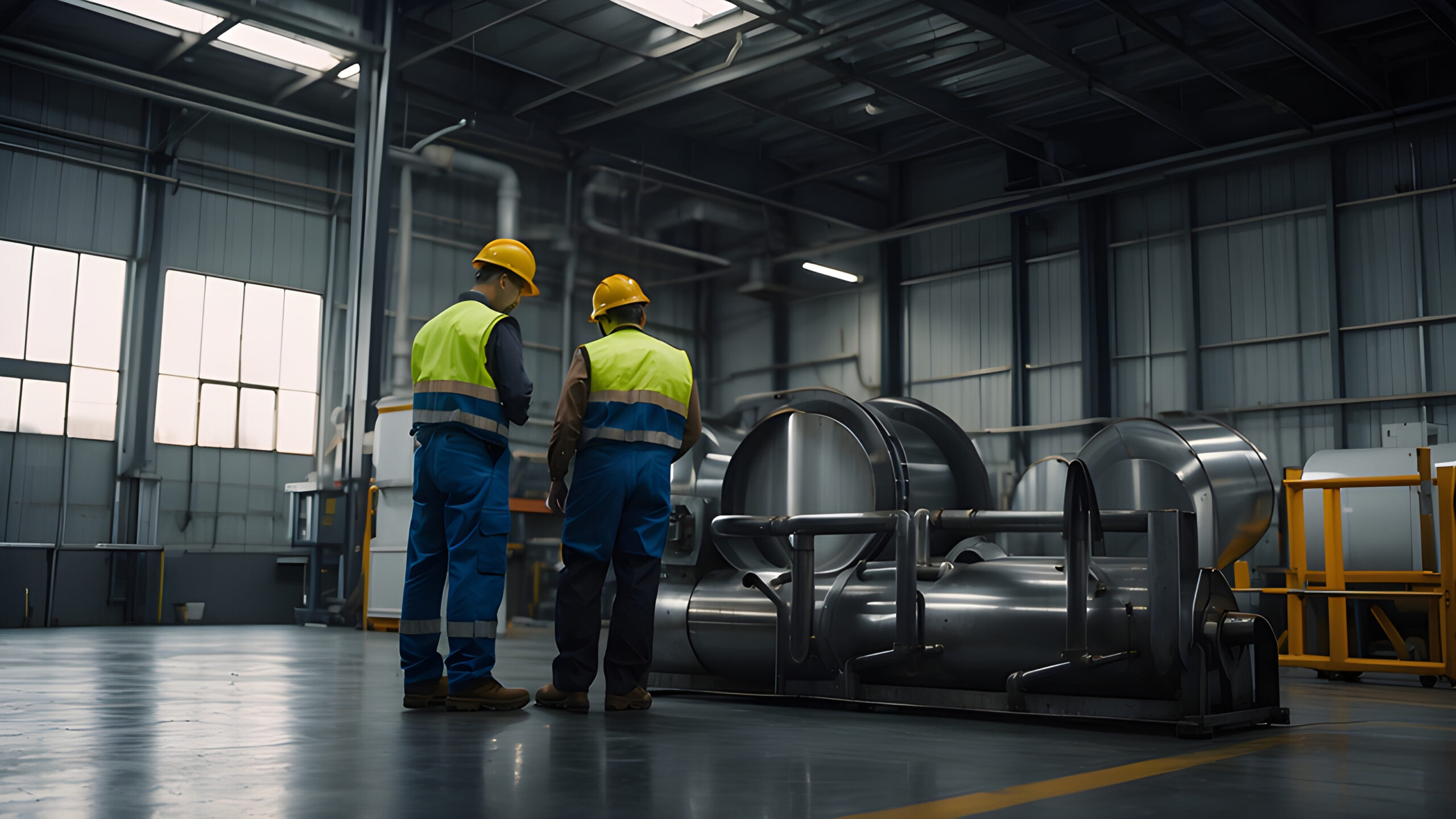
A stainless steel HVAC ductwork manufacturer engineers, fabricates, and delivers corrosion-resistant duct systems built for commercial and industrial buildings. We shear, form, weld, and seal supply, return, and exhaust ducts to SMACNA standards, then coordinate delivery directly to dense urban job sites across Hudson County, NJ.
That’s the short version. The reality of doing this work in a market like Jersey City, Hoboken, or Kearny is a lot more layered than that sentence suggests.
I’m Arthur Dabrowski, owner of HVAC Metals, LLC. We’ve been fabricating sheet metal duct systems out of Kearny since 2015, and over the past decade-plus I’ve watched a lot of mechanical contractors get burned by vendors who couldn’t keep up with Hudson County’s pace, its building codes, or its geography. Salt air off Newark Bay chews through galvanized in ways that surprise people who are used to inland projects. Rooftop mechanical yards on 40-story waterfront towers in Newport or Exchange Place don’t forgive dimensional errors. And downtown Jersey City loading restrictions mean your delivery timing isn’t flexible.
So when a contractor asks what we actually do, the honest answer is: we eliminate the friction that kills project margins.
Why does the alloy choice matter so much near the Hudson River waterfront? Salt-laden marine air from Upper New York Bay and Newark Bay accelerates galvanized steel corrosion on rooftop ductwork faster than most facility managers expect. On waterfront properties in Bayonne and Hoboken, I’ve seen 18-gauge galvanized rooftop exhaust ducts show visible pitting within five years of installation. The same run in 304 stainless? Still clean after a decade.
The material decision really comes down to exposure type and cleaning frequency:
The coastal freeze-thaw cycle is also underrated as a stressor. When condensation gets into a lap seam on a galvanized fitting and freezes overnight, the expansion works the joint. Over years, that’s a leakage problem and eventually a replacement. Stainless handles that cycle better structurally.
For a deeper look at how top contractors navigate material selection across project types, this breakdown on commercial ductwork materials is worth reading.
There’s a version of this explanation that’s basically a brochure. I’m going to skip that.
Here’s what the process looks like when we’re running a stainless duct order for a mid-rise project in Hoboken or a warehouse complex off Meadowlands Parkway in Secaucus:
We start with coil or flat sheet stock – typically 304 stainless for standard commercial applications, 316 for anything touching chemicals, high humidity, or aggressive cleaning cycles. Gauge selection runs from around 20-gauge for smaller-diameter spiral rounds up to 14- or even 12-gauge for large rectangular mains operating at higher static pressures.
What pressure class does your stainless duct need to be rated for? SMACNA defines pressure classes from 1/2-inch w.g. up through 10-inch w.g. positive or negative. Most commercial supply mains run in the 1- to 2-inch w.g. range. Kitchen exhaust and lab duct often push into 3- or 4-inch w.g. The seam type, reinforcement schedule, and joint specification all change with the pressure class. Contractors who don’t specify this upfront end up with duct that either fails inspection or is massively over-built for the application.
We fabricate spiral round and oval stainless duct in-house as well. Spiral lock-seam construction gives you inherently better leakage performance than rectangular duct at equivalent gauge, which is why it’s often the right call for long supply runs in warehouse or data center applications in North Bergen or Kearny.
Logistics in Hudson County is a specific skill. It’s not the same as dropping freight at a suburban industrial park off the Turnpike.
Getting fabricated stainless duct sections into a 25-story building under construction near Grove Street PATH station requires knowing that Newark Avenue has loading restrictions, that your sections need to be sized for the hoist or the service elevator, and that if your truck shows up at 10 AM instead of 6 AM, you’ve just burned the first two hours of a six-person union crew’s day. That’s real money gone for no reason.
Our in-house fleet of box trucks runs early delivery windows – material on the deck by 6:00 AM. This isn’t a marketing line. It’s the difference between a crew that’s installing when their shift starts and a crew that’s standing around waiting. (I’ve heard enough “we’re still waiting on duct” stories from field supers to know how often this kills project momentum.)
For tight downtown streets in Hoboken or the waterfront blocks of Paulus Hook, we pre-bundle and label duct sections by floor and zone. The sections are sized at the fabrication stage to move through whatever vertical transportation is available – elevator, stair, or hoistway. That’s not something you coordinate with a third-party freight carrier who doesn’t know the building.
A Saturday rigging permit along a Route 1/9 corridor near Kearny or a narrow crane window at a Secaucus industrial site isn’t a problem if your material is already staged. If it’s sitting at a warehouse waiting for an afternoon delivery, you’ve missed the window and you’re rescheduling the crane. That’s a cost nobody wants.
Every piece of duct we produce is manufactured to SMACNA construction standards. That covers joint type and spacing, seam integrity, reinforcement schedules, and acceptable leakage by pressure class.
Why does this matter specifically for Hudson County projects? Municipal mechanical inspectors in Jersey City and Hoboken are not reviewing duct the same way a suburban township inspector might. High-rise mixed-use buildings trigger more rigorous inspection cycles, especially for vertical shaft duct, fire and smoke assembly requirements, and kitchen exhaust systems in commercial occupancies.
If your stainless exhaust duct fails an air leakage test because the welds weren’t continuous or the flange bolting pattern didn’t match the pressure class, you’re tearing out work and rebidding labor. That’s not a hypothetical – it happens when fabricators cut corners on QA documentation.
We produce submittal packages: material certs, gauge specs, joint and seam documentation, pressure class notation, and weld inspection records. When the mechanical engineer of record needs to sign off on shop drawings for a lab exhaust system near Journal Square, the documentation exists and it’s organized. That matters for the engineer and for the inspector.
For an in-depth look at how seam welding precision directly affects air leakage test outcomes, we published a detailed technical piece on SMACNA Class A compliance and seam welding that’s worth reviewing before your next submittal package goes to the engineer.
Okay so here’s something that quietly kills bids: slow quotes.
You’re a mechanical contractor estimating a 12-story mixed-use building near Newport with stainless exhaust duct for the commercial kitchen floors and standard supply and return for the upper residential levels. You need a material number within 24 hours to hit the GC’s bid deadline. Your current fabricator takes three to five business days and sends back a lump-sum number with no breakdown.
That’s not a vendor, that’s a liability.
We ingest digital take-offs, architectural files, Revit exports, or PDF blueprints and turn around engineered, line-item quotes within 4 to 24 hours depending on scope complexity. Line-itemed by duct type, gauge, alloy, pressure class, and fittings. If the design changes mid-bid – and it usually does – you know immediately what the cost and lead time impact is, not after the contract is signed.
How quickly can a stainless duct fabricator realistically turn around custom fittings for a time-sensitive retrofit in downtown Jersey City? Depends on the geometry and quantity, but for standard elbows, reducers, and transitions in 304 stainless, we’re typically talking days, not weeks. Complex offsets or welded plenum assemblies take longer – we’ll give you a real number, not a guess.
One procurement loop, one purchase order, one delivery. Duct, hardware, sealants, and hanging materials bundled and labeled. That’s the model. Sourcing stainless duct from one vendor, flange hardware from a distributor across town, and sealant from a third party introduces the kind of supply chain friction that delays installations for no good reason.
Hudson County isn’t a generic commercial market. The building stock here demands fabrication capability across a pretty wide range of typologies.
Towers along the Newport or Exchange Place waterfront corridors deal with coastal salt exposure on rooftop mechanical equipment and exterior duct runs. Stainless spiral or rectangular mains on roof decks are not an over-specification here – they’re the practical choice when you’re calculating lifecycle cost against a replacement cycle that coastal air will accelerate on galvanized.
Retrofitting duct through existing shafts in pre-war brick buildings is genuinely different work. Sections need to be fabricated to exact field dimensions because there’s no room to cut and fit on-site. Confined mechanical rooms mean custom offset and transition geometry, which is where our CNC plasma and laser cutting capability earns its keep. Off-gauge or slightly warped sections are a hard stop in a space like that.
Large-footprint warehouses near the Meadowlands or the industrial zones along the Hackensack River waterfront need high-volume spiral duct for air distribution. These projects move fast – procurement timelines are compressed, sections need to arrive staged and ready to hang. Stainless is common in cold storage and food-grade warehouse applications where cleaning protocols and moisture exposure are constants.
Dense restaurant corridors like Washington Street in Hoboken or Newark Avenue in Jersey City put grease exhaust duct requirements front and center. The NJ Mechanical Code and NFPA 96 are not negotiable here. Continuous-weld 16-gauge stainless grease duct with zero clearance to combustibles where required – this is code, not optional. We fabricate to those specs and document it. For more on grease exhaust fabrication and code compliance, we cover the details in our write-up on custom grease exhaust systems built for code compliance.
I’ll be direct about this because I think it’s useful. Different buyers have different pain points, and conflating them produces a vendor relationship that doesn’t work well for anyone.
Mechanical contractors – project managers, estimators, field supers – need dimensional accuracy above everything else. If a stainless duct section arrives and doesn’t fit the shaft because the flanges are off by an eighth of an inch, the field crew is welding on-site and the schedule slips. Our Accurpress tolerances exist to prevent that specific problem. Rapid change-order pricing matters too; when the engineer updates the drawing mid-job, the contractor needs a revised material cost within hours, not days.
MEP engineers and designers care about submittals, pressure class documentation, and material traceability. They need to know the 316 stainless spec they called out on the drawings is actually what got fabricated, with the certs to prove it. They also need the fabricator to understand the leakage class requirements for the system, not just cut metal to a dimension.
Facility and property managers – especially on waterfront buildings in Bayonne or Jersey City – are usually thinking about total cost of ownership. The conversation about stainless vs. galvanized is really a conversation about replacement cycles and maintenance downtime. A stainless rooftop exhaust duct that lasts 25 years in a salt-air environment costs less over time than cycling through galvanized replacements every seven to ten years, even if the upfront number is higher.
General contractors and developers want schedule certainty and minimal punch-list exposure. Pre-fabricated, zone-labeled sections that arrive on time reduce site labor and eliminate the field fabrication that eats into project contingency.
We operate out of 181-183 Garfield Ave, Kearny, NJ 07032, which puts us well-positioned to serve the full Hudson County corridor without the logistical overhead of a distant fabricator trying to navigate Turnpike traffic from somewhere in central Jersey.
Over eleven years of operating high-tolerance CNC fabrication lines in this market, we’ve built the kind of operational muscle that only comes from actually running stainless duct projects through urban delivery constraints, municipal inspection cycles, and the specific coordination demands of union job sites.
| Metric | Generic Competitor | HVAC Metals, LLC |
|---|---|---|
| Quote Turnaround | 3-5 business days, lump-sum | 4-24 hours, line-itemed by gauge, alloy, pressure class |
| Delivery Model | Third-party freight, afternoon windows | In-house fleet, on-deck by 6:00 AM |
| Stainless Capability | Limited, often subcontracted | Full in-house: spiral, rectangular, custom fittings, grease duct, lab exhaust |
| Submittal Documentation | Minimal or inconsistent | Full package: material certs, gauge specs, weld inspection, pressure class |
| Procurement Loop | Duct only, hardware sourced separately | Duct bundled with hardware, sealants, and hanging materials |
We serve all of New Jersey’s 21 counties, the five NYC boroughs, and Eastern Pennsylvania. If your project is in Hudson County and you’re spec’ing stainless duct, we’re a realistic, local option – not a vendor you’re waiting on from three states away.
Follow our work and connect with us on LinkedIn or Facebook for fabrication updates, project highlights, and industry insights. Ready to send us a take-off or get a quote started? Reach out here and we’ll get back to you fast.
Written by: Arthur Dabrowski
HVAC Metals, LLC
(201) 991-2206