
 CALL NOW
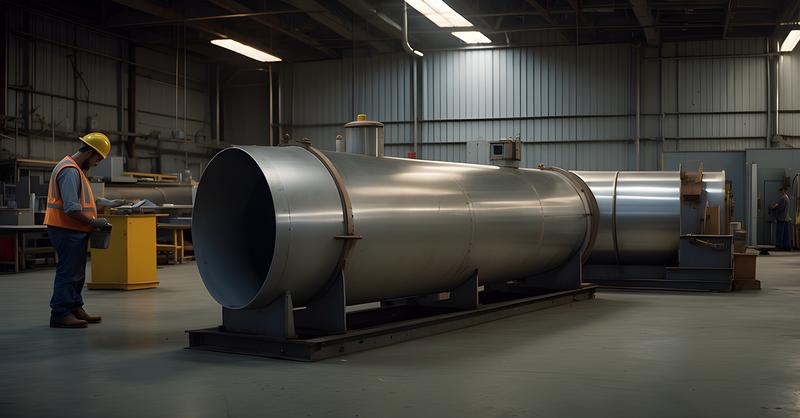
Short version: your kitchen shuts down. The inspector tags the hood, the fire marshal gets a call, and your contractor is left holding a very expensive problem with no clear fabrication solution already in hand.
I’ve seen this play out more times than I’d like to count. A mechanical contractor in Bergen County calls us in a panic because the existing exhaust duct on a restaurant retrofit doesn’t match the new hood geometry. The inspector is coming in 48 hours. The original fabricator took three days just to return the quote. That’s the gap we exist to fill — and it’s exactly why grease exhaust systems demand a fabrication partner who understands both the code environment and the clock.
Commercial kitchen exhaust systems aren’t just moving air. They’re capturing grease-laden vapor (GLV) produced by high-heat cooking, routing it through Type I hood systems, up through ductwork, and out through a rooftop exhaust fan or stack. Every single joint, seam, and access panel in that run is a potential fire ignition point if the fabrication tolerances are off or the material spec is wrong.
SMACNA standards for grease exhaust ductwork are significantly more demanding than standard HVAC duct. We’re talking about:
If your fabricator doesn’t live and breathe these distinctions, the duct they hand you isn’t compliant. Period.
At our Kearny facility, grease exhaust duct runs go through a completely different fabrication process than standard rectangular HVAC duct. The shearing lines are set differently, the MIG/TIG welding protocols are tighter, and every seam gets inspected before the piece leaves the floor. Running a 250-ton Accurpress system since 2015 has given our team a real appreciation for what “liquid-tight” actually means when a piece goes through thermal cycling in a commercial kitchen exhaust stack — it’s not just about the weld bead, it’s about the metal prep underneath it.
Does your current fab shop actually weld grease duct, or do they just roll and lock it? That’s not a rhetorical question. Some shops will hand you a standard snap-lock rectangular duct and call it close enough. It isn’t.
If you’re managing a commercial kitchen exhaust installation in, say, a ground-floor restaurant space in Jersey City’s Journal Square corridor, you’re already dealing with a dense urban constraint set. Tight shaft access, existing structural steel that wasn’t built with modern Type I hood clearance in mind, and a building management office that wants a two-hour installation window. The duct has to be right the first time — there’s no “we’ll adjust it on-site.”
Same story in Manhattan. Managing a commercial kitchen retrofit in Midtown means your rigging window is rigid, on-street staging is basically zero, and the building super is watching every move. Your grease exhaust duct segments have to be pre-fabricated to exact blueprint dimensions, show up on the deck before your crew clocks in, and go in without field modification. That’s not aspirational. That’s the minimum standard for staying on schedule.
We route our own corporate fleet out of 181-183 Garfield Ave, Kearny, NJ 07032 with guaranteed 6:00 AM job site drops. That’s not marketing language — that’s what protects your crew’s morning installation velocity before the Lincoln Tunnel backs up and the day gets away from everyone.
Good question to ask before you order anything. A code-compliant grease exhaust duct assembly for a commercial Type I hood installation typically involves several interconnected components that all have to be fabricated in coordination:
Most of those line items require custom fabrication. Stock catalog parts rarely fit real building conditions.
Can a standard HVAC fabricator handle grease exhaust duct, or does it require a specialty shop? Grease exhaust duct fabrication requires full-penetration welded seams, not standard HVAC lock seam or Pittsburgh joint construction. A shop without certified welding capability and the right material inventory — specifically, the heavier gauge stainless or black steel the code requires — shouldn’t be quoting this work.
Here’s something I see constantly in this market. A contractor submits a grease exhaust duct takeoff to three fabricators. One comes back in four days. One calls and says they’ll get to it next week. The third — us — ingests the architectural file and returns a detailed, accurate material estimate within 4 to 24 hours using our digital estimating system.
That speed gap isn’t trivial. Commercial kitchen build-outs run on tight schedules. A GC who’s waiting on a ductwork quote to finalize a MEP subcontract doesn’t have four days. The contractor who can hand that GC a number fast — with confidence in the accuracy — wins the bid. The contractor who’s waiting on a slow fabricator is explaining to the GC why they can’t commit yet.
We built our estimating workflow specifically around digital blueprint ingestion because the old way — manual takeoffs, paper scaling, back-and-forth phone calls to clarify gauges — just doesn’t match how competitive commercial projects move now. (And honestly, I’ve seen manual takeoffs come back with errors that cost contractors real money in field adjustments. That’s a different kind of painful.)
Not every grease exhaust job calls for the same metal. The application environment drives the spec, and getting it wrong is expensive after the fact.
For most standard commercial kitchen exhaust duct runs, black steel (carbon steel) is the default — it’s what SMACNA and most local codes reference as the baseline for grease duct. For food service environments with heavy moisture exposure, or for exhaust systems in pharmaceutical or cleanroom-adjacent spaces, stainless steel becomes the right call. We process both at our Kearny facility, and our shearing lines handle up to 1/4-inch thickness by 10-foot lengths, so even heavy-gauge stainless isn’t a constraint.
Galvanized steel, for what it’s worth, is generally not code-compliant for grease exhaust duct — the zinc coating degrades under grease and heat exposure. Some contractors don’t know this until an inspector flags it. Now you do.
For a deeper look at how material selection plays out across different commercial HVAC applications, this breakdown of what experienced contractors actually spec covers the decision logic pretty well.
Why do so many grease exhaust fan replacements stall out at the rooftop? Because the new exhaust fan footprint almost never matches the existing structural curb. The old unit was discontinued, the replacement model runs a different base dimension, and now the contractor has a rooftop unit sitting on a pallet while someone scrambles to figure out how to bridge the gap.
We fabricate custom roof curb adapters engineered specifically for that transition — old curb geometry on the bottom, new RTU footprint on the top, structurally compliant and weathertight. It’s one of the more frequent emergency calls we get from mechanical contractors across Hudson, Essex, and Union Counties. The timeline on a custom curb adapter from our shop is measured in days, not weeks.
If you’ve run into this situation before, here’s a more detailed look at how custom curb adapter fabrication actually works and what information you need to give a fabricator to get the right piece the first time.
Sourcing custom grease exhaust duct from one vendor, access doors from a second, the roof curb adapter from a third, and hanging hardware from a fourth is… a lot. Each purchase order is its own delivery window, its own potential delay, its own tracking headache. When one item is late, the whole installation sequence stalls.
We function as a complete supply chain partner — not just a fabricator. Orders ship bundled with installation hardware, sealants, hanging materials, and any supporting components. One delivery. One early-morning drop. Your crew has everything on the deck when the first shift starts.
That procurement consolidation matters especially on grease exhaust jobs where the installation sequence is tight and every component handoff has a dependency. Miss one delivery window in a ground-floor restaurant buildout in Hoboken with a health department opening inspection booked, and the ripple hits the GC, the owner, and your relationship with both.
A lot of contractors treat grease exhaust code compliance as an inspection problem — something to manage after the system is installed. That’s backwards. The inspection outcome is determined at the fabrication stage. If the duct seams aren’t welded to grease-tight spec, if the access door frames aren’t gasketed correctly, if the gauge is wrong — no amount of field adjustment fixes that cleanly.
What code standards govern grease exhaust duct fabrication in New Jersey and New York? The primary reference is NFPA 96, the Standard for Ventilation Control and Fire Protection of Commercial Cooking Operations. SMACNA’s Commercial Kitchen Ventilation guidelines provide the fabrication tolerances and construction methods. Local jurisdictions in NJ and NYC may layer additional requirements on top of those — some New York City buildings have their own supplemental duct spec requirements enforced by DOB. We build to SMACNA standards as the baseline and adjust for local jurisdictional requirements when the job demands it.
Getting the fabrication right the first time is what makes the inspection a non-event. That’s the goal.
Our grease exhaust duct work is built to that standard out of our Kearny shop. If you want to see how our broader fabrication capabilities line up with what your next project needs, the full grease exhaust systems page covers it in detail.
Honestly, the feedback pattern is pretty consistent. It’s usually some version of: “I didn’t realize how much time I was losing chasing parts from three different places.” Or: “The 6 AM delivery actually changed how I schedule my crews.”
One PM we work with regularly — runs a mid-sized mechanical shop out of Newark — told me his guys used to show up at 7:30 and spend the first hour figuring out what was missing from the previous day’s delivery. That’s dead labor time. Paid hours producing nothing. When the material is on the deck before anyone arrives, that morning hour becomes productive immediately.
I’m not going to dress that up into a case study with a percentage outcome. The math is simple: idle crew time costs money. Reliable early delivery stops the bleeding.
How quickly can HVAC Metals turn around a quote for a custom grease exhaust duct system? With a digital blueprint or takeoff sheet, we return an accurate material and labor estimate within 4 to 24 hours. For emergency situations — inspector coming tomorrow, replacement piece needed today — call directly. We’re a local shop in Kearny, not a national distributor routing your order through a warehouse in another state.
You can reach us at 181-183 Garfield Ave, Kearny, NJ 07032. We cover all 21 New Jersey counties, the five boroughs of New York City, and strategic corridors in Eastern Pennsylvania. If your job is in this region, we can get your grease exhaust duct fabricated and on the deck fast.
Follow us on LinkedIn and Facebook for project updates, fabrication insights, and the occasional look at what comes off our shop floor.
Written by: Arthur Dabrowski
HVAC Metals, LLC
(201) 991-2206