
 CALL NOW
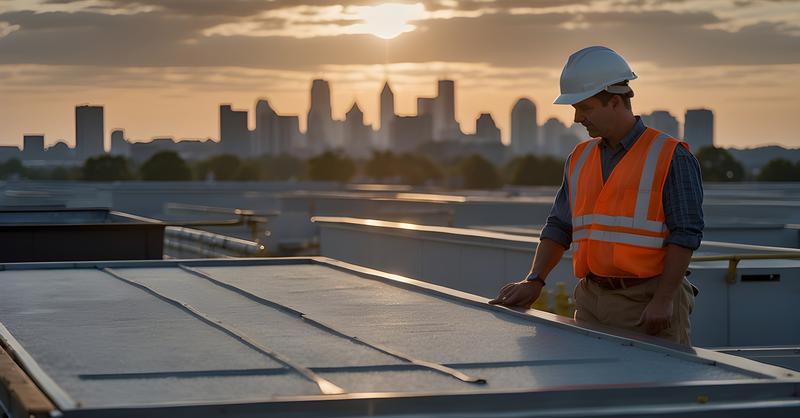
Most mechanical contractors think about the rooftop unit first. The curb adapter? That’s usually an afterthought — until it isn’t. Until you’re standing on a roof in Hoboken at 7:15 AM with a crew waiting, a brand-new RTU sitting on a flatbed, and a legacy curb that doesn’t match the new unit’s footprint by three and a half inches. I’ve seen that exact scenario play out more than once over the past decade running fabrication out of Kearny. It’s not catastrophic, but it is expensive — and almost entirely preventable.
We fabricate custom curb adapters engineered specifically for RTU replacement transitions, and what I can tell you from real production experience is that the dimensional mismatch problem is far more common than the industry likes to admit. Existing curbs stay on the roof for 15, 20, sometimes 25 years. RTU manufacturers change footprint dimensions across equipment generations. When those two timelines collide on a commercial retrofit, you need a precision-fabricated transition piece — not a field-bent workaround held together with caulk and hope.
A curb adapter, in HVAC terms, is a sheet metal transition assembly that bridges the dimensional gap between a legacy roof curb and a replacement rooftop unit. That’s the functional definition. The more honest definition is: it’s the component that protects your labor budget when the new RTU doesn’t drop cleanly onto the old curb.
There are a few configurations we produce regularly at our 181-183 Garfield Ave facility in Kearny, NJ:
Each one gets CNC plasma cut and bent on our 250-ton Accurpress system. When your curb adapter is off by even an eighth of an inch on a commercial rooftop in Newark or a hospital mechanical room in the Bronx, your crew is eating that time. We treat every take-off like it’s absolute law for that reason.
Honestly, the problem starts before anyone picks up a measuring tape. A lot of project managers are working from manufacturer cut sheets that list “nominal” curb dimensions — not actual field dimensions. Nominal and actual can diverge by half an inch or more once you factor in how an older curb has settled, shifted, or been patched over decades. I’ve had contractors send us field measurements that differed from the original install drawings by nearly an inch on one side. Not their fault, but it matters.
The second problem is sourcing. Many contractors order curb adapters through a general sheet metal shop that doesn’t specialize in HVAC transitions, or they’re waiting on a manufacturer’s standard catalog piece that’s close but not exact. “Close” on a roof means field modifications. Field modifications mean labor hours you didn’t budget.
What does a well-spec’d custom curb adapter require? At minimum:
We ask for all of this upfront. Contractors who’ve worked with us know the drill. First-timers sometimes push back on providing RTU submittals, and I get it — it feels like extra paperwork. But that documentation is what gets you a curb adapter that drops in clean on the first try.
Bergen County commercial retrofits are a good example of why this gets complicated fast. You’ve got a lot of mid-century flat-roof commercial buildings up there — think strip malls along Route 4, older office parks in Hackensack, industrial bays in Lodi — where the original roof curbs were installed in the 1970s or 1980s using whatever standard the original mechanical contractor preferred. No uniformity. A 36×36 curb on paper can be 35.5 x 36.25 in the field once you account for decades of thermal cycling and membrane patching.
We had a contractor reach out last spring about an RTU replacement at a warehouse space in Garfield. The existing curb was a non-standard height — something like 14 inches rather than the typical 18 — probably a custom install from the original build. The new unit they spec’d required an 18-inch curb height for proper condensate drainage. So we fabricated a height-extension adapter in 20-gauge galvanized with an internal nailer frame, gave them a flat top surface for the new unit to land on, and got it to the job site by 6 AM the morning of the lift. Crew had it installed before noon.
That’s the scenario where a custom curb adapter isn’t just helpful — it’s the only real option.
I want to be direct about something. There’s a version of this job where a field crew bends up some angle iron and sheet metal on the roof to fill the gap. It works. Sort of. For a while. But it’s not insulated, it’s not vapor-sealed properly, and it almost certainly doesn’t meet SMACNA standards for structural integrity or air leakage. In a commercial building with a mechanical system under a service contract, that’s a liability issue waiting to surface.
A fabricated curb adapter from a shop running SMACNA-compliant production processes gives you:
We run MIG and TIG specialty welding in-house at Kearny. For adapters going into food service or pharmaceutical environments — places like commercial kitchens along the Hudson County waterfront or biotech facilities in Parsippany — stainless steel with TIG-welded seams is often the spec. That’s not a job for a field modification.
One thing I hear from new contractors is surprise at how fast we turn estimates. We’re using digital estimating software that ingests architectural files, blueprint take-offs, and submittal packages directly. You send us the documents; we don’t spend three days scaling paper drawings. Most custom curb adapter quotes come back within 4 to 24 hours depending on complexity. For a straightforward dimensional mismatch adapter in galvanized steel, it’s usually same day.
Delivery runs through our own fleet of box trucks out of Kearny. We cover all of New Jersey’s 21 counties, the five boroughs, and eastern Pennsylvania corridors. The 6 AM delivery option isn’t a marketing line — it’s how we’re structured. If you’re managing a rooftop RTU swap in Midtown Manhattan and your rigging window opens at 7 AM, your curb adapter needs to be on the deck before the crane crew arrives, not sitting on a truck caught in tunnel traffic at 8:30. Our fleet moves before that gridlock exists.
We also bundle installation hardware with fabricated orders — sealants, fasteners, hanging materials — so you’re not sourcing from three different vendors and hoping the delivery timelines align. One purchase order, one delivery, one less thing to coordinate the morning of a lift.
If you want to see how this fits into a broader procurement approach, our piece on finding a reliable curb adapter supplier in NJ goes deeper on what to look for when vetting a fabricator for this kind of specialty work.
Does the fabricator actually specialize in HVAC transitions, or are they a general sheet metal shop taking on curb adapter jobs as overflow work? This distinction matters more than most contractors realize. A general fabricator might hit your dimensions, but they may not think through nailer frame placement, flange angle for membrane integration, or gauge selection for the specific load. We’ve built curb adapter fabrication into our core production line — it’s not a side project for us.
A few things worth asking any shop before you commit:
The freight question is the one that trips people up most often. A shop that hands off to a third-party carrier can’t guarantee a 6 AM job site arrival. Period. That’s not a knock on anyone — it’s just how third-party freight scheduling works.
For a rooftop curb adapter in a coastal New Jersey environment, which metal is the right call? Standard galvanized steel (18 to 20 gauge is typical for curb adapters) handles most commercial applications across the Tri-State. If you’re within a few miles of the Jersey Shore or working on a rooftop in Jersey City or Bayonne where salt air exposure is real, the corrosion timeline on galvanized accelerates. For those projects, we recommend either a heavier galvanized gauge with a sealant coating spec or a full switch to aluminum — lighter on the structural load, better corrosion resistance in marine microclimates.
Stainless steel curb adapters come up for food processing plants, pharmaceutical manufacturing (we do a fair amount of work for facilities in the Parsippany/Morris County pharma corridor), and hospital mechanical rooms where sanitation standards drive material specs. TIG-welded stainless is the right answer there — not galvanized, not aluminum.
We process galvanized steel from 18 to 26 gauge, aluminum, stainless, and specialty alloys including PCD and galvanneal through our Kearny facility. The material selection conversation is always part of our estimation intake. It should be — the wrong material on a rooftop curb adapter doesn’t fail immediately, it fails two or three winters later when you’re no longer in the picture and someone else is dealing with the warranty call.
What’s the minimum information needed to fabricate a custom RTU curb adapter? You can work with field measurements if drawings aren’t available — and honestly, for older buildings, field measurements are usually more accurate anyway. What we need at absolute minimum is the existing curb’s outside dimensions (length, width, and height), the new RTU’s curb opening dimensions from the manufacturer submittal, the desired adapter height, and the roof type (flat, low-slope, or pitched). Photos help. A quick site sketch on your phone helps more than you’d think.
What we can’t work from is “it’s roughly 36 by 36.” Roughly doesn’t work on a roof. Send us actual tape measurements, and we’ll get you a fabricated adapter that fits. That’s the whole point of precision CNC fabrication over generic catalog parts — we build to your actual field condition, not to a published standard size that may or may not match what’s on your roof.
We’re at 181-183 Garfield Ave, Kearny, NJ 07032. Contractors from Hudson County, Essex, Bergen, and down into Union County come through regularly. Others coordinate remotely across the full Tri-State footprint. Either way works.
Follow us on LinkedIn or Facebook — we post fabrication updates, material availability notes, and real job photos from production. Not stock images. Actual work coming off our floor.
If you’ve got an RTU replacement coming up and you’re not sure whether you need a standard curb adapter or a custom-fabricated transition, reach out. We’ll tell you straight. If it doesn’t need to be custom, we’ll say so. If it does, we’ll get you a quote the same day.
Written by: Arthur Dabrowski
HVAC Metals, LLC
(201) 991-2206