
 CALL NOW
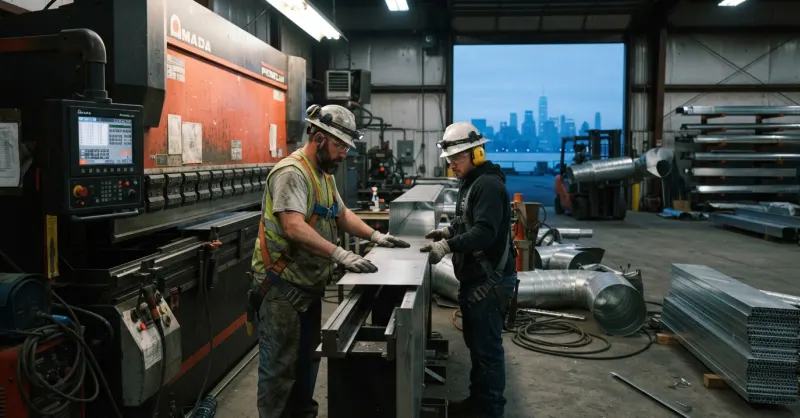
Chlorides. Salt-laden air rolling off the Hudson River and Newark Bay eats galvanized seams from the outside in. I’ve walked rooftops in Paulus Hook where the curb flashings looked fine at eye level, then flipped a panel and found pitting straight through the fastener heads. Five years old. Sometimes less.
The pattern repeats up and down the peninsula. Bayonne, Weehawken, the Hoboken piers. If your building sits within roughly a mile of open water, standard G90 galvanized is a lifecycle problem waiting to be expensed.
Salt air corrosion doesn’t care about your capital budget cycle. It works on its own schedule.
Here’s where I watch specs get lazy. Someone writes “stainless” on a drawing and calls it a day. That’s not a specification. That’s a wish.
316 stainless steel carries molybdenum, which is what actually fights chlorides. For anything sitting on a Jersey City or Bayonne rooftop, exhaust plenums facing the water, or grease-rated hoods pulling marine air, 316 is the honest answer.
304 stainless steel ductwork works fine for interior mechanical rooms, return runs buried inside conditioned space, or below-grade distribution where chloride ingress isn’t realistic. Cheaper. Perfectly serviceable in the right slot.
Mixing them intelligently is where lifecycle cost gets tamed. Nobody needs 316 in a basement return plenum in Kearny. But putting 304 on a rooftop discharge in Weehawken? You’ll be back in three winters.
Our full breakdown on commercial ductwork material selection gets into the trade-offs by application.
SMACNA corrosion standards aren’t a suggestion. They set the floor for gauge, seam construction, and hardware compatibility in aggressive environments. On coastal work, three things trip contractors up:
ASHRAE coastal environment guidance layers on top of this, treating exposure classification as the driver rather than a rubber-stamp material call. If your fabricator can’t hand you the selection logic in writing, you’re gambling. More on how we handle SMACNA Class A seam welding at the shop.
Half the facility directors I talk to in Jersey City and Hoboken manage buildings on both sides of the river. NYC Local Law 97 compliance pressure bleeds westward through portfolio-level reporting, insurance underwriting, and lender questionnaires.
Specifying corrosion resistant commercial ductwork with a documented 25-plus year service life feeds directly into embodied carbon math. Replacement avoidance is emissions avoidance. That story gets easier to tell when you can show material grade, gauge, and expected replacement interval on a submittal.
Should you spec 316 across the entire rooftop when only 40 percent is truly exposed? Probably not, but the documentation you produce during selection is what makes the retrofit defensible three audits later.
Fabrication is half the job. The other half is landing the assemblies on a rooftop wedged between the PATH corridor and a residential tower with a 20-foot loading zone.
We run field measurements with laser verification, cut to those dimensions on our CNC lasers in Kearny, and roll trucks out for 6:00 AM drops. Materials sit on the deck before your crew swipes in. That’s the model.
A story I keep telling because it still stings: a Weehawken retrofit where the crane permit got kicked twice because a competitor’s truck couldn’t clear the Lincoln Tunnel approach during the assigned window. Two mechanics and a rigger idled for four hours. Somebody paid for that (not us, thankfully, but the GC ate it). Now we route stainless assemblies for waterfront jobs through Route 440 or the Turnpike Eastern Spur depending on wind and time of day.
Our early-bird delivery workflow is built around exactly these constraints.
Roof curb transitions are the number-one leak point on coastal retrofits. The old curb footprint never matches the new unit, someone throws break metal and mastic at it, and 18 months later there’s a rust bloom running down the parapet.
Custom stainless curb adapters, welded and gasketed to spec, close that gap. We fabricate them alongside the duct package so everything lands together. Details on our curb adapter process are worth a read if you’re planning a rooftop swap.
316 stainless runs meaningfully higher than galvanized on the invoice. I won’t pretend otherwise. If telling you the truth costs me a bid, so be it.
The math changes when you count the second and third replacement cycles that don’t happen. Fewer emergency calls. No tenant disruption from re-work. Insurance underwriters stop flagging the mechanical scope on your renewal.
On a waterfront asset, the first-cost premium usually pays back inside seven years. On an interior mechanical room, it doesn’t, and you shouldn’t spec it there.
Book an on-site walk. We’ll map exposure zones, measure existing scope, and quote a stainless fabrication package tied to your shutdown window. Our team is reachable through the contact page or via LinkedIn.
Waterfront humidity accelerates every existing corrosion problem between now and spring. Earlier walk, cleaner retrofit.
Field measure typically inside 24 to 48 hours of site access. Shop fabrication on 316 assemblies runs a week or two depending on complexity and current queue. Expedited slots exist for active leaks or shutdown windows tied to a tenant move.
Yes. We sequence deliveries around tunnel restrictions, bridge weight limits, and municipal rigging permits. The dedicated account manager handles the schedule alongside your GC’s superintendent.
We run daily into 07030, 07302, 07310, 07087, 07086, 07002, 07032, 07047, and 07093, among others. Our shop in Kearny sits inside the county, so response times stay tight.
It contributes. Extended service life reduces embodied carbon over the reporting horizon, and documented material grades feed cleanly into retrofit justification packages. It won’t earn credits on its own, but it strengthens the file.
Properly specified and installed, 25 to 40 years is reasonable. Galvanized in the same location often fails inside 8 to 12. Actual performance depends on washdown, wind direction, and how well the welds were sealed.
Written by: Arthur Dabrowski
HVAC Metals, LLC
(201) 991-2206