 CALL NOW
Every restaurant fit-out in Jersey City, Hoboken, or Bayonne lives or dies on three documents: the hood cut sheet, the welded duct submittal, and the suppression interlock drawing. Miss one and the fire marshal walks.
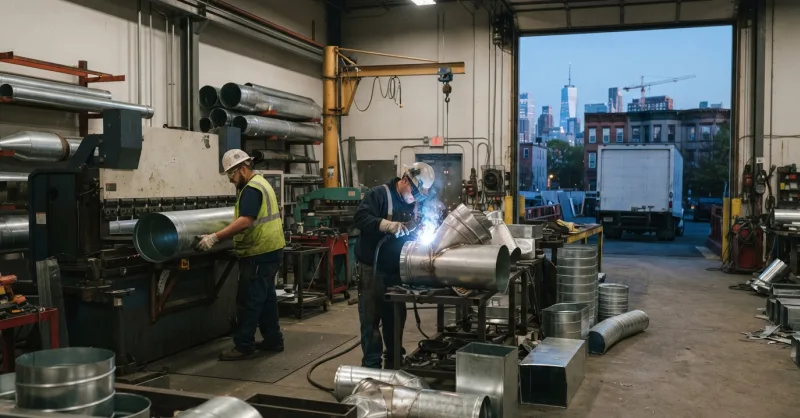
I run a fab shop in Kearny. I’ve watched more grease duct jobs stall on plan review than on any other single trade. The reason is almost always the same — someone tried to source a Type I system through a legacy supply house that treats welded grease exhaust like it’s just another rectangular run.
It isn’t. A UL 710 Type I hood connects to a continuously welded stainless assembly, liquid-tight, with listed access panels every twelve feet or at every change of direction. NFPA 96 doesn’t leave room for creative interpretation on that.
The New Jersey Mechanical Code adopts IMC Chapter 5 exhaust systems by reference, then layers NFPA 96 on top for grease-laden vapor. Your local fire official in Hudson County reads all three simultaneously.
Here’s what that means on paper:
Miss any of these and you’re paying for a second inspection. In Jersey City that can push your opening two weeks, easy.
A UL 710 Type I hood captures grease from fryers, ranges, griddles, charbroilers, woks. A Type II hood handles heat and steam only — dishwashers, pasta cookers, ovens with no grease load.
If your menu changes mid-buildout and a fryer shows up, your Type II hood is now illegal. I’ve watched that exact conversation happen in a Hoboken basement kitchen at 4pm on a Friday. The GC had ordered galvanized round duct through a supply house on Tonnelle. We had to fabricate a full welded stainless replacement over the weekend and swap it Sunday night before the Monday inspection.
That job cost the owner about three times what a proper Type I package would’ve cost from the start. Nobody was happy. But the doors opened on schedule.
Dense mixed-use buildings dominate the market from Bergenline Avenue down through the Jersey City waterfront. Brownstones, converted warehouses, ground-floor retail under six stories of residential. Every one of them has a different roof access problem.
The typical retrofit pain points I see weekly:
Field-measure everything. I don’t trust as-built drawings on any building older than 1990. We send a fabricator to the site with a laser and a notepad before we cut a single sheet. Which brings up a question I get from GCs constantly — how quickly can you fabricate grease duct once field dimensions are locked? For a standard restaurant package in Hudson County, we’re typically shipping welded assemblies within five to seven business days of the signed field dims, with the fan curb and roof transition included. Emergency work goes faster if we clear the shop.
The fire protection contractor and the mechanical contractor rarely talk until the pre-inspection walkthrough. That’s a mistake.
NFPA 96 requires the suppression system to shut down the fuel supply and, in most Hudson County jurisdictions, prove the exhaust fan stays running or shuts down per the specific listing. The interlock has to be wired, labeled, and demonstrably functional before the fire marshal signs off.
I’ve had fire marshals in Bayonne pull the fusible link during inspection just to watch the sequence fire. If your fan doesn’t do what the listing says, you fail. On the spot.
What’s the most common reason grease duct systems fail first inspection in Hudson County? Missing or inaccessible cleanout panels. It’s not sexy, but it’s the number one write-up I hear from inspectors along the Route 440 corridor.
Legacy fabricators quote you a lead time and then release the truck at 11am. Your crew’s been standing on the roof since 7. That’s four hours of billable labor evaporated because a dispatcher in some yard off Communipaw doesn’t understand what a mechanical schedule looks like.
Our fleet rolls out of 181-183 Garfield Ave, Kearny, NJ 07032 before 5am for a reason. Turnpike Eastern Spur to Exit 14C, into Jersey City before the Holland Tunnel queue backs up onto Grand Street. Materials on the deck by 6:00 AM. Crane rigging on the Hoboken waterfront? We stage for the Saturday morning window because you don’t get a second shot at those permits.
Can you deliver to a Jersey City rooftop with a boom truck if we can’t get a crane permit in time? Yes — for grease duct assemblies under a certain weight and length, our box trucks with articulating booms handle it. Bigger fan/curb combos still need a proper crane.
Every grease duct package we ship includes:
Give the plan reviewer a complete package the first time. You’d be surprised how much goodwill that buys you the next time you’re pulling a permit in the same town.
One last thing I’ll admit — no submittal is perfect. We’ve had inspectors flag details we thought were bulletproof. Kearny inspectors read differently than North Bergen inspectors. That’s the job.
Restaurant owners with a signed lease and a July opening. GCs trying to close out a kitchen fit-out without a punch-list disaster. MEP coordinators who need welded stainless that matches the specification exactly. Facilities managers who just got a correction notice from the fire marshal and need welded assemblies fabricated yesterday.
What’s the difference between hiring a general HVAC contractor and a specialized grease duct fabricator in Hudson County? The generalist subs the fab out and marks it up. The specialist owns the welded assembly from cut to delivery, which is where compliance actually lives.
Do you coordinate with fire protection contractors on the suppression interlock design? We coordinate — we don’t wire it. But we make sure the duct penetrations, access panels, and fan connections don’t fight the suppression layout before anyone shows up to inspect.
If you’ve got a Hudson County kitchen project in play, get us the plans. We’ll turn a takeoff in 24 hours and tell you honestly whether your current specification will pass. If it won’t, we’ll say so. If telling you the truth costs me a bid, so be it.
Connect with us on LinkedIn, review our custom ductwork capabilities, or hit our contact page for expedited fabrication on Hudson County restaurant buildouts, roof curb transitions, and emergency retrofits.
Written by: Arthur Dabrowski
HVAC Metals, LLC
(201) 991-2206