
 CALL NOW
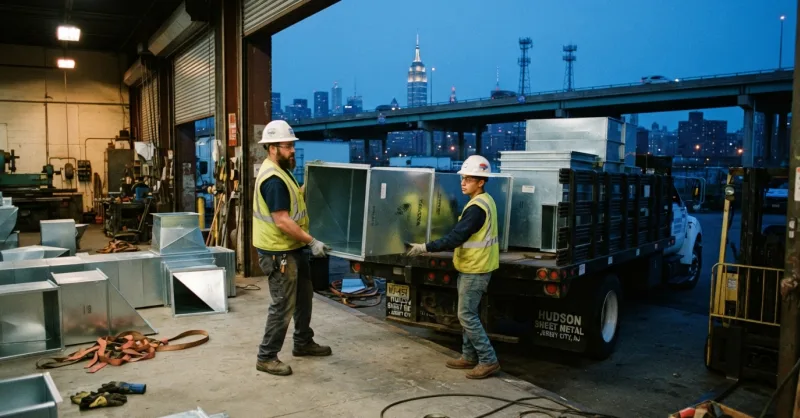
Somebody calls me in July. A Jersey City middle school. The rooftop units are shot, the classroom CO₂ readings are embarrassing, and the district wants everything cut over before Labor Day. That’s the reality of a school HVAC retrofit in Hudson County. Tight windows, occupied buildings, an aging roof deck nobody trusts, and a construction official who wants paperwork the day before yesterday.
At HVAC Metals, we don’t run the mechanical install. We fabricate the sheet metal that makes it possible, and we get it to your deck at 6:00 AM so your crew isn’t billing the district to drink coffee.
The scope is almost never clean. You’re touching rooftop units, air handlers, boilers, exhaust fans, ductwork, curbs, and controls, all while the building is either occupied or on a summer countdown. The engineer’s drawings tell one story. The roof tells another.
Every retrofit gets reviewed against the applicable NJ UCC subcodes administered under NJAC 5:23. The Mechanical Subcode governs duct construction, clearances, and ventilation. The Energy Subcode drives equipment efficiency and commissioning documentation. IMC compliance applies where adopted through the New Jersey framework.
I’m not going to pretend one code edition covers every job. Permit date, occupancy classification, and the alteration scope all shift the answer. The construction official in Bayonne isn’t reading the same page as the one in Weehawken sometimes. Your design professional and your municipal AHJ get the final word.
What we do is fabricate to the approved drawings and the field-verified dimensions. Access doors positioned so the inspector can actually reach the fire damper. Pressure and leakage classes marked on the shop tickets. SMACNA structural standards baked into every seam.
A district business administrator once asked me, straight up, whether ductwork replacement always needs a permit. Honest answer: depends on scope, occupancy, and what the local enforcement agency flags. Sealing an accessible run is one thing. Ripping out a distribution system feeding a fire-rated shaft is another.
Classroom IAQ is the pressure point right now. Every district in Hudson County is looking at outdoor-air delivery, filtration, and controls. The tools that keep showing up on our shop tickets:
None of this works without measured airflow, static-pressure verification, and honest commissioning before students walk back in. If a “guaranteed savings” pitch shows up without a TAB report attached, walk away.
The most common call from a North Bergen or Jersey City retrofit: the new RTU footprint doesn’t match the existing curb. Nobody’s cutting a new hole in a 40-year-old roof deck if they can avoid it. That’s where a field-measured custom curb adapter saves the schedule.
We measure the existing curb, roof construction, curb height, structural framing, and flashing condition. Shop drawings go back to the engineer. Then we cut on the CNC plasma table, form on the 250-ton Accurpress, and weld the adapter to hold flashing continuity through wind-driven rain off Newark Bay.
Delivered at 6:00 AM. Before the crane rigging window opens on Route 1&9 or the ramp off 495. If the adapter isn’t on the deck when the crane sets up, you’re paying rigging by the hour to watch it sit.
Occupied-school work isn’t a general contractor problem you can wish away with a Gantt chart. Summer shutdowns compress everything into eight to ten weeks. After-hours ductwork drops. Temporary ventilation for staff still in the building. Dust containment. Noise windows.
Our contribution is fabricating in modules so your crew installs sections, not raw sheets. Prefabricated plenums, pre-insulated double-wall runs, transitions with the access doors already located. Less on-site cutting. Less field welding on an occupied roof.
A common question from consulting engineers scoping a Hoboken elementary: can we retrofit without replacing every duct run? Usually, yes. Field verification decides. Sealing accessible leaks, resizing branches for the new airflow, pulling degraded liner, and reconfiguring diffusers often gets you most of the way. Full replacement is the answer when pressure class or geometry can’t support the new equipment.
Hudson County isn’t friendly to freight. Hoboken has one lane and a parked delivery van blocking it. Weehawken has grades that punish tandem axles. Jersey City has waterfront wind that makes rooftop rigging a scheduling puzzle. Bayonne adds salt air corroding anything you didn’t spec galvanneal or aluminum for.
Our box truck fleet runs from Kearny out to every school district in the county. Turnpike, Route 3, Route 440, the Pulaski Skyway, 1&9, 495. We plan the route around the school’s loading window and the municipality’s construction hours. Early-bird delivery exists because I’ve watched too many crews eat two hours of billable time waiting on a supply house that promised “morning” and showed up at 1 PM.
Where do most Hudson County school retrofits go sideways on delivery? Loading zones. A Hoboken school on a residential-adjacent block has maybe a 90-minute window before parents start arriving. Miss it and you’re rescheduling the crane.
Our shop sits at 181-183 Garfield Ave, Kearny, NJ 07032. Ten minutes from most of the district lines we serve.
Some districts chase a LEED Gold target on new construction wings or major renovations. That affects energy modeling, commissioning records, materials submittals, and IAQ planning. LEED status can’t be claimed unless the project actually pursues and earns it, so keep the marketing language honest with the district.
What we contribute: double-wall insulated duct systems that limit thermal loss, submittal-compatible fabrication documentation, and material traceability. The acoustic and thermal architecture supports the energy-subcode narrative your engineer is trying to close out.
Facilities directors ask this at least once a month: how fast can you turn a takeoff for a summer retrofit? Blueprint in, estimate out inside 4 to 24 hours depending on complexity. That’s not marketing. That’s the software and the estimator’s calendar.
School HVAC retrofit work across Hudson County rewards the contractors who show up with field-verified components, code-coordinated documentation, and delivery timing that respects the school calendar. Everything else is friction. If telling a district the ductwork can’t be salvaged costs me the fabrication scope on the branch runs, so be it. Better than eating a callback in October when the balancing fails.
Get the drawings to us. We’ll price it, fabricate it, and put it on your deck before the coffee’s cold.
Written by: Arthur Dabrowski
HVAC Metals, LLC
(201) 991-2206