 CALL NOW
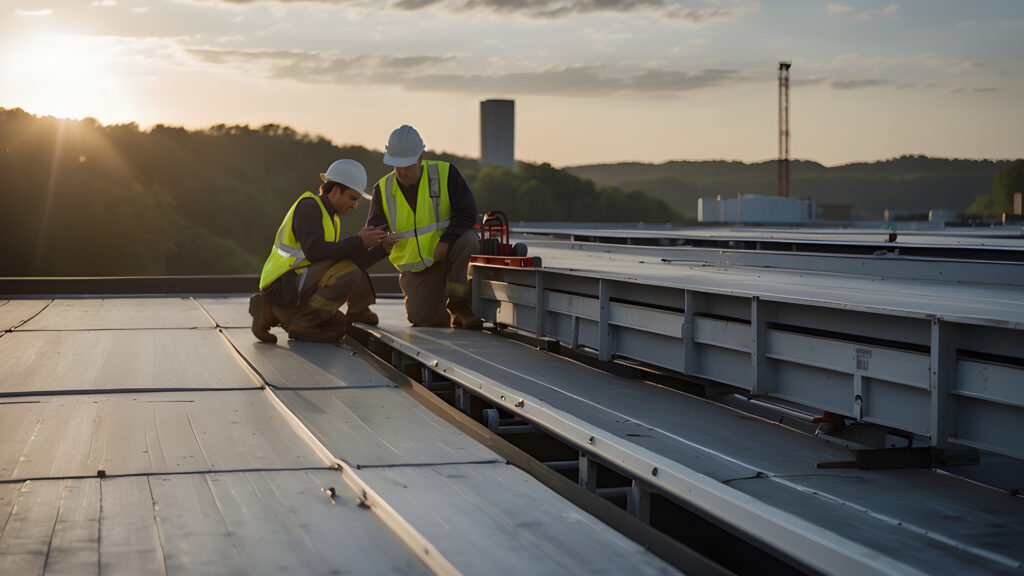
Custom aluminum rooftop equipment rails and plenums for Eastern PA-spec projects are engineered structural supports and sealed air-handling transitions built for RTUs, exhaust fans, chillers, and packaged rooftop HVAC equipment. At HVAC Metals, LLC, we design, fabricate, and deliver these systems from our facility at 181-183 Garfield Ave, Kearny, NJ 07032, serving mechanical contractors, roofing firms, facility managers, and engineers across Hudson County, NJ and the broader Eastern Pennsylvania commercial corridor.
Over the past decade-plus, we’ve built these systems for Jersey City waterfront mid-rises, Bayonne warehouse complexes, Secaucus distribution centers, and Hoboken mixed-use buildings where salt-laden air off the Hudson River and Upper New York Bay accelerates corrosion on anything that isn’t specced correctly. The Eastern PA influence runs deep in our work. Many of the contractors and engineers we serve manage assets on both sides of the Delaware, and they expect the same level of detailed submittals, load tables, and extruded aluminum profile specifications that show up on Eastern PA bid documents.
Galvanized steel handles most ductwork requirements just fine. But rooftop equipment rails and plenums sit in a completely different environment. They’re exposed to wind, precipitation, temperature cycling, and in Hudson County specifically, salt spray that eats through coatings faster than most people realize. We process aluminum in structural sections (channels, angles, tubes, tees) ranging from 0.063″ sheet up to 0.125″ structural plate, and the weight advantage over steel matters when you’re dealing with older roof decks in Union City, West New York, or Bayonne where structural capacity isn’t always what the original drawings promised.
Do custom aluminum rooftop equipment rails require different attachment methods than steel rails on Hudson County buildings? Yes. Aluminum rails use stainless steel fasteners (lag bolts, expansion anchors, or through-bolts) to prevent galvanic corrosion at connection points. We detail every attachment based on the actual deck type, whether that’s poured concrete, steel bar joist, or the occasional wood deck you still find in older Hoboken and Jersey City buildings. The flashing and counter-flashing interface gets coordinated with your roofing contractor so the membrane warranty stays intact. We’ve seen too many jobs where someone bolted a rail down without considering the roofing assembly, and the roofer refused to warrantee the penetration. That conversation never goes well.
We run a 250-ton Accurpress brake and Accurshear system that handles up to quarter-inch material by ten-foot lengths. For rooftop equipment rails, this means we can form heavy structural aluminum sections with the tight tolerances that keep field fitting to an absolute minimum. (If an equipment rail arrives on the roof and it’s off by even an eighth of an inch, your crew burns half the day shimming and re-drilling. That’s the kind of friction we exist to eliminate.)
Our automated CNC plasma cutting tables and laser profiling systems handle the complex geometries that rooftop work demands: notched gussets, slotted base plates for adjustable positioning, and radiused cuts for equipment screen panels. The plenums we fabricate connect RTUs to duct mains with sealed, insulated transitions that prevent bypass air, water intrusion, and the energy loss that comes with sloppy field-built boxes.
The whole process, from approved drawings to fabricated product, typically runs 10 to 15 business days. We keep expedited slots open for projects in Jersey City, Hoboken, and the Secaucus warehouse parks where timelines tend to compress without warning.
I’ve been doing this long enough to know that a rooftop in North Bergen presents a completely different set of problems than one in, say, suburban Bucks County. The wind exposure on bluff-top buildings along Tonnelle Avenue or the Weehawken waterfront palisades creates uplift loads that you just don’t see inland. And then there’s the access question. Try getting a 40-foot rail section up to a roof on a tight Jersey City side street with cars parked bumper-to-bumper and a fire hydrant blocking the only feasible crane setup location.
What wind and snow load ratings should custom aluminum rooftop equipment rails meet for coastal Hudson County installations? Rails and support frames need to account for high-velocity wind zones per IBC requirements adopted under the New Jersey Uniform Construction Code. For waterfront sites in Jersey City, Hoboken, and Bayonne, we design to elevated PSF wind uplift values that reflect coastal exposure categories. Snow loads follow local code requirements, and we factor in drift loading against parapets and adjacent equipment, which is something that gets missed surprisingly often on flat commercial roofs.
The Eastern PA spec culture that many of our clients work within demands documented load tables, material certifications, and detailed submittals. We provide all of that because our sheet metal fabrication capabilities extend well beyond just cutting and bending metal. The engineering documentation is part of the deliverable.
Rooftop plenums are deceptively simple-looking. A box that connects the bottom of an RTU to your duct main. But a poorly built plenum leaks air, leaks water, and wastes energy in ways that compound over years. We fabricate plenums to SMACNA duct construction standards with continuous welded seams, internal insulation where thermal performance matters, and integrated drain provisions for when, not if, condensation forms.
Can custom HVAC plenums be fabricated to match Eastern PA specification formats for cross-border project portfolios? Absolutely. A significant portion of our client base manages facilities in both Hudson County and Eastern Pennsylvania. We format submittals, shop drawings, and material documentation to align with the specification structures common on Eastern PA bid packages. That consistency matters when a facility manager or engineer needs to standardize rooftop support systems across a mixed portfolio of warehouses in Secaucus and distribution centers outside Allentown.
We match plenums to custom curb adapters so the entire rooftop assembly, curb, plenum, and duct transition, fits as a coordinated system rather than a collection of parts from three different vendors. Um, that bundled approach kills a lot of the field coordination headaches that mechanical contractors deal with on retrofit jobs where the existing curb dimensions don’t match anything in a catalog.
Your crane is booked. Your roofer is on site. Your mechanical crew is ready. And the equipment rails are sitting in a warehouse somewhere waiting for a third-party freight company to fit your job into their afternoon route. That scenario costs real money. Six installers standing idle at $85 per hour each burns through $500 before lunch.
We operate our own fleet of box trucks out of Kearny. Deliveries hit your job site deck by 6:00 AM, before your crews clock in and before the predictable morning gridlock on the New Jersey Turnpike, US-1/9, or Route 495 backs everything up. For Bayonne industrial sites off Route 440 or Secaucus warehouse parks near the Meadowlands, we’re talking a 15-minute run from our shop. That proximity isn’t just convenient. It’s a direct line to protecting your labor margins.
What lead time should contractors expect for custom aluminum rooftop equipment rails and plenums serving Hudson County and Eastern PA projects? Standard fabrication runs 10 to 15 business days after shop drawing approval. We maintain expedited capacity for projects where the crane date got moved up or the RTU arrived early. Our digital estimating system turns your blueprints and take-off sheets into hard quotes within 4 to 24 hours, so the front end of the process moves fast too.
Hudson County municipalities reference the New Jersey Uniform Construction Code, which adopts IBC and IMC provisions for rooftop equipment anchorage, structural loading, and corrosion protection. Every rail system and plenum we fabricate ships with documentation that your engineer can review and your building department can approve. We reference SMACNA construction standards for duct and plenum assemblies, NRCA guidelines for roof penetration and flashing integration, and ASHRAE mechanical design criteria where airflow performance is part of the equation.
Roofing contractors care about one thing above all else when equipment rails land on their membrane: warranty protection. Our attachment details specify flashing interfaces, backer rod, and high-build sealant sequences that keep the roof manufacturer’s warranty intact. We’ve learned (sometimes the hard way, early on) that coordinating these details before fabrication starts is infinitely cheaper than sorting them out on the roof with the roofer pointing at your penetrations and shaking his head.
If you’re managing equipment rail installations across multiple sites, the standardization we build into our shop drawings and structural calculations pays off at every building department window in Jersey City, Hoboken, Bayonne, North Bergen, and Kearny.
| Metric | Generic Metal Fabricator | HVAC Metals, LLC (Rooftop Rail and Plenum Specialist) |
|---|---|---|
| Quoting Speed | 48-72 hours, often paper-based | 4-24 hours via digital estimating software ingesting CAD, BIM, and take-off files |
| Engineering Documentation | Fabricates from customer sketches, limited code references | Shop drawings, load calculations, attachment details aligned with SMACNA, NRCA, IBC, and NJ UCC |
| Delivery Model | Third-party freight, afternoon arrival window | In-house fleet, guaranteed 6:00 AM job site delivery across Hudson County |
| Trade Coordination | Minimal input on roofing or mechanical sequencing | Active coordination with roofing and mechanical trades for flashing, crane timing, and installation phasing |
How does HVAC Metals, LLC coordinate rooftop rail deliveries with crane schedules on tight urban Hudson County job sites? We work directly with your project manager and crane operator to time material delivery to the lift window. For sites in Jersey City or Hoboken where street closures and rigging permits dictate a narrow operational window, we stage material on-site the evening before or deliver at first light so nothing holds up the pick. The Kearny industrial area location means we’re minutes from I-78, the Turnpike, and US-1/9, not hours.
If you’re bidding a rooftop RTU replacement in Jersey City, specifying equipment support frames for a Bayonne logistics center, or standardizing plenum designs across a portfolio that spans Hudson County and Eastern PA, send us your rooftop layout, RTU schedule, and deck details. We’ll return a scope-specific quote with load assumptions, material specs, and a realistic fabrication timeline.
Founded in 2015, HVAC Metals, LLC operates with over a decade of CNC fabrication and logistics experience dedicated to the Tri-State commercial and industrial HVAC market. We process galvanized steel, stainless steel, aluminum, copper, galvanneal, and PCD across rectangular, round, spiral, and oval configurations, all manufactured to SMACNA performance standards.
Connect with us on LinkedIn or Facebook, or reach out directly to start the conversation on your next rooftop project.
Written by: Arthur Dabrowski
HVAC Metals, LLC
(201) 991-2206