 CALL NOW
When a mechanical contractor spec’s out a rooftop unit installation in, say, a mid-rise commercial building in Jersey City or a pharmaceutical facility in Bergen County, the equipment rail isn’t the first thing anyone wants to talk about. Everyone’s focused on the RTU, the curb adapter, the duct transitions. The rails? Those are “just the support structure.” Until they’re not.
I’ve seen jobs stall because somebody ordered a generic channel rail that didn’t account for the actual equipment footprint or the rooftop membrane clearance. The RTU shows up, the crew starts setting it, and the rails are off-center or undersized. Highly paid union labor standing around while a field supervisor tries to figure out what to do next. That kind of friction is expensive, and it’s completely avoidable.
Over the past eleven years of fabricating custom sheet metal components out of our Kearny, New Jersey facility at 181-183 Garfield Ave, Kearny, NJ 07032, I’ve watched this scenario play out more times than I care to count. The problem almost always traces back to sourcing rails from a catalog instead of fabricating them to the actual project drawings.
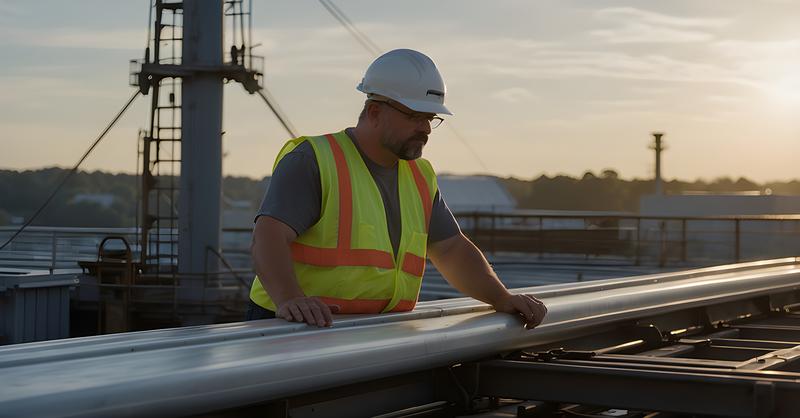
Rooftop equipment rails are structural steel supports, typically fabricated from galvanized steel or aluminum, designed to elevate HVAC equipment above the roof deck surface. They serve three functions simultaneously: they distribute the equipment load across the roof structure, they create the necessary service clearance underneath the unit, and they establish a stable, level platform so the RTU sits exactly where the mechanical drawings say it should.
On a flat commercial roof in Passaic County or a warehouse complex out in Elizabeth, a rail that’s a quarter-inch off level isn’t a “close enough” situation. Refrigerant lines, condensate piping, and ductwork connections all key off that equipment position. Misalignment there creates a cascade of field adjustments downstream that eat labor hours fast.
What makes a custom-fabricated rail different from a stock rail? A fabricated rail is cut and formed to match the actual weight bearing requirements, equipment footprint, and structural attachment points specific to your project. Stock rails are built to approximate common RTU sizes. They’re fine for straightforward installs with standard equipment on uncomplicated roof decks. The moment your job has a non-standard unit, a legacy curb situation, or unusual load distribution requirements, a stock rail is a compromise.
Commercial RTUs in the Tri-State market run anywhere from a few hundred pounds to well over ten thousand pounds for large tonnage units. That load doesn’t distribute evenly across a roof deck, especially on older buildings in Newark or older industrial structures in Paterson where the structural bays weren’t designed with modern equipment weights in mind.
When we fabricate equipment rails here, we’re working directly from the engineer’s drawings and the RTU manufacturer’s weight specifications. The rail gauge, the span, the anchor point spacing, all of that gets calculated against the actual structural load, not a generic industry average. We run those specs through our CNC plasma and laser cutting tables so the finished component matches the drawing exactly, no field trimming, no shimming, no improvised adjustments on the roof deck.
The material choice isn’t just about cost. It’s about what the roof environment demands over a ten or fifteen-year service life.
Yes, and honestly this is where a lot of jobs in the Tri-State market run into trouble. Legacy buildings, and there are a lot of them in Midtown Manhattan, downtown Newark, and across older Hudson County commercial corridors, often have existing roof curbs that were installed decades ago. The original curb geometry doesn’t match any current RTU footprint. So the contractor has two options: replace the entire curb assembly (expensive, structurally invasive, requires opening up the roof membrane) or engineer a transitional solution that works with what’s already there.
We fabricate custom curb adapters and rails that bridge legacy curb geometries to modern equipment footprints. (This is also where our custom curb adapter fabrication process becomes directly relevant to equipment rail design, since the two components often need to work as an integrated structural system.) The rail in this context isn’t just a support; it’s part of the load transfer pathway from the new unit down through the adapter and into the existing curb structure.
Getting that geometry right requires actual engineering input and precision fabrication. Our 250-ton Accurpress handles the bending tolerances on heavy-gauge rail stock that field crews can’t replicate with portable equipment. The cut angles and formed flanges have to match the drawing, not approximately, exactly.
A mechanical contractor managing a retrofit in a mid-rise building in Hoboken told me about a situation where a rail set arrived from a different fabricator and the anchor hole pattern was drilled about three-eighths of an inch off from the curb adapter spec. Doesn’t sound like much. But at four stories up, with a crane on a timed rigging window and a permit that doesn’t allow for a second-day lift, that three-eighths of an inch cost the crew half a day of rework and a rebooking fee for the crane. (Which, if you’ve ever tried to schedule a crane in a dense urban area like Hoboken or Weehawken, you know is not a pleasant conversation.)
That’s the thing about precision fabrication. The cost of getting it right at the shop is always lower than the cost of fixing it on the roof.
This is where logistics matters as much as fabrication quality. A perfectly built rail set sitting in a shop in central New Jersey while a crew waits on a rooftop in Midtown Manhattan is not a solved problem. Getting the fabricated component to the job site at the right time, specifically before the installation crew starts their morning, is half the value we deliver.
Our corporate box truck fleet runs early-morning delivery routes that put materials on the deck by 6:00 AM. Not 9:00 AM after the morning grind on the New Jersey Turnpike has everyone backed up past Exit 13. Before the crew clocks in, before the rigging window opens, before anyone is standing around waiting. If you’re managing a job with a compressed installation timeline in Queens or coordinating a commercial retrofit in Union County, your materials being present at the start of the shift is not a luxury, it’s a direct labor cost protection.
What does it cost to have equipment rails custom fabricated vs. ordering stock? Honestly, the fabrication cost delta is narrower than most contractors expect, especially on any job where the stock option requires field modification. Stock rails that need to be cut, drilled, or shimmed on-site cost labor time that typically exceeds the upcharge for a properly fabricated component. When you run the numbers across a full project, custom fabrication tends to pay for itself in eliminated rework hours.
Here’s something that genuinely frustrates the project managers we work with: having to buy custom ductwork from one fabricator, equipment rails from a structural steel shop, and then source all the hanging hardware, sealants, and installation supplies from a third distributor. Three purchase orders, three delivery timelines, three points of potential miscommunication. When one of those three vendors is late or ships the wrong spec, the job stalls.
We bundle all of it. Custom-fabricated equipment rails, SMACNA-compliant ductwork, plenums, transitions, curb adapters, and the full installation hardware package, sealants, line sets, hanging materials, go out together on the same truck. One order, one delivery, one early-morning drop. Contractors who’ve switched to this model tell us it eliminates the sourcing headache almost entirely. You can see more about how we approach precision fabrication across the full product range on our sheet metal fabrication services page.
North Jersey and the New York metro region have a genuinely punishing climate for rooftop metal components. Winter freeze-thaw cycles, coastal salt air exposure in areas like Bayonne and Staten Island, and summer humidity create an accelerated corrosion environment. Equipment rails that aren’t properly specified for this environment develop surface rust, fastener corrosion, and structural degradation well before their expected service life.
Galvanized steel is the baseline material for most commercial applications in this region, and for good reason. But galvanize isn’t a universal answer. On waterfront or coastal-adjacent projects, or in facilities where chemical exposure is a factor, we push toward higher-spec alloys or specialty coatings. We’re running galvanneal and PCD configurations through our fabrication lines specifically to address these corrosive microclimates. (We also do stainless rail components for pharmaceutical and cleanroom applications in Central Jersey’s biotech corridor, where contamination standards are extremely strict.)
The point is that material selection for a rooftop structural rail isn’t a default decision. It’s a site-specific one.
How do New Jersey and New York building codes affect equipment rail specifications? Both states require SMACNA compliance on mechanical system components, and New York City’s Department of Buildings has additional structural load requirements for rooftop equipment supports. Our fabrication process is built around these code requirements. When you order rail components from us, they’re not fabricated to a generic commercial standard; they’re fabricated to the applicable code for your specific jurisdiction.
One thing that slows down equipment rail procurement in the Tri-State market is the estimation bottleneck. Contractors submit drawings to a fabricator, wait two or three days for a quote, discover the quote doesn’t match the scope, go back and forth, and by the time a PO gets issued, the project timeline has already compressed. That back-and-forth is a legacy problem that comes from shops still relying on manual take-off methods and paper-based estimating.
We ingest digital blueprint files and architectural take-off sheets directly into our estimating platform. Accurate material and fabrication quotes come back within a 4-to-24-hour window. For a project manager trying to hold a bid schedule together in a competitive commercial market, that turnaround isn’t just convenient; it’s what keeps the bidding process moving. You can read more about how our approach to fabrication speed and quality works in practice on our page about NJ metal fabrication precision solutions.
Most fabrication-related mistakes on equipment rail orders happen at the specification stage, not the manufacturing stage. Before submitting an order, a contractor should have answers to at least these questions:
Skipping any of those questions creates risk downstream. We walk contractors through this scope review when they submit their project drawings, not because we’re trying to slow the process down, but because catching a specification gap at the estimating stage costs zero dollars compared to catching it on the roof deck.
If you’re working on a commercial job anywhere in New Jersey, the five boroughs, or Eastern Pennsylvania and you need equipment rails fabricated to spec with actual precision, reach out to us at HVAC Metals, LLC. We’re a local business, we know this market, and we build to the drawing, not to a catalog approximation.
You can also follow our work and connect with us on LinkedIn and Facebook, where we share project updates, fabrication insights, and the occasional behind-the-scenes look at what actually goes into building precision sheet metal components for the Tri-State commercial market.
Written by: Arthur Dabrowski
HVAC Metals, LLC
(201) 991-2206