 CALL NOW
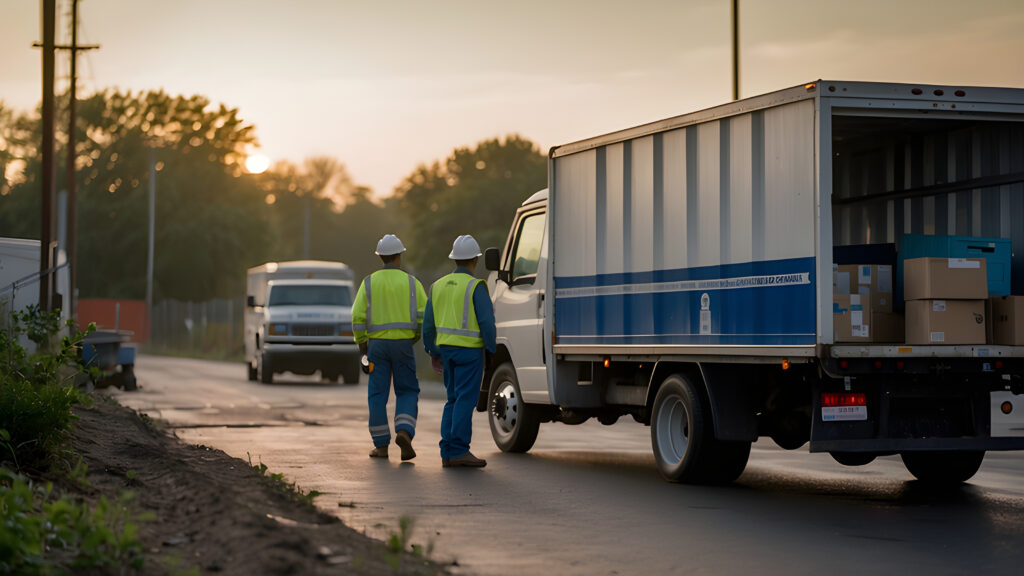
Six mechanics standing around at 7:15 AM waiting on a truck that’s still stuck on the Pulaski Skyway approach. I’ve heard that story more times than I can count. The foreman’s on the phone, the GC is already asking questions, and the day is already bleeding money before a single wrench turns.
That’s the real problem we built HVAC Metals around when Arthur Dabrowski founded the company in Kearny back in 2015. Not just fabrication. Not just supply. The whole logistics chain, timed to how field crews actually operate.
We run our own fleet of box trucks out of 181-183 Garfield Ave, Kearny, NJ 07032. Pre-dawn departures, GPS-tracked routes, and materials staged on deck before your crew clocks in at 6 AM.
Orders confirmed by 3:00 PM get staged, palletized, and dispatched that night.
Routing a truck into Jersey City waterfront at 5:45 AM is a completely different exercise than routing one into Secaucus at the same hour. Anyone telling you otherwise hasn’t done it.
The I-78 Turnpike Extension into Exchange Place and Newport moves cleanly at that hour. Route 440 into Bayonne and Port Jersey? Mostly clear, which matters when you’re delivering heavy-gauge pipe assemblies to contractors working the Global Container Terminal corridor. Route 1/9 through Kearny and into Journal Square has predictable early windows before the first wave of commuter traffic clogs the Pulaski Skyway approach.
We pre-assign routes the night before. Dispatch uses traffic forecasting to flag any overnight lane closures near the Holland Tunnel or Turnpike toll plazas and adjusts departure times accordingly. GPS tracking runs from the moment the truck leaves the yard. Your superintendent or foreman gets confirmation when the truck is 20 minutes out.
That’s the difference between “we deliver in the morning” and a committed 6 AM window. The first is a hope. The second is a logistics operation.
Your driver shouldn’t be sorting through mixed pallets on a sidewalk in Hoboken at 6 AM trying to figure out which flex connectors go to Level 4 mechanical versus Level 7 fan coil drops.
Every order we build is tagged by project, zone, and level. Pipe, fittings, hangers, sealants, and sheet metal duct ship together in sequenced bundles. If your mechanical room rough-in starts on Level 3 and riser piping goes up from there, that’s how we load the truck.
I’ll be direct about something most suppliers skip: getting a truck to the curb at 6 AM is only half the equation. What happens after the truck arrives is where most deliveries fall apart in dense urban environments.
High-rise residential towers along the Hoboken and Weehawken waterfront have strict building management protocols. Security desks, freight elevator booking windows, and loading dock queues that fill up fast. A supplier that doesn’t coordinate with your super ahead of time is sending a truck to sit at the curb for 45 minutes while the building’s dock is already occupied by a concrete contractor’s equipment.
We confirm site access details when the order is placed. Gate codes, freight elevator schedules, boom truck offload requirements, specific floor restrictions. If your site has a narrow crane window on Saturday morning near a Route 1/9 lane closure, we need to know Wednesday.
Contractors working mid-rise multi-family builds along Bergenline Avenue or Summit Avenue in Union City deal with a different headache: almost no laydown space and strict residential noise ordinances that affect early delivery windows in some blocks. We’ve routed around all of it. You just have to tell us what you’re dealing with.
Do mechanical material suppliers with early delivery windows also handle coordination with building security at high-rise job sites in Hoboken and Jersey City? In our case, yes. We collect access protocols, freight elevator booking windows, and loading dock details at order placement so the truck doesn’t sit idle at the curb while your crew waits inside.
We fabricate every duct assembly to SMACNA performance standards and full NJ Uniform Construction Code alignment. That’s not marketing language. That’s what passes inspections in Jersey City, Bayonne, and North Bergen without a callback.
Hudson County municipalities run tight inspection cadences on commercial mechanical permits. Air leakage testing, fire-rated duct accessories, pressure class verification, acoustic performance on double-wall insulated assemblies – these aren’t things you want to discover are wrong after the ceiling is closed.
I’ve seen projects get tagged during mechanical inspection because a duct section was fabricated to a tolerance that was technically close but not SMACNA-verified. The tear-out cost more than the original duct run. Our CNC plasma and laser profiling tables don’t leave that margin of error.
For contractors working pharmaceutical, food-service, or cleanroom tenant fit-outs, we fabricate in stainless steel with the surface finish specifications those environments require. Galvanneal for highly corrosive industrial exhaust. PCD-coated ductwork where chemical vapor exposure demands verified coating integrity from flange to discharge. If you want to read more about how we approach material selection for specific applications, this piece on commercial ductwork materials covers a lot of the ground we walk with contractors during spec review.
What SMACNA pressure class ratings does fabricated sheet metal duct need to meet for mechanical permits in Hudson County NJ? Duct fabricated for commercial mechanical permits in Hudson County typically requires SMACNA Class A or Class B air leakage compliance depending on system pressure and application. Your local municipal building department will reference the NJ UCC and applicable ASHRAE standards, and your submittal package needs to document compliance before rough-in inspection.
The old model: custom duct from one fabricator, schedule 40 steel pipe and grooved fittings from a separate distributor, sealants and line sets from a third vendor, hanging materials from wherever you can get them this week. Three purchase orders, three delivery windows, three chances for something to arrive late or wrong.
I’ve watched mechanical PMs burn hours every week just chasing down mismatched delivery timelines across multiple vendors. One supplier ships the boiler header assemblies on Tuesday. The expansion tanks and circulators show up Thursday. The strainers and control valves never make it before inspection. The crew installs what they have and flags the rest. That’s not a supply chain – that’s a liability.
We operate as a one-stop procurement loop. SMACNA-compliant duct, pipe from ½ inch to 12 inch, fittings, valves, hangers, sealants, line sets, and installation hardware ship together. One order, one truck, one delivery confirmation.
If you’re running concurrent projects across Bayonne, Secaucus, and North Bergen simultaneously, that consolidated procurement model saves significant coordination overhead. One account, one contact, one logistics chain across all three sites.
You can see more about how our early-bird delivery operation ties into the full fabrication and supply chain workflow.
Legacy supply houses still run paper quotes. You send a takeoff sheet, someone manually scales it, they call you back in three days. By then the bid is due tomorrow and you’re padding numbers to cover the uncertainty.
We ingest digital blueprints, CAD files, BIM models, and takeoff sheets directly into our estimating platform. Accurate material and labor figures come back to you in 4 to 24 hours. On a contested commercial bid in Jersey City or a fast-track tenant fit-out in Secaucus, that turnaround is the difference between submitting a competitive number and guessing.
Can a mechanical material supplier with early delivery capacity also provide fast HVAC ductwork takeoff estimates for bid submissions? Yes. We turn around detailed material and labor estimates from digital files within 4 to 24 hours, specifically to give mechanical contractors and estimators the leverage to submit competitive bids without waiting days for supplier pricing.
We’ve built that estimating infrastructure because contractors who win bids need supply partners who can match their pace – not slow them down at the proposal stage.
City inspectors in Jersey City and Bayonne generally arrive on site between 9 AM and 11 AM. If your mechanical room rough-in isn’t complete because the control valves were on a truck that didn’t arrive until 10:30, you’re rescheduling an inspection. In Hudson County, that’s sometimes a week’s delay depending on the municipality’s calendar.
A 6 AM delivery that hits your dock before 7 AM gives your crew two to three solid hours before any inspector shows up. That’s real buffer time. Pipe can be set, duct can be connected, hangers verified, and condensate piping roughed in. Your super can walk the mechanical room with confidence instead of scrambling.
We’ve supported roof set days on waterfront high-rises in Weehawken where the crane window was a 4-hour Saturday permit pulled from the municipality. Materials needed to be staged and ready well before the crane arrived. A mid-morning delivery would have killed the entire crane day and triggered a costly re-permit process. Our truck was on deck before the sun came up.
What’s the best way for mechanical contractors to schedule pre-inspection material deliveries for projects in North Bergen or Union City, NJ? Lock in your delivery order before 3 PM the prior business day. Give us your inspection window and your mechanical room staging sequence. We’ll coordinate the delivery timing to give your crew maximum installation buffer before the inspector arrives. Confirm gate access and freight elevator availability at the same time so nothing delays the offload.
For projects with riser piping that spans multiple floors, we can sequence split deliveries by level so your crew isn’t storing excess material in a tight mechanical room while working three floors up. That level of coordination comes from knowing how Hudson County construction actually runs, not from a generic fulfillment model.
If you’re bidding work in the Tri-State corridor and want a fabrication partner who understands the regional code environment, the Tri-State contractor guide has some context worth reviewing before your next scope negotiation.
I want to be straight with you about how this market actually works, because the language suppliers use can be misleading.
| Operational Metric | Generic Local Competitor | HVAC Metals – Committed 6 AM Window |
|---|---|---|
| Delivery Window Reliability | “Morning delivery” with no committed time. Routes planned day-of. Arrival typically 8 AM to noon, with no alignment to crew start times. | 6:00 AM on-site commitment. Pre-dawn dispatch with routes pre-planned via I-78, Route 440, and Turnpike corridors, sequenced around truck restrictions and known congestion. |
| Pricing Transparency | Basic material pricing. Limited visibility into delivery fees, fuel surcharges, or off-hour premiums. Change orders handled ad hoc. | Line-item material pricing with clearly itemized logistics charges for early delivery, staged drops, and crane-day runs. Digital change-order documentation. |
| Site Coordination Depth | Delivers to curb or dock. No involvement in laydown planning, mechanical room staging, or inspection scheduling. | Palletized and tagged material per zone, coordination with superintendents for elevator and crane windows, alignment with inspection timelines, and access protocol confirmation. |
The table tells part of the story. The part it doesn’t capture is what happens when something changes the night before – a road closure, a dock conflict, a site access problem. That’s where an in-house fleet with direct dispatch communication outperforms any third-party freight arrangement.
How do mechanical supply houses with guaranteed early morning delivery actually differ from standard distributors that offer “AM delivery” in the Hudson County area? The difference is operational specificity. A guaranteed 6 AM window requires a cut-off policy, in-house trucks, pre-planned routes that account for Hudson County’s specific traffic and access conditions, and direct communication with your site’s superintendent. “AM delivery” from a standard distributor typically means the truck leaves when it leaves and arrives when conditions allow – which in dense urban environments like Jersey City or Hoboken can mean 10 AM on a good day.
Most contractors reach out between 2 PM and 6 PM when the next day’s schedule locks in. That’s fine. That’s exactly the window our cut-off is designed around.
Send us your takeoff, your project address, your zip code (07302, 07030, 07002, 07047, 07094 – we know all of them), your access constraints, and your target delivery time. We’ll confirm availability, stage the material, and have a truck on your deck at 6 AM.
We serve all 21 NJ counties, the five boroughs, and eastern Pennsylvania. Our primary strength is the Tri-State metro corridor where logistics precision matters most: waterfront towers, mid-rise multi-family, industrial warehouses, and everything in between.
You can reach us directly through the HVAC Metals contact page or connect with us on LinkedIn and Facebook where we regularly post field updates, fabrication previews, and delivery highlights from active projects across the region.
If telling you the truth about how logistics actually work in Hudson County costs me a project, so be it. I’d rather your crew start installing at 7 AM than have you find out at 9 AM what “morning delivery” really means from the other guy.
Written by: Arthur Dabrowski
HVAC Metals, LLC
(201) 991-2206