
 CALL NOW
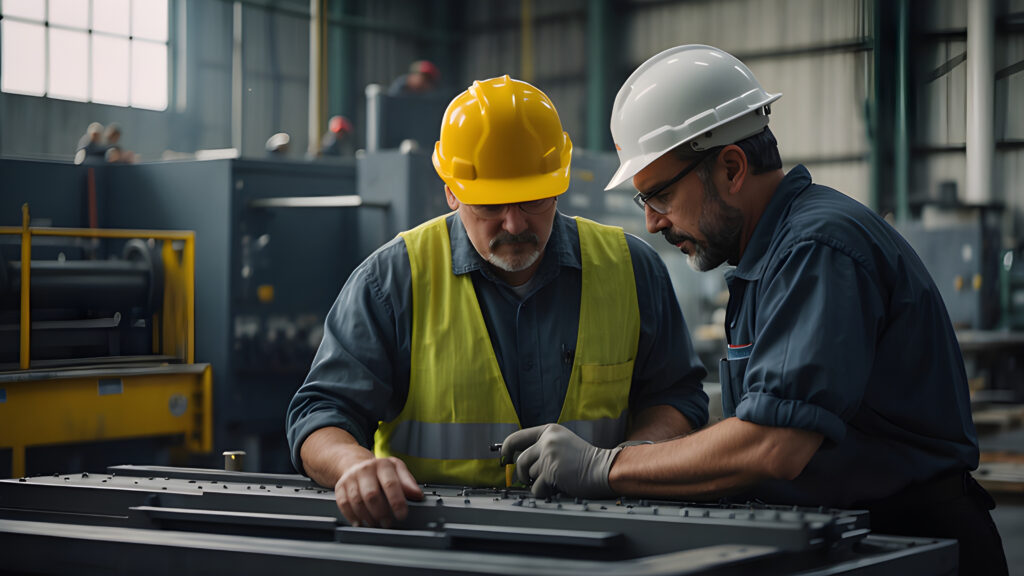
If you are managing a structural fabrication job or a large-scale HVAC mechanical installation anywhere along the Route 1&9 corridor, you already know that “close enough” isn’t a tolerance. It’s a liability. A flanged bracket that’s off by 1/8 inch doesn’t get shimmed on a tight job deck. It gets rejected, re-ordered, and your crew stands there burning billable hours while you’re on the phone trying to explain to a foreman why the pieces don’t fit.
We run a 250-ton Accurpress and Accurshear system out of our Kearny facility at 181-183 Garfield Ave, Kearny, NJ 07032. We process material up to 1/4-inch thickness by 10-foot lengths, handling galvanized steel, stainless, aluminum, copper, and specialty alloys that most general fabricators won’t touch without a conversation about whether their equipment can handle it. Ours can.
What contractors across Hudson County keep running into is a fabricator who quotes fast but can’t hold the geometry. Or one who holds the geometry but takes four days to get material on the deck. Neither version works when you’ve got a union crew staged at Harrison’s Riverbend Industrial District at 7 AM waiting on structural channel components that should have been there before they clocked in.
There’s a version of this conversation that stays in the engineering world, and then there’s the version that plays out on a real job site. When we review CAD files and digital takeoffs for mechanical retrofits in code-dense areas like Jersey City or commercial builds running near the Meadowlands, we consistently catch geometry discrepancies that would have caused installation failures downstream.
A ±1/8-inch variance on a flanged rectangular component might not look alarming on paper. Get that piece to a shaft-constrained install in an older building with tight plenum clearances and you’re looking at field grinding, rework, and a foreman who now needs to find two extra hours somewhere in a schedule that didn’t have them. That’s not a fabrication inconvenience. That’s a direct hit to your labor margin.
Can you actually bend mild steel plate heavier than 1/4 inch in Kearny? Yes. Our Accurpress system handles up to 1/4-inch by 10-foot lengths for standard production runs on A36 and galvanized material. For contractors sourcing structural components for machine bases, equipment enclosures, or HVAC plenums requiring heavier gauge, we also process stainless steel for pharmaceutical and food-service specs, and aluminum alloys for rooftop structural load applications where weight matters as much as strength. The machine does the precision work. Our operators verify it.
Running CNC-controlled bending and shearing means what’s on the blueprint is what comes off the press. There’s no interpretation happening at the machine operator level, no “that’s probably fine” judgment call. The digital file drives the output. That predictability is what protects your crew’s morning installation velocity.
We get asked about this fairly often, especially from contractors who’ve been told that laser cutting is always the more precise option. It depends entirely on what you’re cutting and how much of it.
For straight-line cuts on heavy gauge plate, CNC shearing is faster, more economical, and delivers clean edge geometry without the heat-affected zone you get from plasma or laser processes. No thermal warping on the cut edge. No slag to clean up. And the Accurshear system we run produces consistent, square cuts across full-length material without drift or kerf inconsistency that would throw off downstream bending geometry.
Laser cutting earns its place for complex profiles, tight interior radii, and intricate cutout patterns. Shearing earns its place when you need 20 pieces of 10-gauge galvanized cut to identical lengths with zero margin for error, and you need them ready before an installation crew rolls up to a staging area at 6 AM. (And honestly, the number of times contractors have called us the evening before a scheduled rigging window asking if we can push through a same-day run is… not small.)
How does your shearing service handle stainless steel compared to mild steel? Stainless requires more tonnage to shear cleanly at equivalent gauges because of its work-hardening characteristics. Our Accurshear system is calibrated for this. We adjust blade clearance settings based on material type and thickness to maintain edge quality and prevent the micro-cracking that can occur when shearing austenitic stainless on a press that isn’t properly set up for it. It’s a detail most contractors never see, but it shows up in weld prep and downstream assembly fit-up.
Not every fabricator stocks the same raw material range, and the gap between what a shop says it can run and what it actually produces consistently is sometimes… significant. We process the following across our CNC lines:
Each of these behaves differently under the press brake and shear. Springback characteristics vary. Blade clearance settings change. Die opening selection on the brake shifts depending on material hardness and thickness. Our CNC lines are programmed with material-specific parameters, so a run of 304 stainless gets the correct back gauge positioning and ram stroke compensation automatically, not because someone eyeballed it.
If you want to dig deeper into how material selection affects ductwork performance and code compliance across SMACNA standards, this breakdown on commercial ductwork material selection covers the trade-offs in detail.
There’s a specific kind of pressure that hits when a production line goes down mid-shift and the replacement structural component isn’t a catalog item. You can’t order it from a distributor. It has to be fabricated, and it has to be right the first time because there’s no runway for a second attempt.
We operate right here in Kearny. For contractors and plant operators in Harrison, East Newark, and the surrounding industrial zones, we’re genuinely close, not “close” in the way a shipping estimate is close. Getting a custom-bent bracket or a sheared structural plate back to a facility in the Kearny Industrial Park or Riverbend area from our shop floor is a logistics problem we can actually solve on short notice.
What’s the typical turnaround for an emergency fabrication run near East Newark? For standard production quotes, we work within a 4-to-24-hour estimation window using digital file intake. For emergency situations where a production line is down or a rigging window is closing, call us directly. The answer depends on part complexity and material availability, but we’re not routing jobs through a call center. You’re talking to the shop.
The in-house fleet we operate out of Kearny isn’t a third-party freight arrangement. Our box trucks run our delivery schedule, not a carrier’s consolidated route. That distinction matters when a foreman in North Arlington needs staged material on deck before the crane window opens at first light. Waiting on an LTL truck caught in the predictable morning stack on the Pulaski Skyway is a labor-budget problem disguised as a logistics problem.
The analog bottleneck is real. We’ve seen contractors lose competitive bid windows on commercial retrofits because their fabricator took four days to turn around a basic material and cut list. By the time the quote came back, the general contractor had already awarded the package.
Our estimation workflow ingests digital files natively. Bluebeam PDFs, AutoCAD DWG files, standard take-off sheets, architectural as-builts. The point is to close the gap between what’s on your drawing and what gets programmed into the CNC. When a file comes in with a plenum transition geometry that doesn’t match the field condition noted on the as-built, we catch it before it becomes a shop order, not after the ductwork is already cut.
That kind of early-stage error catching is worth more than a fast quote that’s wrong. We’ve reviewed take-offs from mechanical contractors working mid-rise commercial projects in the metro area where ceiling plenum depth discrepancies were embedded in the plans from the design phase. Catching an unmapped structural beam during digital file review is a CAD revision. Catching it when the ductwork is already on the deck is three days of schedule compression and a conversation nobody wants to have.
For contractors managing NJ steel fabrication partnerships across multiple active projects, the ability to submit files and get binding material estimates back within a single business day changes how you build your bid schedule.
Do you work with contractors who don’t have CAD files and are still working from paper take-offs? Yes. Paper take-offs come through regularly, especially on older building retrofits where the original plans haven’t been digitized. We process them, but the turnaround is longer and the margin for interpretation error is higher. If there’s any way to get a PDF scan of the drawings, even a phone photo of a sketch with dimensions, that helps significantly.
Every piece of ductwork and structural sheet metal component we fabricate is built to SMACNA performance standards. That’s not a marketing statement. SMACNA compliance is the baseline requirement for code inspections across New Jersey, New York City’s five boroughs, and Eastern Pennsylvania job sites. If a mechanical contractor submits ductwork for inspection that doesn’t meet SMACNA Class A air leakage standards, the inspection fails. The duct comes down. The project stalls.
Air leakage failures on rectangular duct systems almost always trace back to seam integrity. Pittsburgh lock seams that aren’t consistently formed will leak. A press brake running inconsistent flange lengths produces seam geometry that doesn’t close correctly under pressure. We’ve seen this on take-backs from shops running older equipment without CNC control, where the operator is manually adjusting back gauge position between bends. The variance accumulates. By the time a 10-foot duct section is assembled, the cumulative geometric error shows up as a leakage path at the seam.
Running CNC-controlled geometry on our Accurpress line eliminates that operator-variable from the equation. The back gauge position is programmed. The flange length is held. The seam closes. If you want to understand specifically how seam welding precision affects SMACNA air leakage test results, we’ve written on that in detail here.
We also fabricate full duct systems in rectangular, round, spiral, and oval configurations, including single-wall and double-wall insulated assemblies for acoustic and thermal applications. The Hudson County market has a broad range of mechanical systems in active service, and not all of them use standard geometry. Custom transitions, offsets, plenums, and specialty fittings are a regular part of our production schedule.
Some of the most time-sensitive work we handle isn’t ductwork at all. It’s rooftop curb adapters engineered to transition between a legacy curb footprint and a new RTU unit with different dimensional requirements. When a rooftop unit replacement doesn’t match the existing curb, and the building owner wants the crane on the roof for one day, not two, you need a custom adapter that’s dimensionally exact and structurally sound before the crane shows up.
We fabricate custom roof curbs, curb adapters, equipment rails, and structural plenums with MIG and TIG welding in-house. The fit-up tolerance on these components matters as much as the weld quality. An adapter that’s 1/4 inch out on the bolt pattern means it doesn’t land flat on the curb, the unit rocks, and the installer has to shim and seal a connection that should have dropped in clean. (That’s the kind of thing that shows up as a callback six months later when someone notices vibration noise.)
Do you fabricate custom roof curb adapters for RTU replacements in Hudson County? Yes. We engineer and fabricate curb adapters for legacy-to-new-RTU transitions regularly. The process starts with field dimensions of the existing curb and the new unit’s base footprint, and we produce a dimensionally exact adapter with structural integrity appropriate for the rooftop load conditions. More on our commercial RTU curb adapter fabrication process here.
Our specialty welding capacity handles material that most sheet metal shops won’t take on. High-strength MIG for structural assemblies, TIG for stainless steel food-service exhaust components where weld bead appearance and surface smoothness are part of the spec, not just an aesthetic preference.
Getting started is straightforward. Submit your CAD files, take-off sheets, or architectural PDFs through our digital intake. We’ll review the geometry, flag any discrepancies we spot during file ingest, and come back with a material and fabrication estimate within 4 to 24 hours depending on project complexity. No obligation. We’ll give you accurate numbers, and if the specs need clarification, we’ll ask before we quote, not after we’ve already cut material.
For structural or HVAC fabrication projects across Hudson County, New Jersey, and the broader Tri-State metro area, we’ve been running this operation since 2015. Over a decade of hands-on manufacturing and logistics work in one of the more demanding industrial corridors in the country will teach you fast that the contractors who stick with a fabricator long-term are the ones who got the geometry right the first time, every time.
Follow our work and connect with the team on LinkedIn and Facebook. If you’ve got a project in motion and need a fabrication partner who can keep pace with your job site schedule, reach out through our contact page or visit our sheet metal fabrication services page for a full capabilities overview. We’re local, we’re accountable, and the shop floor is right here in Kearny.
Written by: Arthur Dabrowski
HVAC Metals, LLC
(201) 991-2206