 CALL NOW
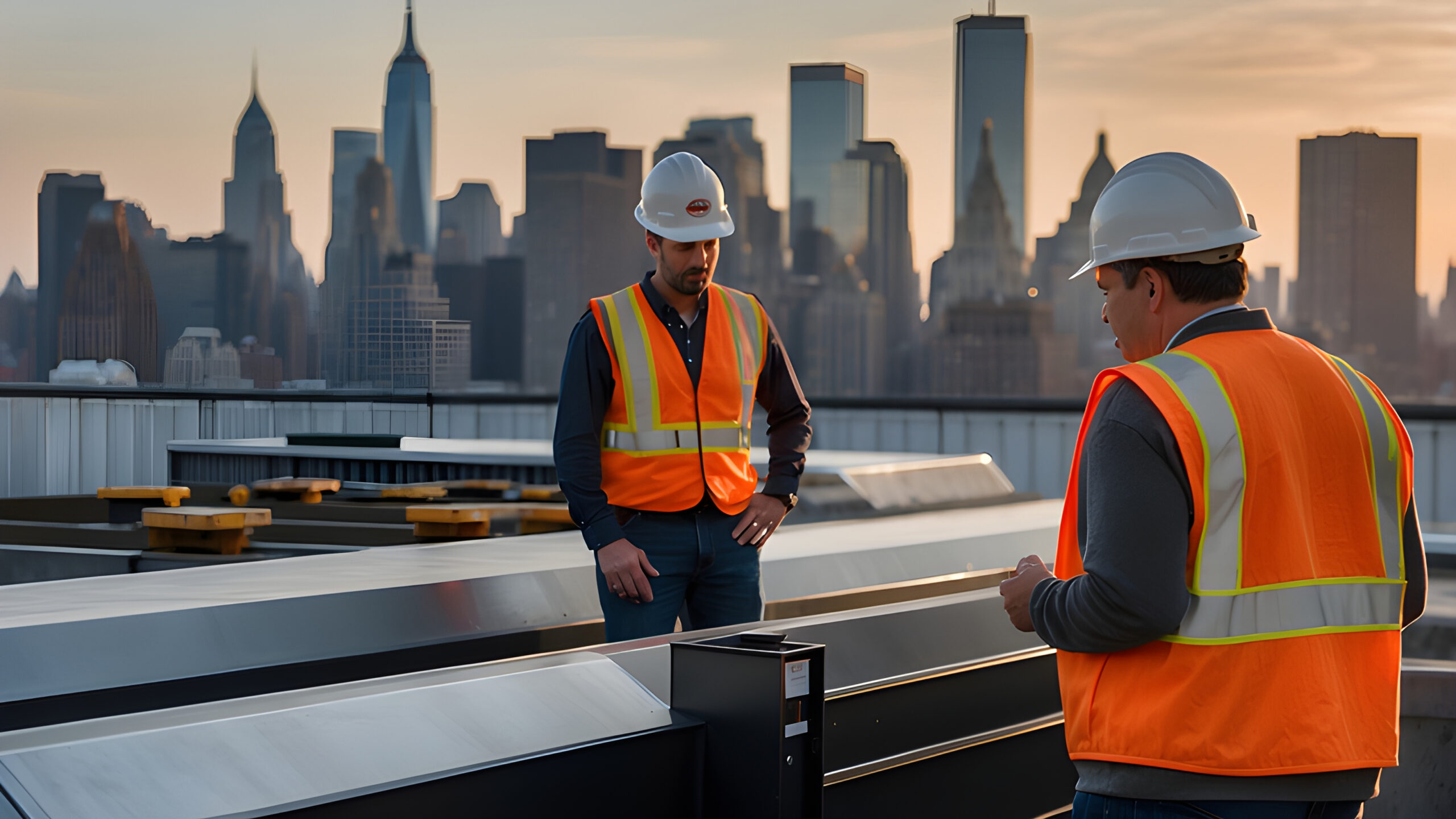
Rooftop unit replacements look straightforward on paper. Pull the old unit, drop in the new one, reconnect the ductwork. But if you’ve been doing commercial retrofits in Jersey City, Hoboken, or anywhere along the Hudson County waterfront for more than a few years, you know the curb is where projects go sideways. The old curb footprint almost never matches the new RTU exactly. And when it doesn’t, contractors are stuck bridging that gap with whatever they can get their hands on — sometimes it works, sometimes it doesn’t, and sometimes it holds up just long enough to become someone else’s problem.
At HVAC Metals, LLC, we’ve been fabricating precision-engineered curb adapters for the New York Metro market since 2015. Our facility sits at 181-183 Garfield Ave, Kearny, NJ 07032 — right in the industrial corridor between the Pulaski Skyway and the NJ Turnpike, which puts us about 12 minutes from the Holland Tunnel and a straight shot to most Hudson County job sites before 6:00 AM.
That geography matters more than you’d think, and I’ll explain why.
Hudson County is dense. I mean that architecturally, logistically, and regulatorily. You’ve got pre-war brick low-rises in Journal Square sitting next to modern glass curtain wall towers in Newport, and everything in between. Bayonne’s older industrial buildings carry entirely different structural loads than a Hoboken commercial plaza built in the last 15 years. Jersey City alone has several distinct permit zones with separate structural review timelines — so what clears DBI on a Tuesday in one zone might sit for two weeks in another.
The coastal exposure piece is not something you can ignore either. Newark Bay and Upper New York Bay create a salt spray environment that degrades standard G60 galvanized steel faster than most people expect. ASCE 7-22 sets the basic wind speed for this corridor at 130 mph, and with Hudson County’s flood zone overlays (AE designation along the waterfront), wind uplift ratings aren’t just a code checkbox — they’re a structural reality you’re going to face during permit review in Hoboken or Bayonne.
What gauge does a roof curb adapter need to handle Hudson County’s coastal wind exposure?
For most commercial RTU applications in Hudson County, 14 to 16-gauge galvanized steel rated G90 to G185 is the baseline. Locations within a few blocks of the waterfront — think Paulus Hook, Newport, or the Bayonne shoreline — often warrant 5052 aluminum or a G185 coating with an additional powder coat layer for corrosion resistance. Wind uplift ratings should hit 150 psf minimum, tested per ANSI/SPRI ES-1. If you’re spec’ing anything lighter for a rooftop in a coastal flood zone and your structural engineer hasn’t signed off, you’re carrying that liability.
I’ve seen contractors get burned by this more than once. They source a curb adapter from an out-of-state fabricator, it shows up without any documentation, and the Jersey City building inspector asks for the structural calc sheet and FM approval. Suddenly a five-day job turns into three weeks of back-and-forth while someone scrambles to produce paperwork that should have been part of the original fabrication package. (And yes, this happens with frustrating regularity — it’s one of those slow-burn problems that doesn’t show up until exactly the wrong moment.)
Every adapter we fabricate ships with IBC 2021 compliance documentation, ASCE 7-22 wind load verification, and NJ UCC Chapter 16 structural alignment. Not because we’re trying to pad the paperwork — because it’s what the permit reviewers in this county actually require.
The measuring step is where most generic adapter suppliers cut corners — and where projects accumulate the hidden costs that show up as labor overruns on the back end. A field measurement that’s off by even 3/16 of an inch in the supply or return opening alignment means your installation crew spends two hours on the deck doing what the fabricator should have gotten right in the shop.
Our process runs like this:
It’s methodical. It’s also how we’ve consistently hit a 98% on-time delivery rate across hundreds of custom installations throughout the New York Metro region.
What RTU brands and tonnage ranges do your custom curb adapters cover?
We fabricate adapters for Trane, Carrier, York, Rheem, Lennox, Daikin, AAON, and most other commercial RTU manufacturers, from 5-ton rooftop splits up through 50-ton package units. Each adapter is engineered to the specific curb footprint and base frame of the model being installed — not a “close enough” standard size that someone from a catalog tells you will work.
| RTU Tonnage Range | Typical Adapter Dimensions | Recommended Material | Base Price Range |
|---|---|---|---|
| 5-10 Tons | 24–48 in. x 24–48 in. | 16 ga G90 Galvanized Steel | Starting at $450 |
| 15-20 Tons | 48–72 in. x 48–72 in. | 14 ga G185 Galvanized Steel | Starting at $875 |
| 25-50 Tons | 72–120 in. x 72–120 in. | 12-14 ga G185 or 5052 Aluminum | Starting at $1,650 |
Pricing varies based on material spec, insulation R-value, curb adapter height, and whether crane lift logistics require additional structural reinforcement in the adapter frame. Rush fabrication carries an additional charge.
I want to be straight with you about something, because I see this mistake regularly and it costs contractors real money.
There’s a handful of Midwest fabricators who’ll sell you a “standard” curb adapter, ship it LTL freight, and it’ll arrive sometime between day 10 and day 14 — if the carrier doesn’t drop it at the wrong terminal. No local code documentation, no field measurement service, no ability to call someone who actually knows what the Hoboken building department is going to ask for when your permit gets flagged. You find out the adapter’s supply opening is two inches off your new RTU’s return configuration when the crane window is already open and your crew is standing on the roof waiting.
That scenario isn’t hypothetical. We’ve had contractors call us from job sites after exactly that situation, asking if we can turn a replacement in 48 hours. Sometimes we can. But it would have been a lot cheaper — and a lot less stressful — to just get it right the first time.
Our corporate fleet routes out of Kearny along the Pulaski Skyway and hits Hudson County sites as early as 6:00 AM. The crane window opens, the materials are already on the deck, and the installation crew goes straight to work. That’s how you protect your labor margins on a competitive New York Metro commercial bid.
If you want a deeper look at how local fab shops actually serve the Tri-State market versus generic out-of-region suppliers, this breakdown on what Tri-State contractors actually need from a metal fab shop is worth a read.
How long does it take to fabricate a custom roof curb adapter for a commercial RTU in New Jersey?
Standard lead time is 5 to 10 business days from the point we confirm your curb dimensions and RTU model. If you’ve got a crane window booked and a deadline that can’t move, expedited fabrication within 48 hours is available. We’ve done it for a school in Bayonne that had a summer break window closing fast — the timeline was tight, we made it work, though I’ll admit the shop schedule that week was not exactly relaxed. Rush orders carry an extra charge, but they’re doable.
Do I need a structural permit for a roof curb adapter replacement in Jersey City or Hoboken?
In most commercial building scenarios, yes. Jersey City’s Division of Building Inspection, Hoboken’s Construction Office, and Bayonne’s Building Department each run their own structural review processes, and they’re not interchangeable. Hudson County applies a floodplain management overlay on waterfront parcels that adds another review layer for properties in AE flood zones. The NJ UCC Chapter 16 structural requirements — seismic anchorage for RTUs over 15 tons in Seismic Design Category C, wind uplift documentation — all need to be in the submittal package.
We build that documentation into every fabrication package we ship. That’s not an upsell; it’s just what responsible fabrication looks like in this regulatory environment.
For contractors who want to understand the full picture of how fabrication quality connects to structural compliance, our page on custom curb adapters as an RTU replacement solution goes through the engineering considerations in more detail.
Sourcing curb adapters from one vendor, flashing and pitch pans from another, sealants from a third — that procurement fragmentation is a quiet budget killer. Every separate purchase order is another delivery timeline to manage, another phone call when something’s wrong, another chance for the job site to stall while you’re chasing down a part that should have arrived with everything else.
We bundle curb adapter orders with the installation hardware, polyurethane sealants, gaskets, and hanging materials in a single fulfillment. One order, one delivery, one truck on your deck at 6:00 AM. The estimating side of that is handled through digital software that can ingest your blueprint files or take-off sheets and return a material and labor quote within 4 to 24 hours — not three days of back-and-forth email.
That compression in the estimating cycle matters when you’re bidding a competitive commercial project in the New York Metro. The contractor who gets back to the property manager first with an accurate number usually wins the work.
I’ve seen adapters fail for a few specific reasons that come up often enough to be worth naming directly:
These aren’t exotic failure modes. They’re the byproduct of generic, off-the-shelf adapter sourcing from suppliers who’ve never been on a Hudson County rooftop and don’t know what the city inspector is going to ask for. (Worth saying plainly: a fabricator who’s never worked in this market genuinely cannot anticipate these requirements. It’s not incompetence exactly — it’s just a complete absence of local context.)
The guide on finding a reliable curb adapter supplier in NJ walks through some of the vetting questions worth asking before you commit to a fabricator for a critical-path commercial job.
Can you deliver a custom roof curb adapter directly to a job site in Hudson County before my crew starts?
Yes. Our box trucks run from Kearny out to Hudson County job sites as early as 6:00 AM, routed via the Pulaski Skyway and NJ Turnpike exits 14 through 14C. If your crane window opens at 7:00 AM, the adapter is on the deck before your crew clocks in.
Getting started is straightforward. You can reach us at our facility at 181-183 Garfield Ave, Kearny, NJ 07032 or submit your project details through our contact page. Give us the RTU model, existing curb dimensions if you have them, roof type (flat, built-up, sloped), and your target installation date. If you don’t have the curb dimensions yet, we schedule a field measurement — laser scan, CAD drawings back to you within 24 hours, and then we go straight into fabrication.
Rush requests, blanket orders for multiple buildings, or projects with crane access constraints (Hoboken’s noise restriction hours run 7am to 6pm weekdays, which affects your rigging schedule) — all of that is worth discussing upfront so we can build the logistics around your actual job site reality, not a generic delivery schedule.
Follow us on LinkedIn or Facebook if you want to see fabrication work and project updates from the shop floor in real time.
If telling you the unvarnished truth about adapter failures or permit requirements costs me a project, so be it. I’d rather give you the accurate picture now than get a call in six months because something didn’t pass inspection. The New York Metro commercial market is too competitive and too code-dense for anything less than that.
Written by: Arthur Dabrowski
HVAC Metals, LLC
(201) 991-2206


