
 CALL NOW
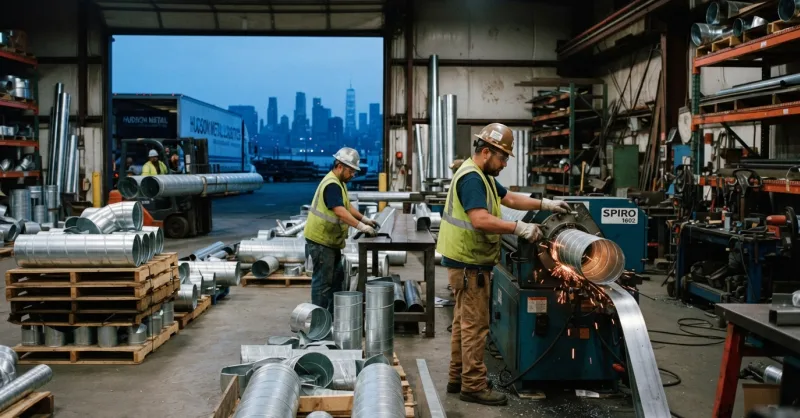
A leaky spiral main in a 38-foot high-bay off the Turnpike Eastern Spur costs more than the sealant it’s missing. I’ve walked plenty of Kearny and South Kearny distribution centers where the fan is screaming, the dock office is 58 degrees, and the mezzanine sits at 84. Same building. Same RTUs. Bad duct.
That’s the pattern. Fabrication shortcuts in the shop become operational headaches at the deck.
Warehouse-scale duct fabrication for logistics builds isn’t rectangular office work scaled up. It’s a different animal: 24 to 60 inch spiral mains, high-static trunks, long horizontal runs above racking, and RTU tie-ins that have to survive a full New Jersey winter and a humid August without pulling apart at the joints.
Every warehouse project we fabricate for in Hudson County sits under three regulatory layers stacked on top of each other. Miss one, the inspector kicks it. Miss two, occupancy slips a month.
Sealing class isn’t a nice-to-have. On a 400-foot spiral main serving racking aisles, the difference between Class A and Class B sealing shows up on the utility bill every month for the next 20 years. I’ve seen owners eat six-figure gas overages because someone let a fabricator ship un-mastic’d longitudinal seams to save a day.
Our shop at 181-183 Garfield Ave, Kearny, NJ 07032 rolls large-diameter spiral in-house. That matters because when a project manager in Secaucus needs a 54-inch main with three saddle taps changed on Tuesday because the racking layout shifted, we don’t wait on a Midwest mill.
Typical fab spec for a logistics build:
Some fabricators still ship spiral with un-sealed slip joints and expect the field crew to catch it. That’s how you fail a leakage test at 2 p.m. on a Friday, three days before tenant move-in.
Hot air stacks. In a 38-foot clear-height building in North Bergen, you can see a 20-degree delta between floor and ceiling on a July afternoon. Standard mixing diffusers don’t touch that.
Spiral round duct high-bay warehouses need targeted throw diffusers, and sometimes destrat fans hung off the trusses. The goal is uniform temperature at pick level, not at the deck. Design decisions we push:
A common question we get from asset managers is: how do we condition a dock office without over-cooling the whole warehouse? Zoned VAV off a dedicated spiral branch, with the dock office on its own thermostat and a small conditioned envelope. The warehouse volume gets its own strategy.
Fabrication is the easy part. Getting 60-foot spiral sections into a working DC off Route 1&9 without shutting down inbound dispatch is where projects live or die.
Our box truck fleet runs early. Deliveries hit the deck by 6:00 AM so crews aren’t standing around at $85 an hour waiting on freight stuck behind a container truck on the Pulaski approach. That’s the entire pitch. Nothing fancy about it.
Common question from 3PL operations directors: what’s the realistic install window during peak Q4? Honestly, we’ve done overnight phased installs Friday 10 p.m. to Sunday 5 a.m., with fabrication pre-staged and rigging permits pulled two weeks ahead. Not every job allows it. Cross-dock buildings sometimes give us four hours between waves and nothing more.
We coordinate with the site’s shift supervisor directly. If your linehaul window closes at 4 a.m. and your first-shift pickers hit the floor at 5:30, we know that before the truck leaves Kearny. Our early-bird delivery model exists specifically because someone somewhere is losing thousands per hour when materials don’t show.
Hudson County industrial zoning isn’t uniform. Bayonne waterfront near Global Container Terminal has salt air that eats galvanized flanges in under a decade. Secaucus Meadowlands parcels off Route 3 have height and truck-routing restrictions that change your rigging plan. South Kearny port-adjacent parcels near the Turnpike Eastern Spur usually have crane windows dictated by container yard operations, not by your GC’s Gantt chart.
Where can we source spiral duct fabricated fast for a Kearny 3PL retrofit? In-county. That’s the honest answer. Freight from out of state adds three to five days minimum and kills your ability to react when the field measures don’t match the drawings (they never do).
For projects along waterfront zones, we push galvanneal or stainless on exterior-adjacent runs. Costs a little more upfront. Saves the owner from a full replacement in year eight. More on material selection in our contractor material guide.
An inspector under NJUCC review wants documentation, not verbal assurances. We deliver:
A question we hear from owner’s reps: will pre-tested duct sections speed up final commissioning? They will, if the field connections are made properly. Shop-tested sections mean nothing if the crew hits them with an angle grinder to fit a bad measurement. Coordination matters.
Our fabrication process aligns with Class A seam welding precision so the test doesn’t become a scramble.
Send drawings. We run takeoffs in 4 to 24 hours depending on complexity. Site walk in Hudson County within the week. Fabrication schedule confirmed against your operational windows before we cut a single sheet.
See our custom ductwork service page for scope details, or connect with us on LinkedIn for project inquiries. One last common ask: can you match legacy curb footprints on RTU changeouts without full roof modification? Yes. Custom curb adapters are a specialty here, and they save the owner from re-flashing a good roof.
Warehouse HVAC isn’t glamourous. Neither is a duct system that quietly holds pressure for 20 years. That’s the job.
Written by: Arthur Dabrowski
HVAC Metals, LLC
(201) 991-2206