
 CALL NOW
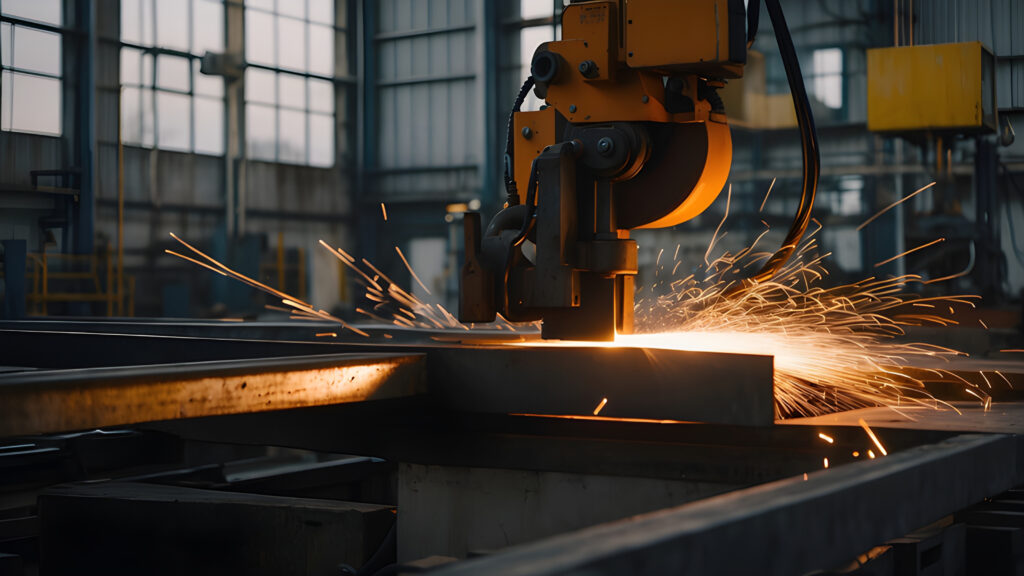
A computer-controlled plasma arc ionizes gas to temperatures exceeding 30,000°F, cutting through carbon steel, stainless, aluminum, and galvanized sheet with repeatable accuracy at production speeds. The table positions the torch via CNC-driven axes, executes nested cut paths, and controls pierce sequence, torch height, and amperage automatically. You get flat, accurate blanks, brackets, base plates, flanges, and gussets, batch after batch, without manual torch drift or inconsistent kerf.
That’s the mechanical reality. The operational reality for plant managers in Kearny and Secaucus is a bit different: your assembly line doesn’t care how elegant the process is. It cares whether the parts show up on time, in tolerance, and ready to fit without rework.
At HVAC Metals, LLC, we’ve been running automated CNC plasma tables out of our Kearny facility since 2015. Eleven years of cutting galvanized sheet, A36 plate, 304 stainless, and aluminum for HVAC contractors, structural steel fabricators, and commercial construction crews across the Tri-State corridor. We know exactly where the friction lives, and we’ve built our process around eliminating it.
This question comes up constantly, and I’d rather give you a straight answer than a sales pitch. Our industrial CNC plasma tables handle:
Positional accuracy on a well-maintained high-definition plasma table runs ±0.015 to ±0.030 inch under standard production conditions. That’s tight enough for most structural connection plates and HVAC flanges. Tighter geometries or critical fit-up parts may warrant a second operation, edge grinding or deburring, which we can discuss during the RFQ stage.
Kerf width varies by thickness and amperage, typically 0.060 to 0.090 inch on mild steel sheet, wider on plate. HAZ depth on carbon steel is real and worth accounting for in heat-sensitive assemblies, though for the bulk of what moves through Hudson County industrial shops, gussets, base plates, equipment frames, curb adapters, it’s a non-issue.
Material selection isn’t just a spec sheet decision. Near the Hudson waterfront and Upper New York Bay, the salt-laden marine air accelerates corrosion on exposed steel in ways that catch contractors off guard, especially on rooftop mechanical platforms and exterior equipment rails. Galvanized sheet handles light-duty coastal exposure well. For anything facing direct marine air contact, 304 or 316 stainless is the honest recommendation. Aluminum is ideal where structural load is secondary and rooftop weight limits apply, which is a real constraint on pre-war buildings in parts of Jersey City and Hoboken.
We also process galvanneal for painted assemblies, PCD duct panels for aggressive exhaust environments, and copper for specialty architectural work. If you’re sourcing for a pharmaceutical cleanroom or food-service kitchen, stainless with a verified mill cert and proper edge finishing is the baseline, not an upgrade.
Plasma cutting and HVAC fabrication have a long relationship. Most of the shaped components that don’t run through a spiral former or rectangular duct line, transitions, offsets, plenums, custom flanges, duct access panels, equipment rail cutouts, come off a plasma table.
I’ve seen HVAC contractors in Union City and West New York get burned badly by shops that hand-torch these components. The kerf is inconsistent, the pierce points blow out, and edge quality varies cut to cut. When you’re assembling a duct system on a fast-track tenant improvement in a high-rise along Journal Square, an off-spec flange gasket seat costs you an hour of field rework that wasn’t in the labor budget.
Our automated tables nest repeated duct shapes across the sheet to minimize scrap. For contractors running repeat orders on standard transition geometries, that nesting efficiency directly reduces material cost per component. It’s not exotic software. It’s just smart programming that manual cutting can’t replicate.
Does plasma cutting affect galvanized sheet edge integrity for HVAC applications? The zinc coating at the cut edge does get disrupted by the plasma arc, exposing bare steel. For interior ductwork, this is typically acceptable and standard practice under SMACNA guidelines. For exterior or corrosive environments, we discuss edge sealing or coating options during the order review so you’re not discovering that problem after installation.
Contractors working on SMACNA-compliant duct systems should review our work on SMACNA Class A compliance and seam welding precision, which covers how fabrication tolerances feed directly into air leakage test results.
Look, I get it. Outsourcing your cutting feels like giving up control of your workflow. Especially when your reputation is built on edge quality and clean fit-up. The shops I respect most along the Tonnelle Avenue corridor and the Bayonne waterfront run tight operations. They don’t have room for a vendor who returns inconsistent parts.
The reality is that high-definition CNC plasma is expensive equipment to operate, calibrate, and consumable-manage in-house. Torch height control sensors, shield caps, nozzles, these wear and drift. Shops that run their own entry-level plasma tables often don’t realize their cut quality has degraded until a batch of parts starts requiring heavy edge grinding before fit-up. (That’s usually when they call us, sort of frustrated and not totally sure how long it’s been slipping.)
When you submit DXF or DWG files to us, we program the nesting and cut path, confirm the material and thickness, and return parts that are flat, deburred to standard, and ready for your welding fixtures. Small batch prototypes, recurring part families, specialty plate in 304 stainless or 6061 aluminum, we process mixed material runs without minimum order drama.
What file formats do you accept for CNC plasma cut part orders? We work directly with DXF and DWG files as the primary formats. STEP files and dimensioned PDFs are workable for quoting and can be converted for programming. If you’re working off a sketch or field measurement, our estimating team can help translate that into a cuttable geometry during the RFQ process, usually within 4 to 24 hours of submission.
Jersey City and Hoboken construction sites are their own category of logistical headache. Limited laydown space, crane windows that close fast, loading dock restrictions, and delivery windows that the site super guards like a hawk. A truck showing up at 2:00 PM with a pallet of base plates and connection brackets creates real problems when the ironworkers needed those parts at 7:00 AM for the morning steel erection sequence.
Our in-house fleet of box trucks runs job-site deliveries as early as 6:00 AM. We route through the NJ Turnpike and US-1/9 corridor specifically to beat the morning congestion that chokes the Pulaski Skyway approach after 7:30 AM. A 6:00 AM drop on the deck means your crew is fitting plates the moment their shift starts, not standing around billing hours against a contract that didn’t budget for waiting.
For construction project managers dealing with frequent field changes and change-order brackets, our 4-to-24-hour estimating turnaround is what makes same-week delivery realistic. You send us a dimensioned sketch or a revised DXF, we price it fast, we cut it fast, and we deliver on a schedule that matches your install phase, not our production backlog calendar.
Palletized loads, smaller truck options for restricted access sites, coordination with site supers on staging areas, we’ve navigated enough Manhattan and downtown Jersey City sites to know that showing up with a flatbed full of loose plate at a congested urban loading dock is a bad day for everyone involved.
Fabrication shops and contractors across the region who need a broader look at how our metal fab operation integrates with field logistics can check out why Tri-State contractors need a reliable metal fab shop built around job-site realities, not warehouse convenience.
Procurement specialists near Port Jersey and Global Container Terminal Bayonne deal with a specific frustration: too many vendors, too little documentation, and delivery schedules that make sense on paper but fall apart when a third-party freight carrier rebooks a Tuesday drop to Thursday afternoon. By then, your assembly crew is pulling from a depleted parts buffer and your production schedule slips.
We run a one-stop procurement loop. Custom cut parts, mandatory installation hardware, sealants, hanging materials, everything bundles and ships on one order, one delivery, one invoice. The process parameters for each job are documented and retained. Material heats are traceable. Part revisions are logged. When you place a reorder six months later, we’re not starting from scratch.
For framework agreements and scheduled releases, that kind of documentation discipline isn’t optional. It’s the baseline for a vendor relationship that scales without becoming a liability.
What tolerances should procurement managers specify for repeat plasma-cut component orders? For most structural and mechanical components, ±0.030 inch on positional accuracy is the standard production tolerance on our CNC plasma tables. Parts requiring tighter fit-up, bearing surfaces or precision mounting holes for equipment installations, should be specified at ±0.015 inch and may need a secondary machining operation depending on geometry. We discuss tolerance requirements during the RFQ stage so pricing and lead time reflect the actual process, not an optimistic assumption.
Visit our sheet metal fabrication services page for a full breakdown of our cutting, bending, shearing, and specialty welding capabilities, or reach us directly at our facility at 181-183 Garfield Ave, Kearny, NJ 07032.
This comes up enough that it’s worth addressing plainly. Laser cutting wins on thin sheet precision, tight tolerances on intricate profiles, and cosmetic edge quality where the cut face is visually exposed. If you’re cutting 18-gauge stainless panels for an architectural feature wall in a Hoboken lobby, laser is probably the right answer.
Plasma cutting wins on cost-per-inch on plate, throughput on structural and HVAC-grade sheet, and material range on thicker carbon steel and aluminum. For base plates, gussets, equipment rail cutouts, duct transitions, and structural connection components that get welded or powder-coated anyway, the plasma edge quality is completely adequate and the economics are substantially better.
The honest answer is that most industrial fabrication in Hudson County’s manufacturing corridor doesn’t need laser-grade edge finish. It needs accurate geometry, consistent kerf, and parts that arrive on time. Chasing laser tolerances on A36 plate that goes straight to a welder is spending money solving a problem you don’t have.
For rooftop mechanical work specifically, including custom roof curbs and RTU curb adapters where dimensional fit between a legacy curb and a new unit is critical, our combination of CNC plasma cutting and precision bending on the 250-ton Accurpress handles the geometry without the laser price tag. An eighth-inch error on a curb adapter means your crew is grinding and shimming on the roof for half a day. Our fabrication tolerances exist specifically to prevent that. You can see more on that process at our custom RTU curb adapter page.
Is CNC plasma cutting suitable for galvanized steel used in railing and support fabrication in coastal environments along the Hudson waterfront? Yes, with a practical caveat. Plasma cuts galvanized steel cleanly and efficiently. The cut edge loses its zinc coating, which matters for anything exposed to the salt-laden air along the waterfront in Bayonne or Jersey City. For structural railings and exterior supports, specifying a zinc-rich primer or cold galvanizing compound on cut edges before final coating is standard practice. We flag this during order review for any coastal or exterior application so the finishing spec matches the environment, not just the interior job equivalent.
We started HVAC Metals in 2015 as a fabrication-forward operation, not a quote-and-wait shop. The automated CNC plasma tables came out of a real operational need: HVAC contractors and fabrication shops in the Tri-State corridor were losing billable hours to slow turnarounds and inconsistent parts from manual cutting operations that couldn’t scale.
Eleven years of running this shop has taught me that the fabrication quality matters, but logistics is often where contractors actually feel the difference. A beautiful cut part that arrives on a Thursday afternoon for a Monday install doesn’t help a crew that needed it Tuesday. The 6:00 AM delivery fleet, the 4-to-24-hour estimating window, the bundled procurement loop – these aren’t marketing language. They’re operational decisions made because I’ve watched expensive field crews standing idle waiting for materials, and it’s a genuinely painful thing to see.
We cover all 21 NJ counties, the five boroughs, and strategic regions in Eastern PA. From the industrial corridors in Secaucus and North Bergen down through the port waterfront in Bayonne, our trucks know these routes. We know where the Pulaski Skyway backs up and we schedule around it. (That kind of detail doesn’t make it into most fabricator brochures, but it absolutely shows up in your project’s daily log.)
If you want to get a sense of the broader operation beyond plasma cutting, the HVAC Metals about page covers who we are and how we work. Or connect with us on LinkedIn and Facebook where we post real fabrication work and project updates from the shop floor.
Send us your DXF files, your blueprint takeoffs, your field sketches. We’ll have numbers back to you faster than your current supplier returns a phone call.
Written by: Arthur Dabrowski
HVAC Metals, LLC
(201) 991-2206