 CALL NOW
Galvanized G90 fails at the cut edge first. That is the structural reality most submittals never address before the brake press fires up on a Hudson County waterfront package. Humid, chloride-bearing air attacks sheared edges and weld zones where the zinc coating is compromised, and road-salt transport along the Turnpike corridors accelerates the same mechanism on exterior intake runs.
For these facilities, the defensible answer is 316L stainless steel selected to ASTM A240, with weld finishing referenced to ASTM A967 and a documented submittal chain that survives engineer review. I have watched contractors try to solve marine exposure with 304 and a heavier gauge, which buys a few years at best before pitting shows up at the weld toes.
Salt-spray exposure is a screening input, not proof of field service life. A 500-hour cabinet test tells you how a coupon behaved in a chamber, not how a duct bank behaves above a Jersey City pier with prevailing onshore wind and seasonal humidity cycling. NACE SP0108 enters the conversation as a corrosion-control reference whose applicability gets confirmed against the actual project scope, and ISO 12944 addresses protective paint systems for steel structures, which is a separate question from stainless grade selection.
Do not assume every site shares the same exposure profile. A Kearny industrial facility behind the Secaucus ridge sees different chloride loading than a rooftop unit on the Jersey City Waterfront, and a cross-Hudson Manhattan intake drawing from the same airshed still has its own access and staging constraints. The exposure review has to be site-specific, and it has to happen before the take-off, not after the first delivery is rejected at the gate.
ASTM A240 governs stainless-steel plate, sheet, and strip material requirements. That is its job, and it stops there. The standard tells you what the mill shipped and what chemistry and mechanical properties the sheet must hold, which is the foundation of every traceability argument you will make later in the submittal.
ASTM A967 governs chemical passivation treatments for stainless steel. It defines the treatment methods and the test practices used to verify that a passivated surface is actually passive, and it does not tell you which ducts need passivation or how a weld should be cleaned before treatment. Those are specification decisions the engineer owns.
NACE SP0108 is a corrosion-control reference whose relevance must be confirmed against the project scope. It is not a duct fabrication code, and treating it as one is how submittals get rejected with a comment that reads like a shrug. ISO 12944 addresses protective paint systems for steel structures and is not, by itself, a stainless-steel grade selection method.
Conflating these four documents is the root cause of most rejected submittals I see across Tri-State projects. A reviewer comments on passivation, the estimator responds with a mill certificate, and three weeks of fabrication time evaporates while everyone argues about which standard applies to what.
| Standard | Actual Scope | What It Does Not Cover | Submittal Evidence It Should Generate |
|---|---|---|---|
| ASTM A240 | Stainless-steel plate, sheet, and strip material requirements | Weld finishing, passivation, or installation | Mill certificate with heat number and chemistry |
| ASTM A967 | Chemical passivation treatments for stainless steel | Which parts require passivation, or weld prep method | Passivation procedure and acceptance test records |
| NACE SP0108 | Corrosion-control reference, scope confirmed per project | Duct fabrication requirements or grade selection | Engineer confirmation of applicability |
| ISO 12944 | Protective paint systems for steel structures | Stainless-steel grade selection | Coating system data for mixed-material assemblies |
Read the table as a routing map. Each document answers a different question, and the submittal package should show the reviewer exactly which question each piece of evidence answers. That structure is what clears review on the first pass instead of the third.
Traceability starts at 0.060-inch 316L sheet verified against ASTM A240 documentation before the material ever touches a shear. Cut-to-size stock arrives with a heat number, and that heat number has to follow the part through CNC laser and plasma profiling, through the 250-ton Accurpress forming station, and into the shipping bundle. Break that chain anywhere and the submittal package loses its evidentiary value.
Mechanical contractors and estimators get evaluated on verifiable records, not verbal assurances. When an engineer asks which heat the third-floor elbow came from, the answer needs to be a document, not a phone call to the shop foreman who may or may not remember.
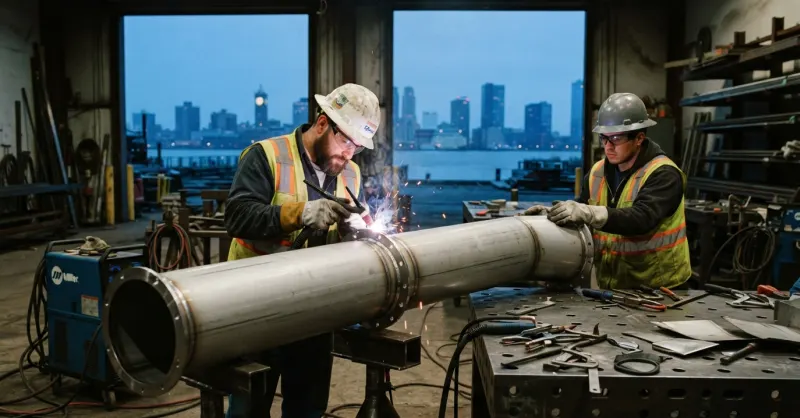
Profiling duct panels and custom fittings on the CNC line keeps the geometry consistent from the first piece to the last, which matters when a phased release means the same fitting gets fabricated twice, months apart, and both runs have to match the approved drawing. The 250-ton Accurpress handles the project-specific geometries that stock shops turn away from, and every formed part carries its record forward.
This is where a lot of vendors fall apart. They can quote the material, but they cannot produce the paper trail that ties the material to the finished fitting. That gap is what forces a contractor into a re-submittal cycle mid-installation, and it is exactly the friction our CNC fabrication and digital take-off process is built to eliminate.
Passivation is not automatic in every application. Where the specification requires it, the project must define the treatment method, the acceptance criteria, and the records that prove compliance, with ASTM A967 as the applicable passivation reference. Leaving that scope implicit in the submittal is how a finished duct bank sits on a dock waiting for a reviewer to decide what “clean welds” means.
TIG and MIG weld process requirements belong in the submittal alongside the weld-joint documentation. The engineer’s corrosion-control requirements control the acceptance decision, and NACE SP0108 relevance gets confirmed per project scope rather than assumed because the building happens to sit near water.
Shop-applied passivation and field touch-up are a real trade-off. Shop treatment gives you controlled chemistry, documented immersion or spray parameters, and test records that travel with the part. Field touch-up covers installation damage but rarely gets documented to the same standard, which is why I push contractors to specify shop passivation as the baseline and treat field work as a repair procedure with its own acceptance criteria.
Blunt engineering opinion: if the specification does not name the passivation method and the acceptance test, the contractor is buying an argument, not a duct system. Get that language into the submittal before the first arc is struck.
Exposure assessment drives material and finishing decisions from the Kearny industrial hub out to the Jersey City Waterfront, and it starts with the variables the spec rarely captures.
ISO 12944 coating-system guidance fits when mixed-material assemblies are present, such as carbon-steel supports or hangers that need a protective paint system alongside the 316L duct. Keep 316L selection anchored to ASTM A240 and do not let a coating standard drift into the grade-selection conversation.
Salt-spray exposure testing informs the review but does not establish field performance. A chamber result is a screening tool, and the site-specific exposure review is what turns that screening data into a defensible specification. Each site’s access and staging constraints feed the logistics plan as much as the metallurgy does, because a duct that arrives at the wrong hour on a constrained waterfront block is a duct that does not get installed.
The Kearny shop sits close enough to the Hudson corridors that I can route a truck to most Hudson County sites without a long haul, which matters when the delivery window is narrow and the laydown area is a single parking space.
Revised BIM/CAD drawings come in, the take-off runs against the approved revision, and the fitting review flags the geometries that need the Accurpress before anything gets cut. That sequence is the gating dependency for fabrication release, and revision control is what keeps the shop from building to a superseded drawing.
The submittal package assembles material records, weld details, and passivation scope into one indexed document the reviewer can walk through without chasing attachments. Rapid take-off turnaround compresses the specification-led buyer journey, which matters when a contractor is trying to hold a crane-hoist sequence that was scheduled weeks ago.
Dedicated account management is the coordination layer between estimator, engineer, and shop. One owner on our side means the engineer’s comment on weld finish reaches the fabrication floor without a game of telephone through three departments, and the contractor gets a single point of contact for release scheduling.
This scenario is illustrative, not a reported HVAC Metals project. A mechanical contractor fitting out a commercial facility near the Jersey City Waterfront, with equipment and duct routes exposed to humid, chloride-bearing air and limited staging space, brought us a specification that called for 316L duct without defining material documentation, weld cleaning, or passivation acceptance records. The site team also faced restricted unloading windows and a planned crane-hoist sequence.
The design review identified the gaps before fabrication. Salt-spray exposure was treated as a screening input, not a substitute for site-specific exposure assessment or proof of field life. We received revised BIM/CAD drawings for take-off and CNC fabrication, and the contractor and engineer confirmed ASTM A240 material requirements, weld details, and the ASTM A967 passivation procedure in the submittals.
NACE SP0108 applicability was checked against the actual project scope, and ISO 12944 was correctly identified as coating-system guidance rather than a 316L selection rule. CNC profiling, Accurpress forming, documented weld passivation, and staged hardware procurement supported the approved package through release.
The contractor planned sequenced early-morning drops from the Kearny hub, subject to site access confirmation, and aligned unloading with the hoist schedule. That sequencing reduces avoidable handling and crew waiting risk, though actual schedule savings depend on approvals, access, and site conditions. No vendor can promise a clean waterfront install from a spreadsheet alone.
Delivery coordination belongs inside procurement, not bolted on afterward. When a Jersey City Waterfront site has a two-hour unloading window and a crane booked for the same morning, the delivery plan is as much a part of the bid as the duct schedule.
Bundled hardware, staged loads, and requested early delivery align to crane and hoist schedules, with the in-house fleet supporting 6:00 AM deck delivery subject to site access confirmation. NJ Turnpike and I-80 routing plus tight urban laydown areas make timing a structural risk, not an inconvenience to be solved by the driver.
Corporate credit terms and account ownership connect to predictable release scheduling for phased installations. A Net-30 or Net-60 program with an approved account lets a contractor commit to a release sequence without renegotiating terms at every phase, which keeps the fabrication calendar stable and the deliveries predictable.
I have seen a load sit on the Turnpike at 5:40 AM because a gate guard was not briefed on the early delivery, and that single delay pushed a hoist sequence by half a day. Confirm the access window in writing before the truck rolls.
Evaluate vendors on four factors: 316L material scope and ASTM A240 documentation, weld finishing and ASTM A967 passivation records, standards clarity that distinguishes ISO 12944, NACE SP0108, and stainless requirements, and Hudson County execution including bundled hardware and early delivery coordination. Those four factors separate a fabrication partner from a supply house that quotes stock and hopes for the best.
| Decision Factor | Generic Supply House / Spot-Market Vendor | HVAC Metals CNC & Logistics Architecture |
|---|---|---|
| 316L material scope | May quote standard stock without a project-specific exposure or documentation review | Can align cut-to-size duct and fittings with requested ASTM A240 material documentation and approved drawings |
| Weld finishing | Passivation expectations may be left implicit | Can coordinate specified weld cleaning and ASTM A967 passivation requirements with documented acceptance criteria |
| Standards clarity | May conflate ISO 12944, NACE SP0108, and stainless-steel requirements | Distinguishes coating-system guidance, corrosion-control references, material standards, and passivation scope |
| Hudson County execution | Delivery timing and access coordination may be separate from procurement | Account management can coordinate bundled hardware, staged loads, and requested early delivery for constrained urban sites |
Send Hudson County facility drawings for a 316L duct take-off, fitting review, and fabrication estimate, or request a review of ASTM A240 material requirements, weld passivation scope, and the project’s referenced corrosion-control standards. When the drawings are approved and the delivery phases are set, submit the duct schedules to coordinate CNC fabrication, bundled hardware, and site-specific delivery windows.
Before committing to a waterfront schedule, compare material documentation, passivation records, unloading access, and hoist timing for your Jersey City or Hudson County package. Project specifications and engineer approval remain controlling throughout, and our job is to make the evidence match the spec. You can reach the shop through our Kearny fabrication facility or visit us at our Kearny, NJ location.
Written by: Arthur Dabrowski
Owner & CEO, HVAC Metals, LLC (Kearny, NJ)
(201) 991-2206