 CALL NOW
The most expensive failure I see in Morris County biopharma work happens months before a single sheet of stainless gets cut. A duct package gets released to the shop with duct-to-equipment interfaces still floating, seam notes missing from the drawing set, and a spec section that references process piping codes as if they govern sheet metal. Crews mobilize against that package and the whole schedule starts bleeding.
Discipline boundaries matter here, and they get blurred constantly. ASME BPE governs bioprocessing equipment design, and ANSI B31.3 is a process-piping code. Neither one is a blanket ductwork standard, no matter how often they appear in the same specification book. NFPA 45, ASHRAE 62.1, and NJAC 7:27 applicability gets confirmed by the engineer of record and the environmental professionals, not by the fabricator reading a submittal at 6 a.m.
We run fabrication and dispatch out of our Kearny industrial hub, which puts Hudson County access and the Morris County corridor within a single coordinated delivery plan. That geography only helps when the release package is clean. A truck rolling west on I-80 with the wrong transition geometry is just an expensive round trip.
My job on these packages is to review drawings, flag what is missing, and fabricate to approved documents. I spent eleven years watching contractors absorb the cost of ambiguous scope before I started running this shop, and that experience shapes how we quote stainless exhaust work today. The engineer owns the design. The environmental consultant owns the permit determination. We own the take-off, the fabrication, and the delivery sequence, and we are precise about where that line sits.
Idle sheet-metal labor is the first casualty. When duct-to-equipment interface dimensions are unresolved, the superintendent cannot lay out hangers, cannot set sleeve locations, and cannot sequence the install around the equipment set. Welders stand down while the project manager chases a dimension that should have been settled at submittal review.
Rework hits next. Treating 316L stainless steel as a complete order description is a common and costly shortcut. The grade designation alone says nothing about material documentation, seam construction, inspection criteria, or how the exhaust chemistry, temperature, condensation, and cleaning regime should shape the fabrication approach. A fitting built to the wrong seam detail gets cut apart and rebuilt, and that labor never appears in the original estimate.
Crane and hoist standby fees compound the damage. When receiving windows slip because a delivery was never coordinated against the site’s hoist schedule, the contractor pays for equipment and operators sitting idle. Those charges land on the mechanical contractor, not the vendor who shipped late.
The release package is the single control point that converts all of this ambiguity into a schedulable scope. Get the exhaust conditions, the specified alloy, the seam and inspection notes, and the connection interfaces onto approved documents before fabrication starts, and every downstream cost stops compounding.
We ingest whatever BIM and CAD files the contractor has available and build the take-off against approved documents, not against assumptions. Missing dimensions, unresolved connection interfaces, and scope assumptions get flagged in writing before anyone commits to a fabrication date. That flag list is often more valuable to the project team than the pricing itself.
Our estimating turn window runs 4 to 24 hours, and that range is honest about its dependency: drawing completeness and scope clarity drive where in that window a given package lands. A clean, legible set with resolved interfaces moves fast. A package with open equipment selections takes longer because the review work is real work.
What we do not do is substitute for the engineer of record or the environmental permitting consultant. NJAC 7:27 air-permit applicability stays with the facility owner and the design professionals. We review, coordinate, and fabricate. The regulatory determination belongs to the people licensed to make it.
Material coordination starts with confirming the specified grade of 316L stainless steel and the traceable documentation the design documents require, where they require it. Welded duct seams get coordinated against the project specification and qualified fabrication procedures rather than asserted as a universal requirement. Some exhaust systems call for welded construction. Others do not. The spec decides, and we build to it.
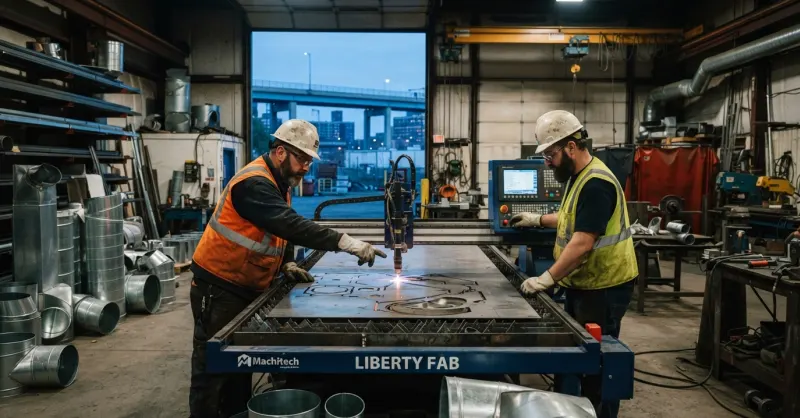
Exhaust-stream chemistry, operating temperature, condensation behavior, and cleaning regimes drive the material conversation in ways a grade designation never captures. Once the geometry is approved, CNC laser profiling of stainless sheet and our 250-ton Accurpress forming for specified transitions and fittings translate those documents into parts that fit the first time.
| Project decision point | Generic supply house or spot-market vendor | HVAC Metals CNC and logistics architecture |
|---|---|---|
| Specialty duct scope | May quote standard stock assumptions that leave custom transitions or interfaces unresolved | Reviews drawings for custom geometry and flags missing dimensions, connections, and scope assumptions before fabrication |
| Stainless specification | May treat “316L” as a sufficient order description | Coordinates the specified grade, material documentation, seam details, and inspection needs with the contractor’s approved documents |
| Code and process boundaries | May conflate process piping codes with ductwork requirements | Names ASME BPE, ANSI B31.3, NFPA 45, ASHRAE 62.1, and NJAC 7:27 while clarifying that applicability depends on discipline and project scope |
| Delivery and installation readiness | May provide a material drop without job-sequence coordination | Plans Kearny dispatch, bundled hardware, receiving constraints, and delivery timing with the Hudson County or Morris County site team |
No single code or material specification automatically applies to every process exhaust system. The assembled system is governed by project specifications, the engineer of record, and the authority having jurisdiction, and each document in the stack carries its own discipline boundary.
Keeping these boundaries straight protects the contractor from a submittal rejection and protects the facility from a compliance gap. A fabricator who blurs them creates risk for everyone downstream.
A commercial mechanical contractor coordinating a Morris County biopharma facility package from a Hudson County project office brought us a duct set with unresolved duct-to-equipment interfaces and no seam, material-documentation, or inspection notes in the exhaust package. The team also had open questions on whether the exhaust source triggered NJAC 7:27 permit requirements. These were proposed review questions, not discovered defects, and the distinction matters.
We ingested the available BIM and CAD files, prepared a take-off, and coordinated the specified 316L stainless steel, welded duct seams, and custom transitions against approved documents. The review identified where ASME BPE and ANSI B31.3 applied to associated bioprocess equipment and process piping rather than as blanket ductwork requirements, and flagged NFPA 45 and ASHRAE 62.1 for design-team applicability review. NJAC 7:27 air-permit applicability stayed with the facility owner and the environmental professionals.
Fabrication capacity included CNC laser profiling and press forming, subject to the approved scope. The contractor used the coordinated release package to sequence fabrication and delivery against drawing approval and material availability, with dispatch planned around Hudson County access, the NJ Turnpike or I-80 as appropriate, site receiving rules, and crane-hoist scheduling. We report lead-time and labor outcomes only where project records substantiate them, which keeps the case study honest.
Kearny fleet dispatch, early delivery coordination, and bundled installation hardware get planned against the actual constraints of each site: receiving windows, truck access, staging area, hoist availability, and route conditions on the NJ Turnpike or I-80 as appropriate. Delivery timing is a coordination problem we solve with the site team, not a promise that any corridor will be clear on a given morning.
Releasing approved duct drawings and delivery constraints together starts fabrication with the installation window and the hoist schedule already aligned. That sequencing keeps stainless exhaust sections off a staging slab they were never meant to sit on, and it keeps crews from waiting on material that arrived after their window closed.
A disciplined release covers the technical inputs and the commercial ones together, and skipping either side creates drag later in the schedule.
Our 4 to 24-hour take-off is available when scope is sufficiently complete. Send drawings for estimation, request a material and compliance coordination review, or release approved drawings and delivery constraints to start CNC fabrication and Kearny dispatch. Review our stainless fabrication capabilities and project delivery process before you commit crews, and reach the team through our Kearny office when the package is ready.
Written by: Arthur Dabrowski
Owner & CEO, HVAC Metals, LLC (Kearny, NJ)
(201) 991-2206