
 CALL NOW
Most stalled distribution-center packages I review do not fail at the brake. They stall because the drawings route high-velocity air distribution through multiple branches and elevation changes without ever reconciling operating pressure, duct leakage classification, and the cited construction standard on one coordinated sheet.
That gap forces a fabrication shop to guess, and guessing on pressure class is how reinforcement schedules get built wrong. The ANSI SMACNA Round Industrial Duct Construction Standards must be confirmed as specified and applicable to the intended service, not assumed because someone saw “high velocity” in a note.
Ordinary HVAC distribution and process ventilation carry different design bases, and the governing New Jersey Mechanical Subcode edition plus the project-adopted code drive what the submittal reviewer actually checks. I treat every one of these as an open coordination question for the mechanical engineer and the authority having jurisdiction, never as a presumed violation.
My own habit, built over eleven years of watching submittals bounce, is to red-line the missing inputs before a single sheet of galvanized G90 steel gets nested. One unanswered leakage class can hold an entire phased release hostage.
Incomplete pressure and leakage inputs delay the fabrication release, and that delay cascades straight into billable field hours. Crews arrive to a staging area with no duct, stand on standby, and then force-fit branches and transitions that should have left the shop dimensioned correctly.
On a constrained Hudson County site with limited laydown, that same delay compresses the hoist window. Crane standby fees accrue while a superintendent waits on a truck, and the absence of a confirmed duct leakage classification and reinforcement schedule is usually the root cause sitting upstream of all of it.
I frame these as operational risk rather than a fixed dollar figure, because every corridor from the Kearny industrial hub to the Jersey City Waterfront carries its own access friction. Idle hours and hoist penalties are real, but they scale with how badly the criteria were left open.
Every take-off starts with the coordinated drawings, not the quote form. We review fitting geometry, round branches, taps, offsets, and transitions, then record explicit assumptions for galvanized G90 steel, spiral lockseam duct, and the high-velocity air distribution the system is meant to deliver.
That review is why our estimate window runs 4 to 24 hours and no faster: completeness of the drawings sets the clock. A clean set with resolved pressure and leakage criteria moves quickly, while a set missing those inputs gets flagged before any fabrication release.
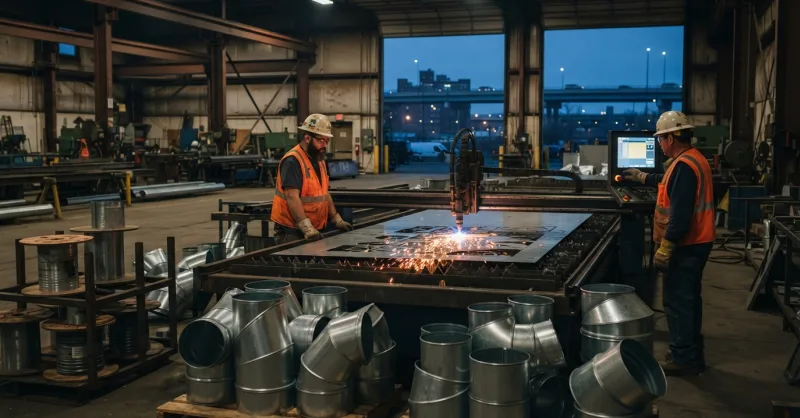
CNC plasma and laser profiling downstream only performs as well as the take-off feeding it. A sloppy cut list produces scrap, so the estimator’s job is to hand the shop geometry it can trust.
Material and construction basis flow from the specification, and I quote galvanized G90 steel to the coating the documents actually call for. Spiral lockseam duct gets planned around the documented geometry, while CNC-fabricated fittings come off the 250-ton Accurpress and Accurshear to match the transitions and branches on the sheet.
The trade-off between standard spiral product availability and custom transition fabrication is real, and any substitution routes back to the project team for review rather than getting quietly swapped in the shop. Pressure class and reinforcement schedule are project-specific inputs, never defaults I invent to keep a schedule moving.
| Evaluation point | Generic Supply House / Spot-Market Vendor | HVAC Metals CNC & Logistics Architecture |
|---|---|---|
| High-velocity geometry | May offer standard spiral products, with custom transitions or branches coordinated separately | Uses drawing-based review to plan spiral lockseam duct and CNC-fabricated fittings around the documented system geometry |
| Material and construction basis | Product availability may drive substitutions that require project-team review | Quotes galvanized G90 steel to the specified material and documents assumptions for estimator review |
| Leakage and pressure coordination | May rely on the buyer to reconcile duct leakage classification and pressure requirements | Flags missing pressure, leakage, or construction-standard inputs before fabrication release |
| Hudson County delivery and procurement | Materials and accessories may require separate sourcing and scheduling | Can bundle installation hardware and coordinate early delivery with the contractor’s site and hoist constraints |
Fabrication is a dependency chain, and approved submittals are the first link. Once those clear, phased release drives CNC plasma and laser profiling, fitting assembly, and joint and seam sealing to the specification, in that order.
Phased release is what lets us hold production capacity across a multi-phase warehouse fit-out without starving the early zones. Bundling hanging hardware into the same shipment also removes a separate sourcing headache for the superintendent.
Sequencing has to respect the contractor’s installation schedule and any design revision affecting duct routing. When a routing change lands mid-run, we re-cut rather than ship a fitting the field will fight.
Early-morning delivery coordination is a planning discipline, not a courtesy call. We align shipment windows with loading-dock availability, site rules, and the scheduled crane-hoist windows that a constrained Hudson County site simply will not flex around.
The NJ Turnpike, the Lincoln Tunnel, and access toward the NYC Five Boroughs are planning context for congested approaches, not proof of any specific route or duration. Shipment status and outstanding coordination items get communicated before crews mobilize, which keeps the hoist schedule honest.
Closeout is where the paper trail earns its keep. We confirm the cited construction standard, duct leakage classification, and pressure class against the approved submittals and the enforced code edition before the package is called complete.
That distinction between HVAC distribution and process or industrial ventilation matters here, because the applicable standards can diverge. Documenting material and construction assumptions is the contractor’s defense during inspection and commissioning, and I would rather hand over a clean record than argue about one later.
Picture a commercial mechanical contractor fitting out a Hudson County distribution facility, coordinating between a Kearny-area fabrication partner, the site team, and consultants serving Jersey City and the broader NYC market. This is an illustrative project outline, not a claim about a completed job.
During drawing review the estimator finds multiple branches and elevation changes, while the package never reconciles operating pressure, duct leakage classification, and the specified construction standard. Limited laydown and fixed hoist windows make oversized or out-of-sequence deliveries a genuine risk.
The rebuild starts with a full drawing review and recorded assumptions for galvanized G90 steel, spiral lockseam duct, and CNC-fabricated fittings, plus a check on whether the ANSI SMACNA Round Industrial Duct Construction Standards are actually specified. Unresolved pressure and leakage criteria go back to the contractor, then phased fabrication, bundled hardware, and sequenced delivery get planned with the site team.
The realistic outcome is fewer avoidable field adjustments and clearer material releases, not a guaranteed installation result. Aligning delivery windows with dock availability and hoist scheduling keeps crews from waiting, and the account manager flags outstanding coordination items before mobilization.
Written by: Arthur Dabrowski
Owner & CEO, HVAC Metals, LLC (Kearny, NJ)
(201) 991-2206