
 CALL NOW
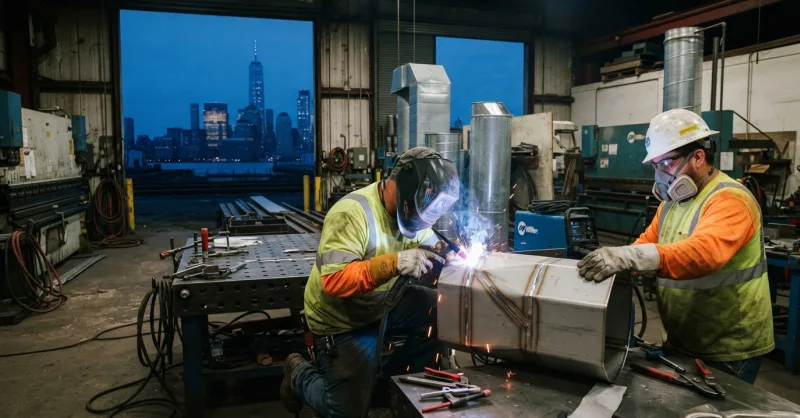
Galvanized exhaust duct on a rooftop in Bayonne or the Jersey City waterfront rusts through in a fraction of the time it lasts inland. Salt air off the Hudson chews the zinc coating, and once that’s gone the base metal starts pitting within a season or two.
I’ve walked plenty of hospital roofs where the exhaust risers looked like Swiss cheese behind the parapets. That’s not a maintenance problem. That’s a spec problem.
Stainless steel hospital ductwork isn’t a luxury upgrade in this county. It’s what the environment and the code actually demand.
The 15–25% premium on 316 stainless is real money on a multi-floor riser package. Not every application needs it. Sometimes a facility director gets talked into 316 for an entire patient tower when 304 would run 30 years without a complaint.
A Route 440 diagnostic lab last year specified 304 across the board to save on the bid. Fume hood risers started weeping at the welded seams inside 18 months. The retrofit cost triple what 316 would have added upfront.
Which stainless grade holds up best for lab fume hood exhaust along the Jersey City waterfront? 316 with 2–3% molybdenum. The chloride resistance is what buys you the extra decade of service life against Hudson River air.
SMACNA duct construction standards are the baseline. Inspectors in Hudson County read the leakage class off the submittal package first, then work backward through gauge, reinforcement, and joint detail.
| System | Leakage Class | Joint Type | Min Gauge |
|---|---|---|---|
| Negative pressure isolation rooms | Class 1 | Fully welded | 20 ga |
| Surgical suite return | Class 2 | TDC/TDF welded corners | 22 ga |
| Lab exhaust risers | Class 1 | Welded longitudinal and transverse | 18 ga |
| HEPA filtration housings | Class 1 | Welded, gasketed access | 16 ga |
Our shop runs 250-ton Accurpress forming and CNC plasma cutting on stainless coil daily. Weld logs and material certs ship with the submittal package. That’s what a commissioning agent at Hudson Regional Hospital or Jersey City Medical Center wants to see before signing off on Class 1 leakage certification.
NFPA 90A duct material requirements mandate noncombustible construction across all I-2 institutional occupancy HVAC systems. Stainless clears that bar without additional wrap in almost every configuration we’ve built for Hoboken University Medical Center or Bayonne Medical Center.
The tricky part isn’t the material. It’s holding -0.01″ w.g. differential in an isolation room when the return duct is leaking 6% at the transverse joints. HEPA filtration housings on the exhaust discharge only work if the duct upstream is actually tight.
12 air changes per hour minimum for airborne infection isolation. Non-negotiable.
How do you keep an isolation ward operational during a stainless exhaust duct retrofit at a Secaucus hospital? Prefabricated riser sections, welded flanges shop-installed, and night tie-ins between 10 PM and 5 AM. We stage the duct at the loading dock the evening before, crane it up during the shutdown window, and the isolation zone is back online by first shift.
Labs along Route 440 and the Kearny industrial parks handle everything from methylene chloride to perchloric acid to formaldehyde fixatives. Each of those chemistries eats duct differently.
Fully welded 316 stainless is the answer for high-hazard exhaust. Gasketed construction with chemical-resistant sealant works for general fume hood runs. Slip-and-drive with sealant is fine for low-hazard general lab ventilation, though I’d push most clients past that spec if the building’s near the water.
One thing that catches design-build teams off guard: perchloric acid hoods need a dedicated washdown-capable exhaust system. You can’t manifold that into a general lab riser. Ever.
Our stainless cleanroom and pharmaceutical duct fabrication program handles the full stack from fume hood collar to stack termination.
Pharmaceutical cleanroom ventilation in Hudson County life sciences facilities runs to ISO 14644 classifications. ISO 5 aseptic zones want 304 or 316 stainless with Class 1 leakage. ISO 7 compounding areas can drop to Class 2.
What documentation does a Secaucus pharmaceutical facility need for validated stainless duct installation? Material certifications by coil heat number, weld inspector logs, pressure test reports, and SMACNA leakage class verification. All packaged with the as-builts before commissioning.
Plenty of Hudson County facilities sit inside portfolios owned by NYC-based health systems and biopharma operators. NYC Local Law 97 emissions compliance pulls those cross-river buildings into the same carbon accounting.
Duct leakage translates directly to fan energy. Class 3 leakage burns 6–10% of your airflow. Tighten to Class 1 and fan power drops 15–25%. That shows up on the emissions ledger.
We deliver leakage class certification, fan power calcs per ASHRAE 90.1, and insulation R-values on every stainless submittal. Skip the paperwork and the sustainability consultant will bounce it back.
Fabrication is half the job. Getting a 40-foot welded stainless riser onto a downtown Jersey City loading dock at 5:45 AM before the street closes to construction traffic is the other half.
Our fleet runs the NJ Turnpike Western Spur, Route 1/9, Route 3, and Route 440 daily out of 181-183 Garfield Ave, Kearny, NJ 07032. Crane windows in Hoboken are brutal (the DOT tolerance for a late rig is basically zero), so materials stage the night before whenever possible.
Can you turn stainless hospital duct fabrication around in 72 hours for an emergency isolation ward retrofit in Bayonne? Yes. Shop pulls the coil, cuts on the CNC plasma table, forms and welds inside the shift, and the truck rolls before dawn. We’ve done it more than once during respiratory surges.
Coordination through a single Dedicated Account Manager, one-stop procurement bundled with sealants and hangers, and 4–24 hour blueprint takeoffs for consulting engineers working tight bid windows.
Talk to us through the contact page or connect on LinkedIn. If telling you a project needs 316 instead of 304 costs me the bid, so be it. The duct still has to be there in 20 years.
Written by: Arthur Dabrowski
HVAC Metals, LLC
(201) 991-2206