
 CALL NOW
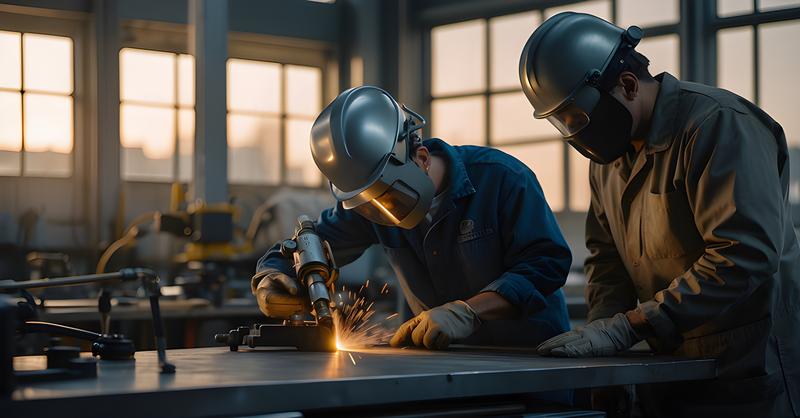
If you’re running HVAC mechanical contracts across New Jersey, the five boroughs, or Eastern PA, you’ve probably already dealt with the welding decision more than once — and maybe got burned by picking the wrong approach for the job. Robotic MIG on a custom curb adapter that needed field-fit adjustments. Manual TIG on a high-volume rectangular duct run that should’ve been automated from the start. It happens.
Over a decade of running fabrication lines at our Kearny shop, I’ve watched this exact mismatch cost contractors real money — not in dramatic blowups, but in quiet labor bleed. An afternoon here, a re-work day there. It adds up fast when your crew in Midtown is standing around waiting for a weld correction that never should’ve left the shop floor.
Automated and manual welding services aren’t competing options — they’re complementary tools with very different performance envelopes. The mistake most contractors (and frankly, a lot of fabricators) make is treating the choice as binary.
Automated welding — think CNC-guided MIG, robotic GMAW seam tracking, programmatic weld schedules — excels where geometry is predictable and volume is high. Rectangular duct runs with consistent joint configurations, equipment rails with repeating weld profiles, or heavy steel plenums where seam consistency directly affects structural integrity under load. Repeatability is the whole point. Every pass hits the same amperage, the same wire feed speed, the same bevel penetration. No variation, no fatigue, no Monday-morning welds.
Manual welding — MIG, TIG, and high-strength specialty work — handles everything automation can’t reach, can’t adapt to, or shouldn’t be trusted with when custom geometry is involved. A curb adapter being engineered to mate a legacy roof curb with a brand-new RTU? That’s manual TIG work, full stop. The joint geometry changes with every unit, every rooftop condition, every building vintage.
At our 181-183 Garfield Ave facility in Kearny, NJ 07032, we run both — and the decision about which process fits your project gets made at the blueprint-intake stage, not on the shop floor day-of.
Our CNC plasma cutting tables and automated laser profiling feed directly into our high-volume welding workflow. When a mechanical contractor submits a take-off for a large commercial build — say, a multi-floor office fit-out in Jersey City or a hospital expansion in Newark — the sheer volume of rectangular and spiral duct means automated seam welding isn’t just faster, it’s structurally more consistent. SMACNA compliance isn’t a checkbox; it’s a load-bearing requirement in New Jersey and New York municipal code environments.
Automated processes hold tolerances that manual welding, even from a skilled welder, can drift on over a long production run. Interpass temperature control, wire feed consistency, bevel angle accuracy across 200 feet of duct seam — these are exactly where programmable weld schedules outperform a tired human hand at 4 PM on a Thursday.
What works well for automated weld production:
Does automated welding work on stainless steel for food-service or pharmaceutical applications? Yes, but with caveats. Stainless requires tighter heat input management to avoid sensitization — the chromium carbide precipitation issue that kills corrosion resistance in the heat-affected zone. Our shop handles this by dialing weld schedules specifically for 304 and 316 grades rather than running the same parameters we’d use on galvanized. It’s not something every fab shop in Hudson County bothers to differentiate.
Honestly, there are jobs where automation just doesn’t belong. Custom roof curb adapters are the obvious one. If you’re replacing an RTU on a building in Hoboken or managing a rooftop mechanical upgrade in the Bronx, the curb geometry is dictated by what’s already bolted to the building — not by what a robot was programmed to expect. Every adapter we build at the Kearny shop gets manual MIG or TIG work precisely because the fit conditions are unique every single time.
Same goes for transitions, offsets, and any component where field measurements drive the final geometry. When a field PM calls us from a job site in Bergen County saying their existing curb is two inches off the RTU footprint, we’re not running that through an automated cycle. We’re building it by hand, measuring twice, and welding once — with the kind of precision that only comes from a welder who understands what the piece needs to do structurally on a windswept commercial rooftop.
Is high-strength MIG/TIG welding necessary for aluminum rooftop components? When structural load is part of the spec, yes. Aluminum’s lower melting point and its tendency to lose strength in the heat-affected zone means filler metal selection and heat input management are critical variables. ER4043 versus ER5356 isn’t just a catalog choice — it affects post-weld tensile strength in ways that matter when you’re hanging equipment rails over an occupied building in Queens.
The material choices we process at HVAC Metals aren’t limited to standard galvanized. Copper, PCD ductwork, galvanneal for corrosive environments, stainless for cleanroom specs — each one carries its own welding procedure requirements. Galvanneal especially, since the zinc-iron alloy coating produces fumes and spatter characteristics that differ meaningfully from standard galvanized sheet.
That’s not trivia. Contractors sourcing specialty ductwork for pharmaceutical projects in Morris County or food-processing facilities in Union County need fabricators who actually know the difference between a galvanneal weld procedure and a standard zinc-coated one. Shortcuts in filler metal classification or preheat temperature on specialty alloys don’t show up immediately — they show up six months later when a seam starts weeping or a joint fails an air leakage test.
You can read more about material selection for specific application environments in our breakdown of commercial ductwork materials and what top contractors choose.
I’ve seen this play out in person — a contractor in Essex County brought us in mid-project after their original fab vendor ran manual welds on a high-volume spiral duct run that should’ve been machine-processed. The joints were inconsistent. Not catastrophically bad, but enough to fail the SMACNA Class A leakage test on the first inspection. Re-work ate two days of labor from a crew that was billing at commercial union rates. The original “savings” from using a cheaper manual process on a volume application evaporated completely, plus some.
The flip side also happens. Automation applied to custom geometry produces parts that technically pass dimension checks but don’t fit the actual field condition. (This is the one that really grinds my gears, because it’s almost always preventable with a ten-minute conversation before the job gets released to the floor.)
The decision framework isn’t complicated once you’ve lived through enough of these situations:
One thing that drives me crazy about legacy fab shops — and I say this as someone who started in this industry before CNC estimating software existed — is the lag time between blueprint submission and material quote. A mechanical contractor bidding a commercial project in Middlesex County or Passaic County cannot afford to wait three days for a fab shop to manually scale their take-off sheets and call back with a number.
Our estimating workflow ingests digital architectural files and take-off sheets directly, and we return accurate material and labor estimates in a 4-to-24-hour window. That matters for welding decisions specifically because the weld process affects both unit cost and lead time. Automated seam welding on a high-volume run is cheaper per linear foot and faster to produce. Manual specialty welding on custom components has a different cost structure that needs to be captured accurately in the bid. Getting that distinction right at the estimating stage protects the contractor’s margin — not just ours.
What’s the typical lead time for custom welded HVAC components in New Jersey? Depends entirely on material availability and order complexity. Standard galvanized ductwork with automated seam welding can move through our Kearny shop quickly. Specialty stainless or custom curb adapters requiring manual TIG work have longer build cycles because the weld procedures are more involved. The honest answer is: get us your take-off early, and we’ll tell you exactly what the timeline looks like.
Getting the weld right in the shop means nothing if your perfectly fabricated components arrive at the job site at 2 PM when your installation crew has been standing around since 7 AM. This is a real, ongoing problem for mechanical contractors in dense urban job sites — managing a commercial retrofit in a mid-rise in Hackensack or a hospital corridor upgrade in Newark means your rigging window is often narrow, your staging area is minimal, and your crew’s morning hours are the most productive ones on the schedule.
Our corporate fleet of box trucks runs out of Kearny and delivers to job sites as early as 6:00 AM. Not because it’s a nice feature to advertise, but because I watched too many contractors lose their whole morning installation velocity waiting on a delivery truck stuck in the predictable gridlock on the Pulaski Skyway or inching through the Lincoln Tunnel. Getting materials on the deck before the crew clocks in is a logistics decision that directly protects labor margins. Simple as that.
We also bundle fabricated metal with installation hardware, sealants, line sets, and hanging materials in a single order. Sourcing custom ductwork from one vendor and hardware from a separate distributor isn’t just inconvenient — it introduces mismatched delivery timelines that create exactly the kind of job site friction I described above. One purchase order, one delivery, one early-morning drop. That’s the model.
For more on how the supply chain piece connects to job site performance, our piece on why Tri-State contractors need a reliable metal fab shop covers the full picture.
Our trading footprint covers all 21 New Jersey counties, the five boroughs, and strategic industrial corridors in Eastern Pennsylvania. That range matters for welding decisions because code environments differ. New York City’s building department has different submittal requirements than Bergen County or Burlington County. Knowing those distinctions ahead of fabrication prevents re-work and rejected inspections.
Managing a large mechanical project in Manhattan — navigating tight crane permits, zero on-street staging, and DOB inspection windows — means your fabricated components need to be exactly right before they leave the shop. There’s no room for field correction when you’re on the 22nd floor of a commercial tower with a two-hour rigging window. That’s the environment our automated precision processes and manual specialty welding are built for.
Can HVAC Metals handle both the fabrication and the delivery logistics for large commercial projects in New York City? Yes. Our in-house fleet handles Tri-State delivery including all five boroughs. We coordinate delivery timing around job site rigging schedules and provide early-morning drops for time-sensitive installation windows.
Welding quality is only as good as the cut and bend quality feeding into it. Our 250-ton Accurpress and Accurshear system handles bending and shearing up to 1/4-inch thickness at 10-foot lengths. CNC plasma cutting tables and precision laser profiling handle the upstream geometry work before any weld process starts.
That matters because a weld joint assembled from a precisely CNC-cut bevel holds differently than one assembled from a hand-cut or shear-cut edge. Root gap consistency, bevel angle accuracy, joint fit-up — these variables directly affect weld penetration, heat input requirements, and ultimately the structural integrity of the finished component. The machining and the welding aren’t separate departments in our shop; they’re a sequential process where each stage depends on the precision of the one before it.
You can get a closer look at how our sheet metal fabrication processes feed into finished component quality over at our sheet metal fabrication service page.
We’re a local shop. Eleven years in Kearny, serving the same contractors, the same boroughs, the same industrial corridors. When you call us, you’re not going through a national distributor’s call center or waiting on a quote from a white-label operation running your blueprints through an overseas estimating team. (Those exist in this industry — and the mismeasurements that come back are… something.)
The process is direct: submit your digital take-off or architectural file, get a detailed estimate within 4 to 24 hours, confirm the weld process and material spec, and we’ll schedule production and delivery. If there’s anything about your field conditions that affects the fabrication approach — unusual curb geometry, a specialty alloy requirement, a tight delivery window on a Manhattan job — we work that out before the job hits the floor, not after.
Our full custom ductwork and specialty component capabilities are outlined on the custom ductwork service page, or reach out directly through our contact page to talk through your project.
Follow us on LinkedIn and Facebook for fabrication updates, project highlights, and the occasional real-world post about what’s actually happening on Tri-State job sites.
Written by: Arthur Dabrowski
HVAC Metals, LLC
(201) 991-2206