 CALL NOW
Last spring a contractor called me from a Kearny staging lot with a straight-face question: could we swap a transition because the field crew had already set the fan curb and the specified connection no longer lined up. That call is what happens when geometry gets drawn before the chemical service basis is settled. Exhaust routing and alloy selection are downstream decisions, and treating them as the starting point guarantees rework.
Every chemical-room exhaust specification begins with the process chemicals themselves, their concentration, operating temperature, moisture carryover, and the cleaning regime the facility actually runs. Those inputs drive the material call, not the other way around. A room handling sodium hypochlorite at ambient temperature presents a different corrosion profile than a space dosing ferric chloride or storing caustic for pH trim, and the duct has to reflect that difference in writing.
Code applicability follows the same discipline. NFPA 820 addresses fire and explosion protection in wastewater treatment and collection facilities, while NFPA 91 covers exhaust systems conveying vapors and particulate. Neither is a universal prescription for every drinking-water chemical room, and adopted NJ UCC provisions plus the local AHJ interpretation govern what actually gets built. I tell every project manager the same thing: confirm the edition, confirm the scope, and document the conversation.
Material selection stays specification-dependent throughout. 316L stainless steel and FRP-compatible transitions are options the engineer approves after chemical compatibility verification against manufacturer data, not defaults a fabricator picks. The service-condition inputs we need before any estimate leaves the shop are straightforward:
Get those five inputs on paper and the rest of the specification falls into place. Skip them and you are fabricating to a guess.
The 250-ton Accurpress does not care about your equipment schedule, but the flange on the FRP scrubber inlet certainly does. When a specified exhaust connection does not match the process equipment interface, the field crew either adapts on the fly or sits idle, and on a constrained plant site both outcomes cost real money. Mismatched bolt patterns and transition lengths stall installation sequencing, burn billable coordination hours, and can collide with a hoist window that was booked weeks out.
FRP-compatible transitions are a detailing discipline, not a catalog afterthought. The fabricator needs verified dimensions and materials before metal is cut, because a transition built to an assumed flange dimension becomes scrap the moment the equipment arrives. I have watched crews cut and re-weld a stainless transition on a Jersey City Waterfront site because nobody confirmed the gasket thickness, and that single omission ate a full shift.
What we require before fabrication starts is a complete interface package. Flange outside diameter, bolt circle, bolt count and size, gasket material and thickness, and the equipment schedule reference all need to be confirmed against the approved drawings. Without that data the estimate is fiction and the delivery date is a promise we cannot keep.
Specifying 316L stainless steel because it sounds corrosion-resistant is not engineering, it is habit. The alloy alone does not establish compatibility with a given chemical service, and a fabricator who treats it as a default is handing the owner a corrosion problem with a warranty attached. Compatibility is verified against the specific chemical, concentration, temperature, and connection materials, and the engineer owns that call.
Corrosion-resistant ventilation is an assembly-level property. The duct alloy, the transition material, the gaskets, and the fasteners all participate, which is why a 316L duct bolted to an incompatible flange still fails. We coordinate the complete system against approved drawings and manufacturer data rather than selling a single alloy as a solution.
| Project factor | Generic supply-house approach | Drawing-coordinated fabrication |
|---|---|---|
| Chemical exhaust geometry | Standard components adapted in the field | CNC-cut custom geometry matched to approved connection details |
| Material coordination | 316L treated as a default without service verification | Specified 316L and FRP-compatible transitions subject to engineer-approved compatibility |
| Code and design coordination | Limited distinction between standards and adopted code | Documented review of NJ UCC, NFPA 820, and NFPA 91 applicability with the design team |
| Delivery readiness | Timing varies by vendor and order | Dedicated account coordination, bundled hardware, and planned early-morning delivery |
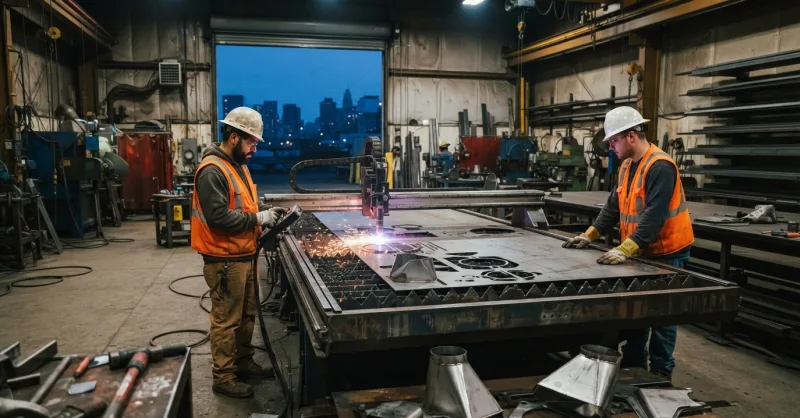
CNC laser profiling and CNC plasma cutting resolve the interface problem at the source, because the geometry is driven by the approved drawing rather than a field measurement taken under pressure. Our 250-ton Accurpress forms transitions to consistent angles and dimensions, which means the flange that leaves the shop matches the flange the equipment schedule called for. Tolerances and interfaces are settled before metal is cut, and that is the entire point of drawing-based estimation.
BIM/CAD intake feeds the estimate directly, so the take-off reflects the actual connection details instead of a square-foot guess. SMACNA fabrication practices govern how we build the assembly, and those practices matter more on corrosion-resistant ventilation because a poorly formed seam becomes a corrosion initiation site. Constructability drives every decision here, not machine specifications for their own sake.
Field fit is the test that matters. A duct that arrives dimensionally correct installs in hours; one that needs field cutting consumes a crew for a day and compromises the coating or alloy surface in the process. We build to the drawing so the crew bolts up and moves on.
Teams routinely conflate adopted NJ UCC provisions, NFPA 820, and NFPA 91 without confirming which one actually applies to a drinking-water versus wastewater chemical room. That confusion shows up in the drawings as a citation without a scope, and it surfaces during review as a question nobody can answer. The adopted code governs; the standards inform, and the AHJ interprets.
Exhaust discharge coordination and routing within constrained plant spaces are design-basis decisions that shape fabrication. Discharge location, stack height, and routing clearances all affect duct geometry, and a routing change after fabrication starts means rework. We document the design review rather than assert compliance, because the engineer and AHJ own the determination.
The review items we confirm with the design team and authority having jurisdiction are specific. Adopted code provisions, the applicable NFPA edition, the project specification language, the AHJ interpretation, and the discharge routing all get documented before fabrication proceeds. That record protects everyone when the inspector arrives.
This scenario is illustrative and not a claim about an actual Hudson County project, but the sequence is one we run regularly. A municipal water infrastructure contractor coordinating a chemical-room upgrade out of the Kearny industrial hub discovered during drawing coordination that the exhaust connection did not match the specified FRP process equipment. The design documents also needed clarification on chemical service conditions, exhaust routing, and which code provisions applied. These were project discoveries, not defects.
We received approved BIM/CAD details and turned a rapid estimate around against the actual connection geometry. CNC cutting and forming produced the specified duct and transitions to the approved dimensions, and the engineer confirmed whether 316L stainless steel was appropriate for the service. FRP-compatible transitions were coordinated to the verified equipment interface, and the design review covering NJ UCC, NFPA 820, and NFPA 91 was documented with the design team.
Delivery was sequenced around site access and scheduled hoist activity, with hardware bundled to the installation order. Outcomes are reported only as verified by project records, and we invent no savings, durations, or approvals. The value in this sequence is that the interface, the material, and the code questions were resolved before metal was cut.
Plant access windows and staging limits shape Hudson County work more than most contractors expect. A treatment facility running live operations may only allow deliveries through a single gate during a narrow morning window, and a truck that arrives late sits while the crew waits. Our 6:00 AM delivery planning exists because idle labor and hoist standby exposure are the two costs that quietly destroy a mechanical budget.
Bundled installation hardware and dedicated account coordination reduce that exposure by putting the right parts on site in the right order. Routes along the NJ Turnpike toward the Jersey City Waterfront and the connections toward the NYC Five Boroughs inform delivery planning, not assumptions about site conditions. The delivery-planning inputs we confirm with every project are the site access window, the staging area, the hoist or crane schedule, and the hardware bundle contents.
Get those four confirmed and the delivery becomes a scheduled event instead of a hopeful phone call.
Before the exhaust scope is locked, review the connection interfaces, the material assumptions, and the delivery sequencing, especially where access and hoist scheduling affect installation. Procurement that locks a scope built on unverified flange dimensions or an unconfirmed alloy commits the project to rework it cannot schedule around. Traceable material specification, clear exclusions and assumptions, and dependable account communication are the procurement criteria that actually protect the schedule.
Net-30 or Net-60 terms may be relevant for eligible established commercial accounts, and we discuss those directly with the account rather than burying them in a bid. The three pathways forward are straightforward: send drawings for a take-off and estimate, request a material and SMACNA coordination review, or coordinate approved fabrication with a scheduled delivery. Reach us through our fabrication and estimating team to start any of them.
Written by: Arthur Dabrowski
Owner & CEO, HVAC Metals, LLC (Kearny, NJ)
(201) 991-2206