 CALL NOW
Most odor-control duct failures I get called in to autopsy never started in the shop. They started at a Kearny plant gate at 5:40 AM, when a truck showed up with sections that could not clear the access road and the crane window closed at 7:00. The duct was fine. The coordination was dead on arrival.
Corrosive exhaust attack on underspecified alloys is the first structural failure I see on Hudson County retrofit work. A contractor inherits a duct schedule that names a generic stainless grade, the shop quotes to that grade, and six months into service the welds are pitting because the actual exhaust chemistry demanded a molybdenum-bearing alloy. Where the project engineer’s corrosion assessment calls for 316L stainless steel, that specification has to travel intact from the contract documents to the cut list. It is a specified material option, not a default answer for every odor stream.
Negative-pressure ventilation punishes every field-modified joint. A fitting that gets trimmed on a rooftop to clear a scrubber inlet loses its designed seam geometry, and the leakage class the engineer wrote into the spec evaporates with it. Interface conflict between duct, scrubber, fan, and support steel compounds the problem, because four trades converge on the same anchor points and nobody owns the final elevation until the steel is already set.
Four failure modes account for nearly every stalled odor-control duct package I have reviewed:
One boundary deserves blunt clarity. The New Jersey Department of Environmental Protection Treatment Works Approval program regulates specified treatment-works construction and modifications, and whether a given duct scope triggers that review is a project-team question confirmed with the owner, engineer, and NJDEP. Fabrication never assumes it either way. The engineer and owner own design criteria and regulatory submissions, while industrial duct construction traces strictly to issued specifications.
An unresolved flange detail on a drawing becomes a missed lift window on the NJ Turnpike corridor, and the cost cascade from there is predictable. The estimator prices a connection based on an ambiguous note, the shop holds the spool pending an answer, and the mechanical crew arrives for a restricted shutdown window with nothing to hang. That crew is not free while it waits.
Constrained Hudson County plants rarely offer a second hoist slot on short notice, so a missed window converts directly into crane standby charges and a rescheduled outage negotiation with plant operations. When standard fittings arrive and require field adaptation inside a tight plant space, the rework happens at prevailing labor rates in the worst possible location, often on a mezzanine with no room to swing a wrench. Unbundled hardware makes it worse, because a crew chasing gaskets and fasteners across three suppliers burns billable hours that never appear on the original estimate.
I have watched a single underspecified transition detail push a two-week duct installation into a five-week slog. The duct itself was fabricated correctly to what the drawing showed. The drawing simply did not show enough, and the field paid the difference in idle time, rework, and a second crane mobilization nobody budgeted.
Constructability review before the quote is the only reliable defense. When the take-off resolves material grade, seam type, flange details, and support interfaces up front, the shop builds to a settled target and the field installs without improvisation. Procurement clarity is schedule protection, and it costs nothing compared to a standby crane on a Tuesday morning.
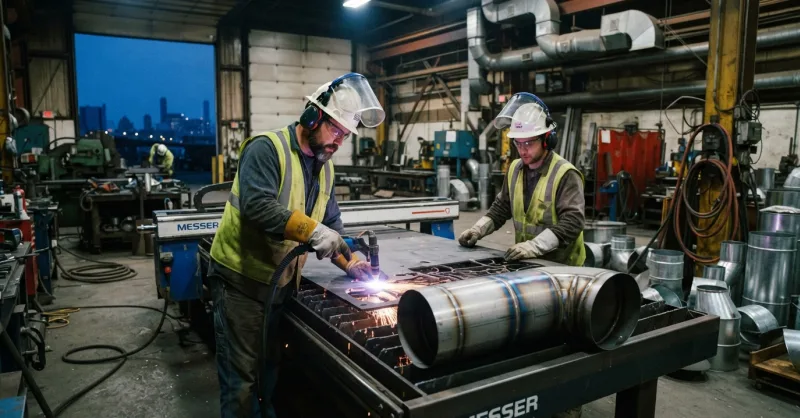
Our 250-ton Accurpress and CNC plasma and laser profiling exist to answer exactly the diagnostic above. Custom duct panels and fittings get profiled to the drawing geometry, formed for the specified bends and transitions, and welded into stainless seams, flanges, access sections, and engineered supports that match the issued package rather than a stock catalog.
Material selection follows the engineer, not the shop. When the corrosion assessment identifies 316L stainless steel for the exhaust environment, we price and fabricate to that grade with the connection details the documents require. The engineer supplies design pressure, material grade, seam type, flange details, support criteria, and inspection requirements; we build to those inputs and flag gaps before steel is cut. SMACNA construction practices and the project-specific pressure and leakage requirements form the fabrication baseline throughout.
| Technical Comparison Parameter | Generic Supply House / Spot-Market Vendor | HVAC Metals CNC & Logistics Architecture |
|---|---|---|
| Corrosive exhaust material coordination | May quote standard stock material without resolving project-specific alloy and connection details | Can price 316L stainless steel and custom geometry against the project’s specified material and drawing package |
| Negative-pressure duct geometry | Standard fittings may require field adaptation where routing is constrained | CNC plasma and laser profiling and forming support drawing-led custom sections, subject to approved design |
| Compliance documentation boundary | May leave responsibility for treatment-works review unclear | Identifies Treatment Works Approval as a project-team applicability question; fabrication remains aligned to issued specifications |
| Hudson County delivery interface | Delivery timing and bundled items may require separate coordination | Dedicated account coordination can sequence fabrication, hardware, and delivery around access and crane-hoist windows |
Fabrication conformance and regulatory approval are separate tracks, and conflating them creates risk for everyone on the project. Our work aligns to issued specifications: material traceability as required, weld and connection scope defined in the quote, and drawing coordination that keeps the shop and the field reading the same document. That documentation supports the contractor’s submission package without implying we secure approvals or certify ventilation performance.
Whether a treatment-works modification requires NJDEP review under the Treatment Works Approval program stays with the project team. The owner and engineer confirm applicability with the agency, and we fabricate to whatever design criteria emerge from that process. Four responsibility boundaries keep the interface clean:
When a contractor asks us to “handle the NJDEP part,” the honest answer is that we cannot, and pretending otherwise would put the schedule at risk. What we can do is make sure the duct we deliver matches the drawing package the agency review was based on, which is the fabrication contribution to a clean submission.
BIM and CAD drawings come in first, and our estimators ingest the model or the flat sheets directly rather than re-keying dimensions from a PDF. The duct schedule gets reviewed line by line against the drawings, which surfaces material grade conflicts, missing connection details, and unclear support interfaces before a number ever reaches the quote.
That review produces a take-off that resolves the questions the field would otherwise answer with a torch. Connection details, flange specifications, access section locations, and the required delivery sequence all get settled in the estimate, so procurement clarity survives intact into fabrication. Our 4-to-24-hour take-off turnaround exists for a specific reason: Hudson County odor-control retrofits move on bid deadlines, and a contractor who cannot price the duct scope in time loses the job before the shop ever sees it.
Estimation output ties directly to the approved drawing package. When the engineer issues a revision, the take-off updates against the same document set, and the shop cuts to the current revision rather than a superseded one. You can send drawings through our estimate request channel and get a coordinated number back fast.
Constrained laydown space drives every delivery decision at these plants. A Hudson County facility rarely has room to stage a full duct package, so we break fabrication into manageable sections sized to what the site can actually receive and unload in one window. Controlled plant access adds another layer, because security check-in, escort requirements, and gate hours vary facility to facility and must be confirmed for each delivery.
Our in-house fleet runs a 6:00 AM on-deck delivery schedule for exactly this reason. Early arrival aligns unloading with crane-hoist availability before plant operations ramp up, and it protects the contractor’s installation window instead of consuming it. Routes from Kearny through the NJ Turnpike corridor and toward the Jersey City Waterfront get planned around local access restrictions, and every route and site rule is verified before the truck rolls.
Five site constraints govern how we sequence any Hudson County delivery:
A mechanical contractor bidding an odor-control upgrade at a Hudson County facility coordinated from Kearny, working against constrained routing between an exhaust collection point and treatment equipment. Drawing review flagged tight access for long duct sections and a planned lift window competing with facility operations. Those conditions came from the contractor’s field verification, not from assumptions about the plant.
The engineer confirmed design pressure, corrosion exposure, material, and the interfaces among duct, scrubber, fan, and support steel. With those inputs settled, we estimated custom industrial duct construction in the specified 316L stainless steel, with CNC-cut sections, formed transitions, and coordinated flanges built to the approved documents. The project team separately checked whether the overall treatment-works modification required NJDEP review or a Treatment Works Approval, which is their call to make and confirm with the agency.
Execution focused on staging manageable duct sections for the confirmed delivery window, running the Kearny-to-Hudson County route with the in-house fleet, and aligning unloading with crane-hoist scheduling and plant access. Any published outcome metrics for a project like this require verified project records before they appear in an asset, and we hold to that standard rather than dressing up a scenario with invented labor savings.
Phased facility work strains cash flow in ways a single-shipment job never does, which is why qualified contractors can structure purchases under Net-30 and Net-60 corporate credit programs. The terms follow the delivery sequence rather than a lump-sum invoice date, so a multi-phase odor-control retrofit does not force the contractor to carry the full duct package on the balance sheet before the first section lands.
Bundled hardware and compatible installation accessories ship with the duct, which removes the scattered-purchasing drag that eats field hours. Material documentation is provided as required by the specification, and lead times are quoted against the confirmed delivery sequence so the procurement manager can plan around real dates instead of optimistic ones. Enterprise procurement criteria we build the quote around include:
Our shop sits at Kearny, NJ, which keeps the whole supply chain short for Hudson County contractors. You can review our fabrication capabilities before the bid goes in.
The pathway from drawing package to confirmed delivery window has three clean entry points, and each one matches where a contractor actually stands in the bid cycle. Send the wastewater odor-control duct drawings and duct schedule for a coordinated take-off and fabrication estimate when the bid is live. Request a review of specified alloy, duct construction details, and SMACNA-related requirements against the project documents when the material questions are still open, keeping design and regulatory determinations with the engineer. Submit approved drawings, delivery sequence, and Hudson County site constraints when the award is confirmed and fabrication needs to move.
Before award, compare field-fit and schedule risk for custom corrosive-exhaust duct against the project’s routing, access, and hoist plan. A stock-vendor quote that ignores section lengths and lift weights looks cheaper on paper until the first crane window closes. Request a Kearny-based estimate for the Hudson County scope and put the fabrication plan next to the field plan where it belongs.
Three funnel actions summarize the path:
Written by: Arthur Dabrowski
Owner & CEO, HVAC Metals, LLC (Kearny, NJ)
(201) 991-2206