 CALL NOW
Nothing about rail maintenance exhaust ducting moves until the approved schedule, gauge callout, and connection detail agree with each other. I have watched contractors release a package on a single-line diagram and pay for it three weeks later when the field crew found a 14-inch offset nobody priced.
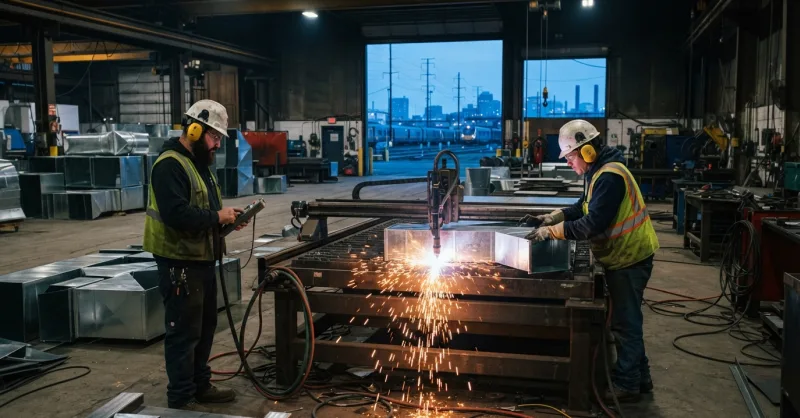
Our shop converts coordinated drawings into welded exhaust fittings and straight sections using CNC plasma and laser profiling, then forms them on a 250-ton Accurpress brake. Material selection follows the engineer’s schedule, whether that lands on 16-gauge black iron, galvanized G90, or stainless, and we quote deviations for contractor approval rather than substituting quietly.
NFPA 91, NFPA 130, ASHRAE 62.1, and NJAC 7:27 each address different concerns, and none of them hands you a universal gauge table. The design team and the authority having jurisdiction confirm applicability, system classification, and emissions obligations for the specific operation. Fabrication supports that determination; it does not replace it.
Hudson County sites add their own pressure. A Kearny rail facility with a narrow laydown yard and a single unloading window forces us to bundle hangers, sealants, and fittings by installation sequence, then dispatch on our in-house fleet for a 6:00 AM on-deck delivery. That sequencing discipline is what keeps a maintenance shutdown from stalling on a missing elbow.
Estimators hunting a Union County rail maintenance exhaust ductwork fabricator are rarely browsing. They are holding a bid release or an approved submittal with a deadline attached, and they need a shop that can read a schedule and answer within a day.
Three intents dominate the inbound calls we field. Procurement teams want custom welded rail maintenance exhaust ducting quoted against a real specification. Engineers want to talk through NFPA 91 and NJAC 7:27 applicability before they commit to a classification. Site teams want Kearny-area fabrication with early delivery that respects a constrained gate schedule.
NJDEP’s Chapter 27 air-quality pages and its air-permit applicability guidance are legitimate research starting points, and the Port Authority’s Mechanical Design Guidelines reference SMACNA sealing and testing alongside NFPA 130 for transit ventilation contexts. None of those sources proves a given shop exhaust system is governed identically, which is why we route applicability questions back to the design team.
My own read after eleven years in this trade: the search query is a symptom, and the real question behind it is whether the fabricator can hold a revision log and a delivery window at the same time. We built our estimating workflow around that assumption.
Start with a number: a 16-gauge black iron section behaves very differently from 18-gauge galvanized once you factor in temperature, particulate loading, and weld prep, and the schedule has to state which one the system needs.
We verify gauge and alloy against the engineer-approved schedule before any plate hits the plasma table. Where the design calls for welded construction, our MIG and TIG welders build seams and fittings to the specified joint detail, and we identify SMACNA construction, sealing, and testing requirements inside the submittal and coordination workflow so nobody discovers a leak-test obligation at the eleventh hour.
Here is the blunt version: fabrication alone certifies nothing. A shop that tells you its welds satisfy NFPA 91 without an engineer’s classification and an AHJ review is selling you a liability. We document what we built and against which drawing revision, and the compliance determination stays where it belongs.
Our take-off target runs 4 to 24 hours from drawing intake, and that clock only starts when the files are actually coordinated. Incomplete exhaust schedules and uncertain joining details are the two bottlenecks that blow past it every time.
BIM and CAD ingestion lets us pull dimensions directly and flag conflicts between an equipment connection and a field route before steel is cut. Late drawing revisions get logged against the release, and we re-check fitting geometry against the current revision rather than the one that arrived first.
Coordination between duct sections, supports, and equipment connections is where most packages quietly fail. A hanger detail that ignores a structural beam or a flange that misses a fan inlet by two inches turns into field cutting, and field cutting at height on an active rail site is the most expensive labor on the job.
We would rather spend an extra hour in the office reconciling a support spacing table than send a crew up a lift to improvise. That trade-off is not glamorous, and it is the one that protects the schedule.
A 20-foot section will not fit through a gate designed for a pickup truck, and no amount of good welding fixes that. Restricted laydown and unloading areas drive how we break a package into shippable modules before fabrication begins.
Kearny’s industrial corridor sits close to the NJ Turnpike and the approaches to the Lincoln Tunnel, and traffic on those routes does not care about your crane-hoist window. We coordinate dispatch, delivery window, and unloading responsibility with the site team in advance, and we confirm access rather than assume it.
Work sequencing around facility operations matters just as much. A rail maintenance bay that stays live during installation limits where crews can stage material, which pushes us toward smaller, labeled deliveries timed to the actual installation order instead of one large drop.
If lifts are required, arrival gets coordinated around crane-hoist availability, because crane standby fees at $120 per hour erase the margin on a small package fast. Our in-house fleet exists partly to remove the third-party carrier variable from that equation.
Spot-market vendors sell what is on the shelf. We quote against the specified material and gauge, and we document any deviation for contractor approval instead of letting stock availability quietly rewrite the specification.
The table below lays out the practical difference across four evaluation dimensions that matter to a project executive signing off on a rail-facility package.
| Evaluation dimension | Generic Supply House / Spot-Market Vendor | HVAC Metals CNC & Logistics Architecture |
|---|---|---|
| Rail exhaust scope | May provide standard duct and fittings without tying the package to coordinated rail-maintenance drawings | CNC-cut sections and custom welded exhaust fittings produced from approved project details; NFPA 91 and NFPA 130 applicability stays with the design team and AHJ |
| Material and fabrication basis | Stock availability may drive substitutions that require further review | Quote against specified material and gauge, including 16-gauge black iron only when specified; document deviations for contractor approval |
| Quality and compliance coordination | Generic product descriptions can leave sealing, testing, and documentation questions unresolved | Identify SMACNA construction and testing requirements in the submittal and coordination workflow; do not claim that fabrication alone certifies code compliance |
| Hudson County job-site delivery | Delivery may be decoupled from installation sequence and site access planning | Bundle duct, welded fittings, and specified installation hardware; coordinate dispatch, delivery window, and unloading plan with the site team |
A commercial mechanical contractor supporting a rail-maintenance facility in the Union County and Hudson County corridor brought us a package that had stalled in drawing review. Conflicting duct dimensions between an equipment connection and the field route had surfaced alongside a tight staging area and a single unloading window.
Before fabrication, the team had to resolve system classification, discharge details, material and gauge, and which requirements actually applied. NJDEP’s Chapter 27 resources and air-permit guidance informed the research, and the project team made the applicability call, since NJDEP material on intermodal rail yards does not by itself place a specific maintenance operation inside a rule.
The mechanical engineer issued coordinated revisions and confirmed whether NFPA 91, NFPA 130, ASHRAE 62.1, and NJAC 7:27 applied to the specific systems in scope. We used those approved drawings to quote SMACNA-aligned fabrication, including specified 16-gauge black iron and welded exhaust fittings where the design called for them.
CNC profiling, forming, fitting checks, and bundled hardware carried the release forward. Labeled duct sections shipped in installation sequence, delivery access and unloading responsibility were confirmed in advance, and arrival was coordinated around crane-hoist availability. The verified outcome was reduced field measurement and staging friction, not a guaranteed performance number, and I would rather report it that way than dress up a fabrication job as a compliance certificate.
Multi-phase commercial work runs on predictable cash flow, so we extend Net-30 and Net-60 corporate credit programs to qualified accounts. That matters when a rail-facility package spans several shutdown windows and the contractor needs fabrication released before the final invoice clears.
Drawing and revision control sits at the center of every enterprise package we quote. Specification traceability, documented material and gauge, and fabrication capacity for custom fittings all feed a predictable estimating conversation, and clear distinction between supplier scope and engineer or AHJ approval keeps the responsibility line visible.
Procurement leads who want to see how we handle take-offs and material review can start with our custom sheet metal fabrication capabilities and then send drawings for a coordinated estimate. The faster the files arrive, the faster the 4 to 24-hour take-off clock starts.
Send your Union County rail-maintenance exhaust drawings for a coordinated take-off and fabrication estimate, and we will flag gauge, joining, and staging questions before they become field problems. A drawing and material review covering specified gauge, welded exhaust fittings, SMACNA requirements, and open NFPA or NJAC applicability questions gives your design team a clean handoff.
Once approved drawings land, we release for CNC fabrication, fitting coordination, hardware bundling, and a Hudson County delivery plan. Before the next shutdown or installation window, check drawing revisions, unloading access, and delivery sequencing, because those three items sink more rail-facility packages than any weld defect.
Our shop and fleet operate out of HVAC Metals, LLC, 19 Central Ave, Kearny, NJ 07032, which puts us close to the corridor where most of this work happens. Reach out through our contact page when the bid releases.
Written by: Arthur Dabrowski
Owner & CEO, HVAC Metals, LLC (Kearny, NJ)
(201) 991-2206