 CALL NOW
No CNC file gets released from our Kearny floor until the geometry traces back to an engineer-approved, revision-controlled drawing. Transit tunnel ventilation duct is a life-safety system, and I treat the fabrication package as a documented scope, not a performance certification.
That distinction matters because a fabricator who starts cutting from a superseded coordination set creates scrap the contractor pays for twice. Late clarifications cost far less than a field retrofit inside a restricted Hudson County access window.
Intake runs through BIM and CAD ingestion, and we log every revision against the submittal register so no panel is cut from a stale file. I have watched a single unlogged shaft detail change ripple into three weeks of rework, and I will not repeat that on a transit job.
NFPA 130, IMC, and NJ UCC applicability enters the package as a coordination input, confirmed by the design team and the authority having jurisdiction. Our job is to reconcile joint details, support geometry, material callouts, and smoke-control damper interfaces against the approved set before release.
The drawing-intake checkpoints we close on every transit package:
Division of responsibility stays explicit in writing: the engineer owns fire and life-safety performance, the installer owns field fit and inspection readiness, and the fabricator owns dimensional conformance to the released set. Contractors who want that intake process mapped can review our CNC fabrication and estimating capabilities before sending drawings.
At 18-gauge G90, a tunnel ventilation section behaves very differently from commodity duct stock, and the specification, not the supply house catalog, decides the gauge. We use G90 galvanized steel only where the drawings call it out, and stainless 304 or 316 where the engineer specifies it.
Constructability review happens before the first panel nests. Joint type, reinforcement spacing, support geometry, coating systems, and damper interfaces are all project-specific, and I refuse to substitute a standard detail for a specified one without written engineer direction.
ASTM E84 evaluates surface-burning characteristics of tested materials; it does not, by itself, prove a complete duct assembly meets NFPA 130 or tunnel fire-performance criteria. That single sentence resolves more confusion on transit submittals than any other clarification we issue.
I have sat in preconstruction meetings where a vendor waved an E84 label as if it closed the fire-performance question. It does not. The specified assembly, operating conditions, supporting evidence, and acceptance criteria belong to the project engineer and the authority having jurisdiction.
NJ UCC and IMC applicability follows the same rule: the design team confirms it, and we document what we fabricated against what was specified. That posture protects the contractor during AHJ review because our scope statement never overreaches into engineering territory.
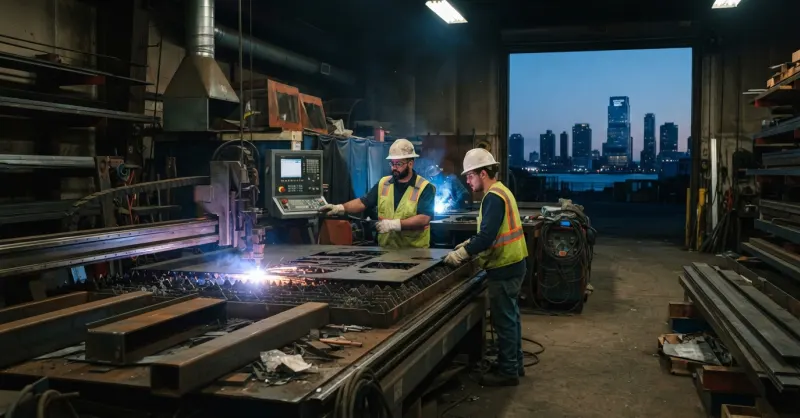
A 0.5-inch dimensional drift at a damper opening becomes a field retrofit, so we hold panel geometry through CNC plasma profiling and CNC laser-cut duct panels before anything reaches the brake. Forming runs on the 250-ton Accurpress, which gives us consistent bend allowances on long and irregular tunnel sections.
SMACNA construction practices govern joint selection and reinforcement, and the shop builds to those details rather than improvising at the bench. Long sections get broken at coordinated joints so they can actually travel through a tunnel portal and turn a corner in a constrained staging area.
Piece identification is where fabrication discipline meets field reality. Every section leaves Kearny labeled to its installation sequence, with lot tracking tied to the submittal, so crews install in order instead of sorting a pile at 6:00 AM.
Field cuts through G90 zinc coating expose bare steel and start corrosion at the worst possible location. Controlled shop fabrication protects coating integrity and holds dimensional fit at smoke-control damper openings, which is exactly where inspection attention concentrates.
The fabrication controls we document on every transit release:
My own habit came out of years of watching crews sort unlabeled duct in the rain: I walk the first article of any new tunnel section myself before the run releases. It catches a reversed damper collar faster than any drawing review.
Opening dimensions get reconciled against the approved damper schedule before fabrication release, because a mismatched collar drives red-tag exposure and field retrofit that no schedule recovery absorbs. We coordinate the duct connection geometry; damper selection, system acceptance, and commissioning authority stay with the design team and AHJ.
Interface conflicts surface in the shop during constructability review, not at the tunnel portal at 5:30 AM. That sequencing is deliberate, since a collar that misses by an inch inside a shaft transition can idle a hoist crew for an entire access window.
We ask for the damper schedule, the approved detail sheets, and the equipment access clearances in the same intake package as the duct drawings. When those three documents disagree, we flag the conflict in writing and hold the affected sections until the engineer resolves it.
Contractors planning phased transit work can route interface questions through our project intake team early, which keeps the fabrication release aligned with the current approved schedule rather than a superseded one.
Documentation is what keeps fabricator scope distinct from fire and life-safety engineering, and that separation protects the contractor during AHJ review. We assemble the package as we fabricate, not after the fact.
The recordable basis is straightforward: SMACNA practices, the specified material callouts including G90 galvanized steel where specified, and the released drawing revision. Everything in the package traces to one of those three anchors.
Each transit submittal package includes:
Transparent exclusions matter as much as inclusions. Stating plainly that we do not certify system performance or conduct commissioning keeps the division of responsibility clean when the inspection team asks who owns what.
A 6:00 AM on-deck delivery beats a noon arrival every time on a transit site, because the receiving window closes before the first shift meeting ends. Our in-house fleet runs sequenced loads from Kearny, and the site superintendent confirms unloading and crane-hoist access before we dispatch.
Hudson County logistics are their own discipline. Staging is constrained, security controls slow every gate entry, and transit operations coordinate access windows that do not move for a fabricator’s convenience. Approaches via the NJ Turnpike, I-80, Kearny, and the Jersey City Waterfront are planning context, not guaranteed routes or times.
Unsequenced dispatch has a measurable cost: loaded field crews idle at $120 to $185 per laborer-hour plus supervision, while crane and hoist standby commonly plans at $500 to $1,200 per hour. A missed access window burns a full shift and compresses the next one.
Delivery planning inputs we confirm before any load leaves the shop:
I will not promise a schedule outcome from logistics alone, because site conditions and installation drive the result. What sequencing does control is sorting time and field modification risk, and those are the variables contractors can actually manage.
The difference between a spot-market quote and an engineered fabrication package shows up in documentation, material claims, interface coordination, and delivery sequencing.
| Evaluation dimension | Generic Supply House / Spot-Market Vendor | HVAC Metals CNC and Logistics Architecture |
|---|---|---|
| Tunnel-specific documentation | May quote standard duct products without a clear drawing-to-fabrication review. | Can organize project drawing intake and fabrication scope around engineer-approved details, SMACNA construction practices, and applicable NFPA 130 interfaces. |
| Materials and fire-performance claims | May rely on broad material labels or unqualified fire-resistance language. | Identifies G90 galvanized steel and other materials only where specified; explains ASTM E84’s scope and flags tunnel performance questions for the engineer. |
| Damper and assembly coordination | May treat smoke-control dampers as separate procurement with limited fit-up coordination. | Coordinates duct connection geometry and interfaces against approved schedules and details; damper selection and system acceptance remain with the design team. |
| Fabrication and delivery sequencing | Standard lead-time and delivery assumptions may not match restricted transit-site access. | CNC plasma and laser capability, short-run flexibility, dedicated account management, and planned early delivery can support phased Hudson County work, subject to confirmed access and scheduling. |
This scenario is illustrative, built from the coordination failures we see repeatedly on transit work, and it is not a claim about a completed HVAC Metals project. A mechanical contractor executing a Hudson County ventilation upgrade was coordinating fabrication from the Kearny industrial area with site work near the Jersey City Waterfront.
During constructability review, the team found that a shaft transition and adjacent equipment access were not fully resolved in the current coordination set. A late route adjustment could conflict with supports and smoke-control damper access, and delivery depended on a restricted receiving window, constrained staging, and crane-hoist availability.
The rebuild started with the contractor’s engineer issuing revised, approved geometry and interface details. We received the controlled CAD and BIM files, estimated the take-off, and CNC-fabricated the identified sections in specified material, which included G90 galvanized steel.
SMACNA practices governed construction, required material information was recorded, and smoke-control damper interfaces were coordinated against the approved schedule. NFPA 130 and NJ UCC/IMC applicability, along with any ASTM E84 evidence requirements, were confirmed by the design team and the relevant authority, not assumed by us.
Piece-marked sections were then sequenced to the confirmed installation plan and delivery window, with the site superintendent coordinating unloading and crane-hoist access before dispatch. The intended benefit is reduced sorting and field modification risk; actual schedule, fit, and compliance outcomes depend on approved drawings, site conditions, installation, inspection, and commissioning.
Early intake identifies missing geometry and interface information before procurement commitments harden, which is the cheapest point in any transit project to resolve a conflict.
Four engagement paths cover the work from estimate through delivery:
Drawings in, fabrication out: that is the whole model, and it works best when the first conversation happens before the submittal deadline rather than after it. Our shop sits at Kearny, New Jersey, close enough to most Hudson County receiving gates to make an early window realistic.
Written by: Arthur Dabrowski
Owner & CEO, HVAC Metals, LLC (Kearny, NJ)
(201) 991-2206