
 CALL NOW
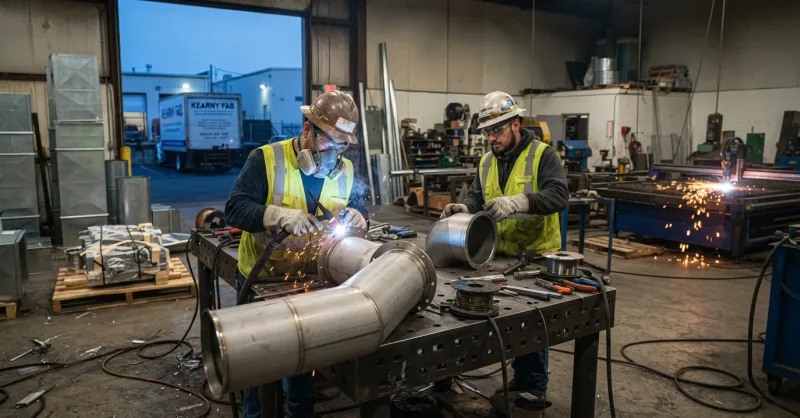
Medical device manufacturing exhaust ductwork should be specified from the process exhaust assessment, design documents, and authority requirements. HVAC Metals can review take-offs and fabricate 316L stainless steel components with corrosion-resistant welds where specified, coordinating SMACNA practices, applicable NFPA 91 provisions, access, and delivery with the mechanical contractor.
I have watched estimators reach for 316L as a reflex on every pharma and device-fab job, and that reflex costs real money when the exhaust stream is a benign solvent vapor that 304 handles without complaint. The appropriate material, gauge, jointing, and finish depend on the exhaust stream, design documents, and project requirements. Nothing else settles it.
Chemistry comes first because it dictates everything downstream. A process stream carrying chlorides or acidic condensate pushes you toward a molybdenum-bearing alloy, while a clean thermal exhaust may run in galvanized at a fraction of the cost. Gauge follows the static pressure class and the support spacing, and jointing follows the leak-tightness the process demands. Finish follows cleanability and the owner’s standards.
Code review sits on top of that material logic, not beside it. The NJ UCC mechanical subcode routes the installation through the authority having jurisdiction, and that AHJ wants to see the design intent documented before the first hanger goes up. ASHRAE 62.1 governs ventilation air for occupied spaces and does not substitute for process exhaust design, which is a distinction I have had to draw for more than one contractor who conflated the two standards on a submittal.
Every stainless package starts with drawing ingestion, and a clean BIM or CAD take-off at ±1/16 inch on cut geometry saves the field crew a full day of trimming. We pull the model or the flat drawings into the profiling software, nest the parts, and cut on the CNC laser so the transitions match the shaft dimensions the first time.
Forming runs through the 250-ton Accurpress, which handles the heavier stainless gauges without the springback surprises that plague lighter brakes on 316L. Bend allowances get calculated against the actual alloy and thickness rather than a generic table, because 316L work-hardens differently than mild steel and a wrong allowance turns a square transition into a twisted one.
Welding is where the specification either holds or falls apart. Corrosion-resistant welds get executed to the procedure named in the contract documents, whether that calls for TIG on thin-wall stainless or MIG on heavier sections, and inspection criteria follow the same documents. I will not tell a contractor a weld passes visual and penetrant inspection until our QC lead has actually run it.
The fabrication sequence we run on a typical stainless exhaust package looks like this:
Custom transitions and short-run fittings resolve the congested ceiling and shaft routing that standard catalogs cannot touch. Engineering approval stays with the responsible design professional, and we fabricate to their intent rather than substituting our own judgment on alloy or weld class.
Three compliance layers govern a medical device exhaust package, and mixing them up on a submittal is how projects stall at the AHJ desk. SMACNA governs fabrication practice: gauge tables, reinforcement spacing, seam types, and the construction details that make ductwork perform at its rated pressure class.
NFPA 91 applies where the exhaust-system hazard brings it into scope, covering duct construction, clearance, and discharge provisions for the specific process. NJ UCC mechanical-subcode review runs through the local AHJ, who confirms the installation against the approved design. HVAC Metals supports coordination and documentation across all three, but we do not certify or approve design, and I make that boundary explicit on every quote.
ASHRAE 62.1 stays in its lane as a ventilation reference for occupied-space air, and treating it as a process-exhaust standard is a common submittal error. When a contractor sends me a package that cites 62.1 for a solvent exhaust run, I flag it before fabrication because the AHJ will flag it later.
A stock counter sells you a fitting; a specification-driven fabricator reads your drawings and builds to them. The difference shows up when the exhaust stream demands a specific alloy and weld detail that no shelf carries.
| Project factor | Generic Supply House / Spot-Market Vendor | HVAC Metals CNC & Logistics Architecture |
|---|---|---|
| Exhaust-specific material coordination | May offer standard stock without resolving process-specific material questions | Can quote specified 316L stainless steel and coordinate corrosion-resistant weld details against drawings and project criteria |
| Fabrication and fit-up | Standard configurations may leave field teams to resolve custom transitions | CNC profiling and forming support custom geometries, transitions, and short-run components |
| Standards and documentation | May not connect the order to the contractor’s project review workflow | Supports coordination around SMACNA, NJ UCC/AHJ review, and NFPA 91 where applicable; design approval remains with responsible professionals |
| Delivery and procurement | Separate sourcing and delivery can add coordination steps | Bundles fabricated components and requested installation hardware, with delivery coordinated to Hudson County staging and Morris County site constraints |
The table is not a knock on supply houses, which serve a legitimate role on standard work. It is a map of where a specification-driven shop earns its keep on a stainless exhaust package with real code exposure.
A 6:00 AM on-deck delivery beats a noon drop every time, because the crew is on the deck and the crane is already mobilized. Our Kearny industrial hub sits close enough to the NJ Turnpike and I-80 that a Morris County run is a planned route rather than a gamble, though I will not promise a delivery time until the jobsite, route, and schedule are confirmed.
Hudson County staging introduces its own friction: urban loading zones, tight access windows, and hoist coordination that has to line up with the building’s crane schedule. We bundle hangers and installation hardware with the fabricated components so the crew is not chasing separate deliveries while the hoist sits idle at $120 per hour in standby.
Route planning accounts for Turnpike traffic and the I-80 corridor toward Morris County, and we schedule early-morning drops to clear the receiving window before the site gets congested. The delivery plan is built around the contractor’s actual constraints, not a generic promise.
A commercial mechanical contractor fitting out a medical device manufacturing space in Morris County, coordinating procurement through a Hudson County project team, handed us a package with unresolved exhaust-stream assumptions and congested routing near other services. The delivery sequence also had to account for constrained unloading and a narrow crane-hoist window.
The contractor confirmed applicable requirements with the engineer and AHJ rather than assuming a universal material or code rule, which is the right call and saved a submittal revision. We received the coordinated CAD/BIM take-off, priced the specified 316L stainless steel, and reviewed custom transitions and access constraints with the contractor.
Fabrication planning addressed corrosion-resistant welds as specified, SMACNA practices, NJ UCC review, and NFPA 91 applicability, with ASHRAE 62.1 treated as a ventilation reference rather than a substitute for process-exhaust design. Components and requested hardware were bundled and staged from the Kearny hub.
The contractor received a sequenced delivery plan coordinated around the site’s receiving window and hoist schedule, which reduced the risk of crews waiting on custom pieces. Any schedule or labor improvement gets documented from actual project records rather than asserted in advance, and I hold to that discipline on every post-mortem.
Enterprise procurement on a multi-phase fit-out lives or dies on take-off accuracy and specification traceability. A drawing-based take-off that reconciles against the issued-for-construction set keeps the package honest, and documented scope boundaries prevent the change-order fights that eat a project’s margin.
Dedicated account management threads the coordination between estimator, engineer, and AHJ review so nobody is re-explaining the package to a new contact each phase. Net-30 and Net-60 corporate credit programs support the cash flow on multi-phase commercial construction, and we set those terms against the account rather than per order.
Fabrication and coordination capability is what we bring; engineering, certification, and code-approval responsibility stay with the responsible design professionals and authorities. Drawing that line clearly before release prevents the disputes that surface mid-installation.
The scope-review checkpoints we walk with every contractor cover the mandatory entities in one pass:
Send the drawings or take-off package for a fabrication-focused estimate, request a materials and weld-detail review for coordination with your engineer and AHJ, or schedule the full fabrication and logistics deployment including the Hudson County staging and jobsite receiving plan. Comparing lead time, custom-transition scope, and delivery constraints against a Kearny-based plan before you release the package is the cheapest risk review you will run on the job.
Written by: Arthur Dabrowski
Owner & CEO, HVAC Metals, LLC (Kearny, NJ)
(201) 991-2206