 CALL NOW
Releasing a duct package to the shop floor before the process designer’s exhaust schedule is reconciled against field dimensions is the single most expensive mistake I see on pilot plant work. A fabricable package and a commodity duct order look similar on a purchase requisition and behave nothing alike once the first spool hits the roof.
The exhaust schedule drives everything downstream: conveyed-material hazards, stream chemistry, operating temperature, moisture load, and particulate characteristics. Each of those inputs narrows the material and joining decision before a single sheet gets nested on the plasma table.
For a Northern New Jersey pilot plant, duct fabrication should begin with the approved process-exhaust design, conveyed-material hazards, and corrosion requirements. HVAC Metals can review drawings, scope welded black iron or 304 stainless steel as specified, and coordinate fabrication, hardware, and delivery within its 4 to 24-hour estimate window.
Hudson County adds a second layer of constraint that has nothing to do with metallurgy. Kearny, Jersey City, and the corridors feeding the waterfront compress your laydown space and your truck windows, which means the duct package has to arrive in a sequence the site can actually receive. Get the engineering right and the logistics wrong, and you are still paying crane standby.
Start with the process designer’s exhaust schedule and documented stream chemistry, temperature, moisture, and particulate hazards. Confirm material compatibility, joining details, cleaning or maintenance needs, and applicable code and project specifications with the engineer of record and authority having jurisdiction. Selecting welded black iron or 304 stainless steel on material name alone is how specification control quietly dies.
Chlorides or aggressive service push the conversation toward 316 stainless steel for specification review, and that review belongs to the engineer of record, not to whoever answers the phone at a supply house. Welded seams behave differently than gasketed or flanged connections under thermal cycling, and the maintenance crew that has to open a duct run at 2:00 AM cares about which one you chose.
Availability-led substitution by spot-market vendors breaks specification control in ways that surface months later as pitting, seam failure, or a rejected inspection. I have watched a contractor eat a full re-fabrication because a vendor swapped alloy grade to hit a ship date nobody had asked him to hit.
| Pilot-plant requirement | Generic Supply House / Spot-Market Vendor | HVAC Metals CNC & Logistics Architecture |
|---|---|---|
| Process-specific duct package | May supply standard stock; custom scope and drawing coordination may be separate | Digital take-off and custom CNC fabrication coordinated against approved project documents |
| Material and joining coordination | Availability-led substitution can complicate specification control | Can quote specified welded black iron or 304 stainless steel, subject to drawings, material availability, and approval |
| Code and fabrication interface | May treat duct as a commodity item | Frames SMACNA fabrication practices alongside NJ UCC review and NFPA 91 applicability review; design and code approval remain with responsible professionals |
| Hudson County delivery readiness | Delivery timing may be less integrated with installation sequencing | In-house fleet and early delivery coordination can be planned around site access, unloading, and hoist schedules; route and arrival timing require confirmation |
Three review interfaces govern a pilot plant exhaust package, and each one carries a different scope limit. Keeping them separate in the submittal prevents the assumption that a fabricator’s stamp substitutes for an engineer’s seal.
We frame SMACNA fabrication practices alongside these reviews. Design approval, code interpretation, and AHJ sign-off remain with the responsible professionals, and I will not sign a letter that pretends otherwise. That boundary protects the contractor as much as it protects us.
Exhaust discharge location and fire or explosion prevention review get confirmed against the actual project documents every time, because a provision that covered one process suite will not automatically cover the next one down the hall.
Coordinated drawings and equipment schedules come in through our digital take-off, and the output is a priced, traceable scope tied line by line to the approved documents. Missing interface details and incomplete duct elevations get flagged for resolution by the design team before anything releases.
That 4-to-24-hour estimate window exists so a mechanical contractor evaluating a materials pilot plant duct fabrication package in Northern NJ can keep the schedule moving without committing to a number built on assumptions. My estimating desk runs the take-off against the drawing set, not against a verbal description of the job.
Fabrication releases only after dimensions and material selections are approved. It is a slower first week and a faster last month, and I have never regretted holding that line.
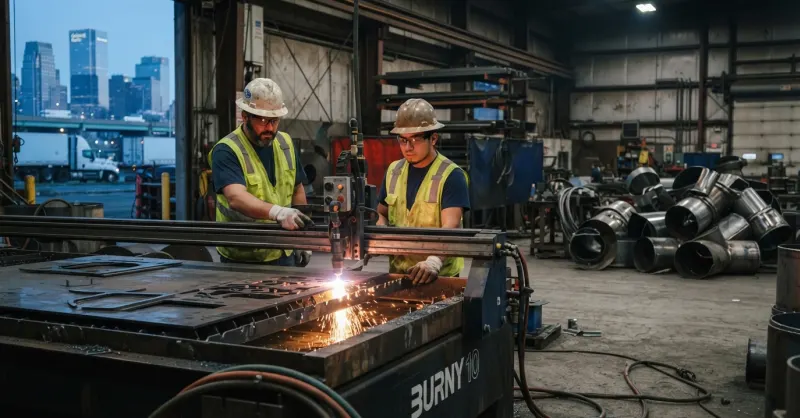
CNC plasma cutting and CNC laser profiling handle the custom geometries and transitions that a stock duct order cannot produce, and the 250-ton Accurpress covers high-tolerance formed components where bend consistency matters across a multi-phase run. MIG and TIG welded duct seams carry the welded black iron and 304 stainless steel sections once the material call is approved.
Agile manufacturing matters most on pilot plant work because the scope moves. We toggle between high-volume multi-phase runs and emergency short-runs without rebuilding the production schedule from scratch, which keeps a late process-equipment change from becoming a six-week delay.
Hardware bundling keeps installation hardware with the duct package so the field crew is not chasing hangers and gaskets across three suppliers while a hoist window burns. Every one of those claims stays tied to approved drawings and project requirements, because a shop capability is not a substitute for a design decision.
Limited laydown space, booked hoist windows, and truck access around the Kearny industrial hub and the Jersey City Waterfront turn delivery into a scheduling problem rather than a shipping problem. The NJ Turnpike and Lincoln Tunnel routing constraints are planning considerations that require project-specific verification, and I confirm current access rules and site requirements before any dispatch.
Our in-house corporate fleet and coordinated early-morning delivery let us split shipments to match available laydown and hoist windows instead of forcing the whole package onto a site that cannot hold it. Truck access, unloading responsibility, and site readiness get confirmed in writing before the truck rolls.
I grew up in a shop where the foreman measured twice and the driver still called ahead from the road. That habit is why our dispatch sheet lists a contact name and a phone number for every delivery, not just an address.
Freight planning studies around Harrison Avenue and the Newark to Jersey City Turnpike corridor inform how we sequence a Hudson County run, though actual route suitability and restrictions always require verification against the day’s conditions.
An illustrative scenario we use to calibrate our own workflow: a mechanical contractor outfitting a pilot-process suite in Hudson County, with fabrication coordinated from the Kearny industrial hub and site deliveries staged around nearby Jersey City construction activity. The drawing set contained process-equipment connection changes and incomplete duct elevations, which is the normal condition of a pilot plant package rather than an exception.
The team had to reconcile the exhaust schedule with field dimensions, identify material requirements from the process designer, and sequence oversized sections against limited laydown space and a booked hoist. We received coordinated drawings and take-offs, flagged the missing interface details for resolution by the design team, and priced the specified welded black iron and 304 stainless steel sections separately so the contractor could see exactly where the cost sat.
The package tracked NJ UCC review, SMACNA fabrication requirements, and NFPA 91 applicability without substituting for engineering or AHJ approval. CNC profiling, specialty welding, hardware bundling, and delivery sequencing supported the approved scope once it released.
The proposed workflow that follows is not a guaranteed performance claim: release fabrication only after dimensions and material selections are approved, split deliveries to match available laydown and hoist windows, and confirm truck access, unloading responsibility, and early-morning site readiness before dispatch. That sequence reduces avoidable receiving and field-fit risk without promising code approval or a specific schedule saving.
For contractors who want the full picture of how we build and deliver these packages, our custom fabrication capabilities page lays out the shop floor and the logistics side together.
Enterprise procurement on a pilot plant package comes down to traceable scope against approved drawings, material and gauge documentation where specified, change management, bundled hardware, and delivery coordination. We run Net-30/60 corporate credit programs for multi-phase commercial construction so a phased commissioning schedule does not stall on a payment cycle.
Responsibility boundaries stay clear throughout: engineering and code interpretation sit with the responsible professionals, fabrication sits with us, and installation sits with your crew. That clarity is what makes a change order a conversation instead of an argument.
Pick the pathway that matches where your package stands right now:
Our shop sits at Kearny, NJ, which keeps a Hudson County delivery inside a single morning window when the site is ready to receive it.
Written by: Arthur Dabrowski
Owner & CEO, HVAC Metals, LLC (Kearny, NJ)
(201) 991-2206