 CALL NOW
Most industrial exhaust failures I get called into diagnose never started in the shop. They started on a rooftop in Jersey City where a drawn route collided with a steel beam nobody field-verified, and the crew stood around waiting on a transition that had to be cut by hand.
Industrial exhaust fabrication in Hudson County starts with the process, airflow, exposure, and project drawings. The fabricator coordinates material selection and duct geometry with the design team, checks applicable mechanical code compliance and NFPA 91 scope, then plans delivery around site access and installation sequencing.
Three diagnostic lenses catch the real problems: unresolved airstream chemistry, incomplete field dimensions, and code scope confusion. Local exhaust ventilation design lives or dies on those three, and NFPA 91 applicability depends on the specific system and hazard rather than acting as a universal mandate.
I have spent eleven years watching contractors eat change orders because a drawing package looked complete until the tape measure came out. The fabrication was never the weak link.
Stainless steel 304 handles most general exhaust service, but 316 earns its premium when chlorides, moisture carryover, or aggressive process byproducts enter the airstream. Galvanized and galvanneal remain viable where the exposure permits and the design documents allow.
Grade, gauge, joining method, and construction details must be specified from the conveyed airstream, corrosive environment, design documents, and governing requirements. Generalizing that selection is how corroded exhaust sections get replaced twice in five years.
Material choice ties directly to local exhaust ventilation performance. A duct that pits through at a weld seam loses capture velocity long before anyone notices the leak.
| Project factor | Generic Supply House / Spot-Market Vendor | HVAC Metals CNC & Logistics Architecture |
|---|---|---|
| Material and compliance coordination | Product availability may lead the conversation; system hazard and corrosion exposure may remain with the buyer to resolve. | Coordinates specified corrosion-resistant steel or other selected material with project documents, mechanical code compliance, and applicable NFPA 91 scope. |
| Exhaust-specific geometry | May supply standard sections that require field adaptation to project routes and connections. | Can review drawings for custom transitions, offsets, plenums, and CNC-profiled components for the specified exhaust layout. |
My blunt opinion: buying duct off a shelf for a chemical exhaust run is a false economy. The material conversation belongs at the drawing review, not at the receiving dock.
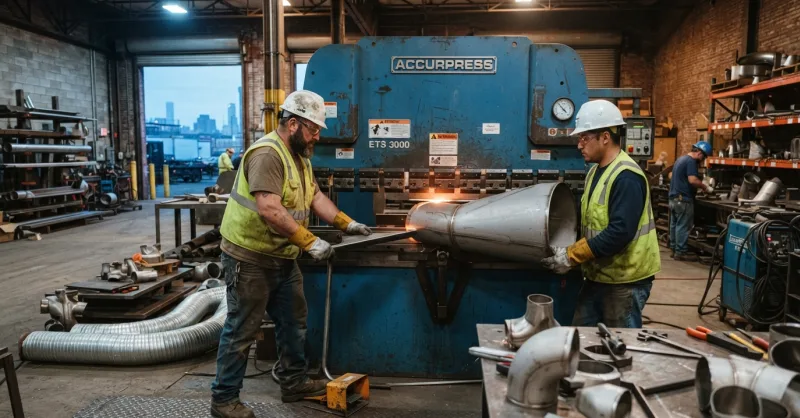
Our CNC plasma cutting and laser profiling produce transitions, offsets, plenums, and welded duct sections that follow the drawn exhaust route without field improvisation. The 250-ton Accurpress forms the heavier gauge work with repeatable bend geometry.
That capability matters most in retrofit conditions, where an exhaust run has to thread around existing structure and connect to equipment with uncertain dimensions. Custom geometry requires accurate field dimensions and revision coordination up front, which eliminates the rework standard sections force on site.
Every section we form follows SMACNA fabrication practices and the applicable mechanical subcode. Fit-up tolerances, reinforcement spacing, and weld quality are not negotiable line items on a bid sheet.
Here is the friction point: if the field dimensions arrive wrong, CNC precision just cuts the wrong part faster. I would rather hold a release for a verified dimension than ship a beautiful transition that misses by two inches.
Compliance starts with the process and hazard, then moves to whether NFPA 91 applies to that specific system. Mechanical code compliance and the applicable mechanical subcode follow, and the design team establishes whether separate environmental permits or approvals are required.
A fabricator does not certify a complete system or secure project permits. Those responsibilities stay with the design team, installing contractor, and authority having jurisdiction. Air balancing is a downstream commissioning step coordinated with the installing contractor after installation.
Before releasing fabrication, confirm the conveyed material and hazard, design airflow and pressure requirements, duct route and access, specified material and gauge, joining and support details, and applicable code and permit requirements.
Blueprint ingestion and digital take-offs sit at the front of every release we run. We read the current revision, quantify the scope, and flag the gaps before a single sheet gets cut.
Fabrication can then ship bundled with requested supports, sealants, hanging hardware, and consumables, subject to project scope and availability. That replaces the fragmented sourcing that leaves a superintendent chasing hangers from three vendors while the duct sits on the truck.
Phased release capability keeps schedule-critical fit-outs moving, and qualified accounts can work against Net-30/60 credit terms sized to multi-phase commercial construction.
Kearny-based account coordination aligns fabrication releases with Hudson County site access, crew sequencing, and crane-hoist availability. The 6:00 AM on-deck delivery window exists because that is when a Jersey City street can still take a truck.
Realistic constraints govern the plan. Loading restrictions, limited laydown area, and the simple fact that a delivery truck cannot wait on site all shape when a release leaves our floor. Route and delivery timing through Kearny, the NJ Turnpike approaches, the Jersey City Waterfront, and NYC Five Boroughs coordination are project-specific, never guaranteed for every site.
I have staged enough failed deliveries to know that a truck circling the block burns more money than a well-planned early release ever will.
A commercial mechanical contractor managing an industrial tenant fit-out near Kearny, with constrained rooftop and loading access, brought us a package that had stalled in the field. The drawn exhaust route did not match existing structure, connection dimensions were uncertain, and the airstream and corrosion exposure still awaited design team confirmation.
Code and NFPA 91 scope were unresolved as well, and nobody had settled whether separate environmental approvals applied. That is a package that cannot be fabricated responsibly, only reviewed.
We received the current drawings and take-off, coordinated revisions with the contractor, and fabricated the approved transitions and duct sections in the specified corrosion-resistant steel. CNC cutting and forming carried the custom geometry, and hardware and supports were bundled as scoped.
The contractor retained responsibility for system design, installation, required approvals, and commissioning, with air balancing planned after installation. Delivery was scheduled to the approved receiving window and crew sequence, accounting for loading restrictions and crane-hoist availability rather than assuming a truck could idle on site.
Documented schedule variance stays with the contractor’s records. What I can state plainly is that the release moved once the dimensions and scope were settled, not before.
Scope clarity, constructability, and field coordination carry more weight than any promotional claim I could make about our shop. Code applicability and permitting must be verified for each project, system hazard, and local authority having jurisdiction.
Four pathways cover most of what contractors bring us:
Our shop sits at Kearny, NJ, close enough to most Hudson County sites that a scope conversation and a site walk can happen in the same morning. Start with the drawings at hvacmetals.com and we will tell you what the package actually needs.
Written by: Arthur Dabrowski
Owner & CEO, HVAC Metals, LLC (Kearny, NJ)
(201) 991-2206