 CALL NOW
Catalog spiral lockseam duct and a fabricated dust collection manifold are not the same procurement category, and treating them as interchangeable is where Hudson County schedules start bleeding money. A supply house sells you straight runs and standard fittings from inventory. A manifold is a geometry problem: branch spacing driven by process equipment, custom transitions, cleanout access, and a connection schedule that has to reconcile with what is actually bolted to the floor.
I have watched contractors try to assemble a manifold out of stock tees because the lead time looked shorter. The field crew then spends two days cutting and welding abrasion-resistant steel in a space with no ventilation and no overhead clearance, which is the worst possible place to do precision work.
We fabricate to approved documents. That boundary matters. Your engineer owns the system design, the hazard analysis, and the code applicability determination. We own the cut geometry, the forming, the match-marking, and the delivery sequence. IMC Section 511, NFPA 652, and NFPA 664 get logged as review entities on our package, but the adopted editions and interpretations belong to the project engineer and the AHJ.
Before we release anything to the shop floor, the package needs the current approved drawing set or CAD/BIM files, equipment and branch connection coordinates, specified material and thickness, cleanout and access locations, finish requirements, and the installation sequence. Missing any one of those stalls the take-off.
Estimating starts at the connection schedule, not the overall plan sheet. We ingest PDF, CAD, and BIM files and reconcile branch dimensions against equipment cut sheets before a single plate gets nested. Our stated estimating window runs 4 to 24 hours, conditioned on document completeness and scope clarity.
The packages that stall almost always share the same gaps: undefined material thickness, branch coordinates that conflict with the structural drawings, and cleanout locations nobody resolved. Jersey City and Kearny teams submitting incomplete sets get a call, not a guess.
Material selection drives everything downstream, and the engineer’s specification governs. We process abrasion-resistant steel, galvanized G90, 304 and 316 stainless, aluminum, PCD, and galvanneal, but we do not substitute without written approval. A vendor who swaps alloy because the mill is out of stock is transferring risk onto your inspection.
Abrasion allowance trades directly against weldability and coating integrity. Thicker plate buys service life but complicates fit-up on tight-radius transitions, and heat input during welding can compromise a galvanized coating if the shop does not control it. Conductive bonding and grounding coordination, where the system design requires it, has to be planned before fabrication, not drilled in afterward.
Combustible dust control assumptions stay with the responsible engineer. Our job is to fabricate the specified geometry in the specified alloy so those assumptions have a physical system to attach to.
| Material | Typical Manifold Service Condition | Fabrication Consideration | Coordination Note |
|---|---|---|---|
| Abrasion-resistant steel | High-particulate process streams | Harder cutting and forming; controlled weld procedure | Confirm thickness against engineer’s wear allowance |
| Galvanized G90 | General industrial exhaust | Weld zones require coating repair | Verify field touch-up responsibility |
| 304 / 316 stainless | Corrosive or cleanroom-adjacent service | Dedicated tooling to prevent cross-contamination | Confirm surface finish requirements |
| Aluminum | Lightweight runs with moderate duty | Lower forming loads; galling risk on tight bends | Confirm support spacing with engineer |
| PCD / Galvanneal | Paint-ready or specific finish systems | Handling care to protect surface | Confirm finish sequence before dispatch |
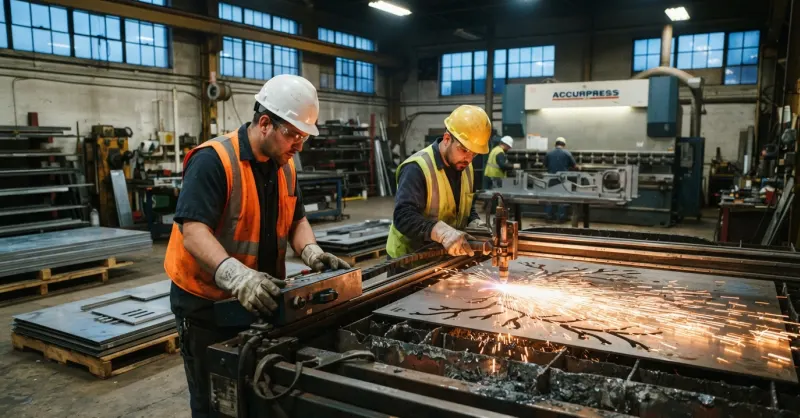
Branch cutouts, custom transitions, and gusset geometry get profiled on our CNC plasma and laser tables, which holds the cut line to the drawing instead of to a field measurement taken at seven in the morning. That precision is what eliminates field re-cutting of abrasion-resistant or galvanized components, and it is the single biggest labor saver on a manifold package.
Forming runs on the 250-ton Accurpress. Specified plates and fittings get broken to the approved bend lines, and every component is match-marked so the crew on the roof knows exactly where each piece lands in the sequence. I have seen unmarked manifolds turn a two-day install into a four-day puzzle.
The spiral lockseam duct interface is a coordinated connection detail built to approved drawings, not a joint the installer improvises on the deck. We document that interface in the fabrication package so the field connection matches the shop geometry.
Shop-controlled fit-up tolerances reduce the field modification risk that drives inspection rejections. When a branch lands where the drawing says it lands, the air-balance verification and leak checks have a fighting chance of passing on the first walk.
Every fabrication package we release carries a log of the review entities the project team flagged: IMC Section 511, NFPA 652, NFPA 664, combustible dust control provisions, and bonding and grounding coordination where the design requires it. That log is a coordination tool, not a certification.
Hazard analysis, code applicability, adopted editions, and life-safety approval rest with the qualified design professionals and the AHJ. We fabricate to released documents. A citation on a drawing does not establish compliance on its own, and any fabricator who tells you otherwise is overstepping.
Our in-house fleet runs early-bird drops with 6:00 AM on-deck coordination, subject to scheduling and site access. That window exists because a crane sitting idle at $120 per hour while the crew waits on a truck is a cost nobody budgets for and everybody pays.
Routing through the NJ Turnpike, I-80, and the Kearny industrial hub into Jersey City Waterfront sites is planning context, not a guaranteed transit time. Congestion, construction closures, and unloading-area clearance all move the number, so we treat the route as a variable and the delivery window as a commitment we confirm with site supervision.
Installation hardware gets bundled from our facility so fasteners and sealants arrive with the manifold instead of in a separate shipment three days later. Crane or hoist availability, staging space, and crew readiness have to be resolved before dispatch. I will hold a truck rather than drop steel into a site that cannot receive it.
A commercial mechanical contractor coordinating dust collection modifications at a Kearny industrial facility brought us a package during pre-fabrication review. The diagnostic surfaced three problems before any steel was cut:
We flagged IMC Section 511, NFPA 652, NFPA 664, combustible dust control, and the specified abrasion-resistant steel for confirmation by the responsible engineer and AHJ. Once approved geometry and material requirements came back, we reviewed the CAD and BIM files, prepared the take-off, and fabricated the specified manifold sections using CNC cutting and forming.
The coordination package addressed the specified spiral lockseam duct interface and documented the required connection details. It did not replace system design or hazard analysis, and we made that clear in writing.
Outcomes were framed as project objectives: reduced field modification risk, component deliveries aligned to the installation sequence, and an early drop coordinated with site supervision. Crane availability, delivery access, staging space, and crew readiness remained dependencies to resolve before dispatch. That is how a coordinated package should read.
The commercial pathway runs in three stages, and each one has a clear deliverable.
Enterprise buyers evaluating us should expect document control, material traceability, transparent exclusions, and dedicated account management. Credit terms are available where approved, which matters on multi-phase commercial work.
The regional risk checkpoint is the Hudson County schedule review: delivery window, unloading constraints, and installation sequence assessed together before we commit a production slot. Get that review done early and the rest of the project has room to breathe.
Written by: Arthur Dabrowski
Owner & CEO, HVAC Metals, LLC (Kearny, NJ)
(201) 991-2206