 CALL NOW
Last spring a Jersey City crew sat on a reserved hoist for two hours because a transition spool arrived with the wrong bolt pattern. That is a logistics failure dressed up as a fabrication problem, and it is exactly what a buildable duct package is designed to prevent.
For an EV battery plant in New Jersey, define the exhaust scope from approved process criteria, drawings, and the applicable code before release to fabrication. We review BIM/CAD files, coordinate specified 316L stainless steel components, and plan sequenced delivery; the engineer and AHJ confirm design and compliance.
The complete architecture runs from digital take-off through material and geometry coordination, CNC fabrication, and sequenced 6:00 AM delivery into Hudson County. Scope must be locked from issued-for-construction drawings and the adopted code before a single panel is cut.
I treat New Jersey Mechanical Code 2021, IMC Section 502, NFPA 704, hazardous exhaust systems, and flammability limit control as review terms. They are not fabrication certifications, and no shop in this region should present them as such.
Process stream chemistry, flammability limit control, and NFPA 704 hazard identification drive the design of hazardous exhaust systems in ways a stock supply house cannot resolve. 316L stainless steel is a specified material where the design calls for it, never an automatic suitability claim for every stream.
The design team must confirm stream chemistry, temperature, code basis, and safety controls before we review material compatibility against the process exhaust specification. Fabrication follows that confirmation, and it does not replace it.
New Jersey has adopted the IMC as its Mechanical Subcode with state amendments, which means the applicable edition must be verified against the permit before anyone quotes a duct package. Hazardous-exhaust provisions including IMC Sections 502 and 510 get checked with the project engineer and local officials, not assumed from a prior job.
NFPA 704 and flammability limit control belong to process-safety and design coordination, owned by qualified professionals. When a vendor blurs product supply with code or safety assurances, the contractor inherits the exposure at inspection.
Hudson County AHJ coordination for Kearny and Jersey City industrial facilities runs through the local construction official, and interpretations vary by municipality. I have watched a submittal stall for three weeks over a fire-rating detail that nobody flagged at bid time.
Map each entity to its correct owner before release:
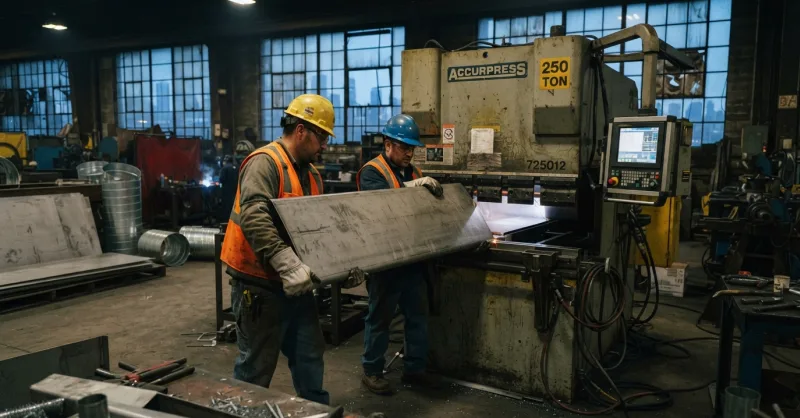
The 250-ton Accurpress forms project-defined fittings and transitions once the geometry is settled, and welded stainless assemblies go out only where detailed and approved by the design team. Material compatibility review runs against the process exhaust specification, line by line.
CNC laser profiling handles approved duct panels and fittings with repeatable edge quality, while CNC plasma cutting serves heavier project-defined components. Geometry coordination closes drawing revisions before release, which is where most field-fit risk actually gets eliminated.
| Evaluation area | Generic Supply House / Spot-Market Vendor | HVAC Metals CNC & Logistics Architecture |
|---|---|---|
| Hazardous-exhaust scope | May quote stock duct without resolving process-specific drawings or material requirements | Reviews the approved scope, geometry, and specified material, including 316L stainless steel where the design calls for it |
| Code and safety coordination | May blur product supply with code or process-safety assurances | Identifies New Jersey Mechanical Code 2021 and IMC Section 502 as review terms; treats NFPA 704 and flammability limit control as safety/design coordination matters, not fabrication certifications |
| Custom fabrication | Standard catalog components may require field adaptation | CNC laser/plasma cutting and Accurpress forming support project-defined fittings and transitions |
| Site delivery | Delivery timing and bundled items may require separate coordination | Dedicated account management can coordinate hardware, sequencing, and early delivery planning for Hudson County access and hoisting constraints |
The first two rows carry the real risk. A vendor who quotes stock duct against a process-specific drawing leaves the contractor holding a material question that should have died at bid time.
Rows three and four decide whether the package installs cleanly. Custom forming and coordinated delivery remove field adaptation, which is where labor hours quietly disappear.
Late equipment connection revisions and incomplete process exhaust schedules dominate field-fit risk, and a 4-to-24-hour take-off turnaround protects bid deadlines for Hudson County packages. BIM/CAD drawing ingestion and digital take-off feed scope review against issued-for-construction drawings, then controlled fabrication revisions, then CNC release.
Release gate checks stay fixed: approved drawings, material callouts, connection dimensions, and revision status. Skip one and the shop cuts the wrong part.
Hudson County congestion, limited staging, security access, and coordinated hoisting windows shape delivery sequencing as much as fabrication does. The Kearny industrial hub and NJ Turnpike access give us a clean run to most sites, but the Lincoln Tunnel approach and Jersey City Waterfront corridors punish any truck that arrives outside its window.
Our in-house corporate fleet supports guaranteed 6:00 AM delivery on deck, aligned to reserved crane-hoist slots before the morning traffic thickens. Security check-in at waterfront facilities can eat forty minutes, so the schedule builds that in rather than discovering it at the gate.
My blunt opinion on staging: if the site plan shows no laydown area, the delivery plan has to become the laydown area. We sequence loads to the installation order so nothing sits exposed on a congested deck waiting for a crew that is not ready.
A mechanical contractor pricing an industrial facility package in Hudson County brought us in for fabrication coordination through Kearny, with deliveries planned around the NJ Turnpike corridor and a constrained Jersey City-area site. The pre-fabrication review surfaced the diagnostic problems fast.
Connection dimensions mismatched across drawing revisions, material callouts were unclear on two branches, and the delivery plan ignored both the limited staging and a scheduled hoist window. Those are scenario assumptions to validate against actual project documents, not asserted site findings.
The contractor’s engineer confirmed process criteria, material compatibility, code basis, and required safety controls. We then reviewed the released drawings and take-off, fabricated the specified assemblies using CNC processes, and coordinated the stated 316L stainless steel scope.
New Jersey Mechanical Code 2021, IMC Section 502 and applicable hazardous-exhaust provisions, NFPA 704, hazardous exhaust systems, and flammability limit control stayed inside coordinated project review, with code interpretation and safety design owned by qualified professionals and the AHJ.
A phased delivery plan matched site access and the reserved crane-hoist schedule, reducing avoidable handling and the risk of crews waiting on mis-sequenced components. Any schedule or labor benefit here is a target to measure, not a guaranteed outcome.
The applicable requirements depend on the adopted mechanical and fire codes, the exhaust process, and the AHJ interpretation. New Jersey has adopted the IMC as its Mechanical Subcode with state amendments, so the edition applicable to the permit must be verified and relevant hazardous-exhaust provisions including IMC Sections 502 and 510 reviewed with the project engineer and local officials.
Written by: Arthur Dabrowski
Owner & CEO, HVAC Metals, LLC (Kearny, NJ)
(201) 991-2206