 CALL NOW
The most expensive mistake I see on Hudson County chemical-plant projects starts before a single sheet is cut: a contractor hands us a drawing set with an NFPA 704 diamond in the corner and assumes the fabrication spec is settled. It is not. That diamond is a hazard-communication label for emergency responders, and it tells a fabricator nothing about alloy selection, seam integrity, or whether the exhaust stream will eat through a weld in eighteen months.
For Hudson County chemical-plant projects, hazardous exhaust duct fabrication starts with the process exhaust data, approved drawings, and applicable code review. Specify 316L stainless steel only after confirming chemical compatibility; detail welded duct joints to the project requirements, then coordinate fabrication, inspection records, and site delivery.
IMC Section 510 governs hazardous exhaust construction, but the adopted New Jersey edition and any local amendments require confirmation with the authority having jurisdiction before we detail a single joint. Corrosive fumes and flammable vapors are process data points that belong to the engineer’s hazard analysis, not to a shop-floor assumption. I have watched a mechanical contractor eat a six-figure rework bill because nobody resolved the stream chemistry before releasing the first spool to production.
My position is blunt: the fabricator owns geometry, material conformance, and weld execution. The design professional owns the hazard analysis and code interpretation. Blur those lines and the project stalls at the worst possible moment, usually mid-shutdown.
316L stainless steel is a candidate material, never a default. Chemical compatibility review has to trace four inputs across every duct section before we commit an alloy to the cut list.
A mid-production alloy change drags cost and schedule hard. Re-profiling flat stock, re-qualifying weld procedures, and re-cutting formed sections can push a release date by two to three weeks. Mismatched material on welded duct joints exposed to corrosive fumes shows up later as pitting at the heat-affected zone, and that failure lands on the contractor during warranty.
Welded duct joints get specified by the approved documents, and the submittal package carries the weld and inspection records that prove conformance. That means procedure qualification records, welder certifications, and any required nondestructive testing results travel with the fabrication release, not after the fact when the inspector shows up on a Tuesday morning.
Before we detail a single seam, the applicable IMC Section 510 edition and any local amendments have to be confirmed. New Jersey adopts code editions on its own cycle, and a detail that satisfied last cycle’s language may not satisfy the current one. I have seen contractors assume a seam is a commodity option, then discover the specification called for full-penetration welds on a section handling flammable vapors. That gap between assumption and specification is where joint integrity fails.
Flammable vapors and corrosive fumes drive joint construction because leakage in either service is a safety event, not a nuisance. NFPA 704 stays where it belongs: communication context for responders, not joint design authority. The design professional interprets the code, the AHJ confirms the edition, and we build to the approved detail.
Documentation discipline protects everyone. When a weld record is missing at inspection, the contractor absorbs the delay, the crane sits idle at $120 per hour, and the shutdown window compresses. Bundling those records into the submittal package eliminates that field scramble entirely.
Fabrication follows approved drawings, full stop. Our Kearny shop ingests BIM and CAD files, runs the take-off and submittal coordination, and flags missing dimensions or material callouts back to the contractor and engineer rather than resolving them unilaterally. That flagging discipline is the difference between a clean release and a field modification nobody budgeted.
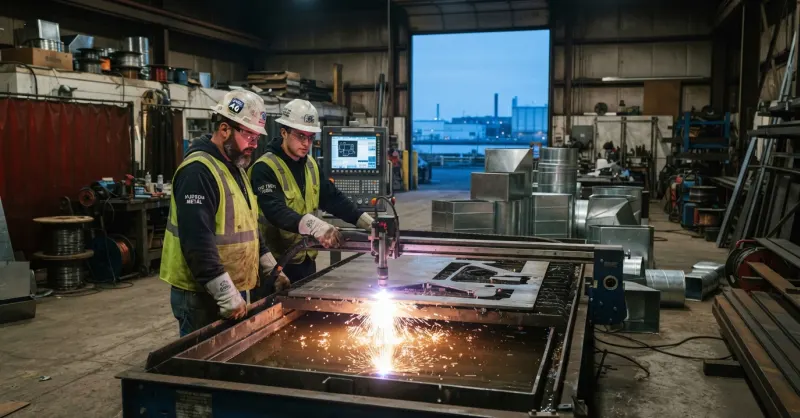
CNC laser profiling and CNC plasma cutting handle the approved geometry, and the 250-ton Accurpress forms sections to the specified bend allowances. Working 316L stainless steel demands tighter control than galvanized because the material work-hardens and springback runs higher, which forces us to dial forming parameters per gauge rather than running a generic setup.
The Kearny industrial hub gives us a production reality that matters to Hudson County contractors: we are minutes from the NJ Turnpike, which compresses the distance between a fabrication release and a Jersey City Waterfront receiving dock. When a drawing set arrives with unresolved callouts, we return the questions the same day instead of letting the job sit in a hold queue.
I keep a personal rule on the floor: no spool leaves the shop without a material identification tag matching the approved submittal. That habit came from a project years ago where a mixed stainless load nearly reached a chemical facility, and I have never let it happen since.
A receiving window that collides with planned crane-hoist activity is the logistics failure mode that quietly kills shutdown schedules. Sequenced early-morning delivery planning has to account for these constraints before the truck rolls.
A delivery time does not override site access or traffic conditions, and I tell every contractor that plainly. We plan the 6:00 AM delivery window and confirm truck access and offloading in advance, but the site controls the gate.
The gap between a spot-market quote and a coordinated fabrication scope shows up in the details that decide whether a hazardous-exhaust project runs clean.
| Evaluation area | Generic Supply House / Spot-Market Vendor | HVAC Metals CNC & Logistics Architecture |
|---|---|---|
| Hazardous-exhaust scope | May quote from a generic duct schedule without resolving process-stream assumptions. | Builds the estimate around approved drawings and stated exhaust conditions; flags missing information for contractor and engineer review. |
| Material and joint coordination | May treat stainless selection and seams as commodity options. | Quotes specified 316L stainless steel and welded duct joints when required by approved project documents; does not substitute material or joint design without authorization. |
| Code and hazard context | May conflate a hazard label with construction requirements. | Distinguishes NFPA 704 hazard communication from IMC Section 510 requirements and calls for confirmation of the applicable New Jersey code edition and amendments. |
| Hudson County execution | May leave packaging, sequencing, hardware, and site timing to the field team. | Coordinates CNC fabrication, bundled procurement, delivery sequencing, and receiving details for Kearny and Hudson County sites, subject to access and schedule confirmation. |
Each row ties back to approved drawings and stated exhaust conditions. We do not overstate capability beyond fabrication and logistics execution.
Consider an illustrative scenario, not a verified customer project: a mechanical contractor upgrading a process exhaust system at an industrial facility in Kearny, with project management based in Hudson County and equipment access coordinated around the NJ Turnpike corridor. During pre-fabrication coordination, the team identified conflicting duct dimensions between the field routing and the drawing set, unspecified chemical constituents for a section exposed to corrosive fumes, and a receiving window that overlapped planned crane-hoist activity. These are scenario assumptions for the case-study framework, not claims about a particular site.
The engineered rebuild started with the contractor’s engineer and facility team confirming process data, material compatibility, the design basis, and applicable code requirements. HVAC Metals received coordinated CAD and BIM files, estimated and CNC-profiled the approved geometry, and fabricated specified 316L stainless steel sections with welded duct joints where the approved documents required them.
Throughout that coordination, the narrative kept NFPA 704 hazard communication distinct from IMC Section 510 construction provisions, and we documented open questions for the responsible design team rather than resolving them in the shop. That discipline is what keeps a fabrication release defensible when the inspector reviews the submittal.
On the logistics side, the contractor sequenced labeled duct sections and installation hardware to the agreed receiving window, confirmed truck access and offloading arrangements, and avoided scheduling arrival during the crane-hoist conflict. Outcomes here are project-specific targets, such as fewer field modifications or reduced handling, not guaranteed results.
The regional competitive risk I see most often is a contractor committing to a shutdown or hoist window before drawing readiness, material availability, site access, and schedule dependencies are reviewed. That commitment gets made in a planning meeting, and the consequences land on the shop floor and the receiving dock weeks later.
The Kearny-to-Hudson County production and delivery feasibility review is the decision gate. We check whether the drawings are ready for release, whether the specified alloy is available in the required gauge, whether site access supports the planned delivery sequence, and whether the schedule dependencies hold together. If any of those fail, we say so before the shutdown date is locked.
Code interpretation rests with the design professional and the authority having jurisdiction. HVAC Metals owns fabrication and logistics execution, and we execute against approved documents with documented material identification and weld records. That division of responsibility is what keeps a chemical-plant exhaust project on schedule and defensible at inspection.
If you are weighing a shutdown window, send the drawings and scope notes for a take-off before you commit. Reach our Kearny shop through the HVAC Metals contact page, or review our fabrication capabilities to see how the production and delivery layers fit together.
Written by: Arthur Dabrowski
Owner & CEO, HVAC Metals, LLC (Kearny, NJ)
(201) 991-2206