 CALL NOW
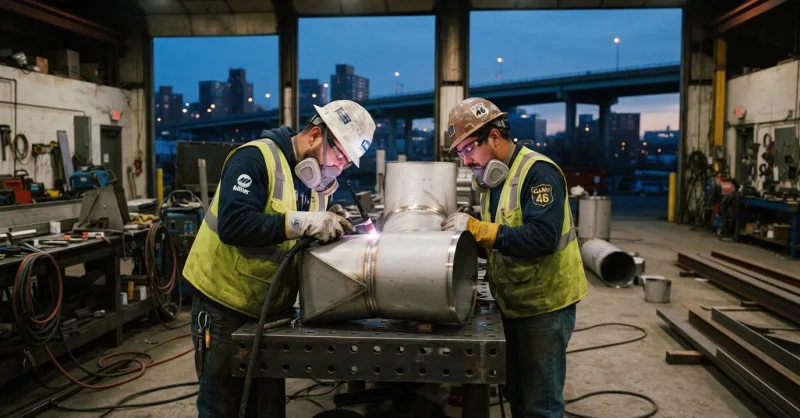
A 16-gauge 316L stainless transition arrived at a Hudson County deck last spring with a seam detail that matched nothing on the approved drawing. The vendor had quoted from stock availability, not from the process chemistry basis, and the field crew spent the next day grinding and re-welding at elevation while the hoist sat idle.
That failure pattern repeats across the Route 287 corridor. A six-person mechanical crew standing by at $120 to $165 per hour burns $720 to $990 per hour of dead labor, and a missed four-hour loading window stacks crane standby charges on top of it. Field adaptation of stainless transitions runs 12 to 24 man-hours per fitting cluster once you factor re-fabrication lead time and failed leakage verification.
The resolution is architectural, not heroic. Engineer-approved drawings get translated into CNC-profiled geometry with acid-resistant duct seams, reconciled against NJ UCC and NFPA 91 checkpoints before any cutting begins, then released on a Kearny-planned early window. Design approval and code interpretation stay with the engineer of record and the authority having jurisdiction throughout.
Exhaust chemistry drives the specification, and nothing else does. Electrolyte solvent vapors, fluoride-bearing off-gases, and thermal cycling from pilot-line equipment each push the alloy and joint detail in different directions, which is why 316L stainless steel and acid-resistant duct seams are project-specific choices rather than universal corrosion claims.
Four inputs must be resolved before material release:
SMACNA leakage class functions as a project specification to be confirmed against the design documents. It never substitutes for hazardous-exhaust code requirements, and conflating the two creates submittal rejections that cost weeks.
NFPA 70 electrical interfaces matter more than most fabricators admit. Exhaust fan disconnects, sensor penetrations, and interlock conduit often land within the duct routing envelope, and a fabrication release that ignores those clearances forces field offsets nobody priced. I keep a marked-up electrical coordination sheet pinned above my estimating desk for exactly this reason.
NJ UCC applicability and NFPA 91 requirements get reconciled at the same checkpoint. Once chemistry, temperature, cleaning, and electrical coordination align with the approved drawings, the package is ready to cut.
Regional supply houses quote what sits on the shelf. That works for 24-gauge galvanized general ventilation and fails badly on hazardous-process exhaust, where the alloy, seam detail, and joint finish are the entire point of the specification.
| Project requirement | Generic Supply House / Spot-Market Vendor | HVAC Metals CNC & Logistics Architecture |
|---|---|---|
| Battery-exhaust material coordination | May quote available stock without resolving process-specific chemistry or joint requirements. | Coordinates the specified 316L stainless steel, acid-resistant duct seams, and fabrication details against engineer-approved documents; material suitability remains a design-team decision. |
| Code and specification handoff | May treat general duct availability as sufficient for a hazardous-exhaust application. | Uses NJ UCC, NFPA 91, NFPA 70, and the specified SMACNA leakage class as coordination checkpoints, without representing fabrication as code approval. |
| Custom transitions and fabrication | Standard fittings may require field adaptation around shafts, equipment, or existing services. | CNC plasma/laser profiling and high-capacity forming support project-specific transitions, offsets, and custom geometries from approved drawings. |
| Hudson County / Route 287 delivery coordination | Delivery may be scheduled independently of site access or installation sequencing. | Kearny-based account coordination can bundle duct and hardware and plan an early delivery window around the contractor’s access, hoist, and laydown constraints. |
Third-party carriers compound the problem. A driver who has never seen a Jersey City Waterfront loading dock will not know that the freight elevator books at 7:00 AM sharp, and the crew eats that delay.
BIM and CAD files hit our estimating desk and turn around in 4 to 24 hours depending on drawing completeness and schedule pressure. That window covers take-off, material reconciliation against the specification, and a scoped fabrication estimate the project executive can actually bid against.
From there the work moves to CNC plasma and laser profiling, where custom transitions and offsets get cut to the coordinated geometry rather than adapted in the field. Our 250-ton Accurpress forms the heavier stainless sections and the tight-radius offsets that congested shafts demand, and welded or finished joints follow the engineer’s specification exactly.
The agile toggle matters here. A multi-phase laboratory fit-out might run hundreds of linear feet of straight duct alongside a dozen one-off stainless fittings, and we switch between those production modes without re-quoting the job. Short-run emergency replacements slot into the same queue because the machinery and the crew are already set up for stainless.
Supports and installation hardware get bundled with the duct where the specification calls for it, and every section carries a sequence label keyed to the approved layout. Fabrication executes the approved package. It does not constitute code approval, and I tell every contractor that plainly on the first call.
Traceable material documentation travels with the release as required by contract, which keeps submittal review clean and inspection predictable.
Three scheduling systems rarely talk to each other: estimating, fabrication, and the field installation calendar. A Route 287 project can have its drawings coordinated through a Hudson County contractor, its duct cut in Kearny, and its field crew sequenced by a construction manager working a completely separate schedule.
Routing along the NJ Turnpike and I-80 shapes the delivery plan as a planning consideration, not a guaranteed travel time. Traffic on the approach into Jersey City or the Waterfront changes hour to hour, so we build the window with margin rather than promising a precise arrival.
Our in-house fleet runs a 6:00 AM on-deck delivery that decouples material arrival from the crew’s billable start. Duct and bundled hardware land before the hoist operator clocks in, which eliminates the standby charge that accumulates when a truck shows up at 9:15 and the crane has been sitting since seven.
Jersey City Waterfront and NYC Five Boroughs constraints stay project-specific: curb access, loading restrictions, hoist windows, and limited laydown space all get confirmed with the site logistics lead before dispatch. For a broader view of how we sequence commercial work, see our capabilities overview.
An illustrative scenario, not a claim about a completed HVAC Metals project, shows the coordination pattern clearly. A commercial mechanical contractor was fitting out a battery research laboratory for a Route 287-area client, with estimating and fabrication running through Kearny and installation handled by a Hudson County field team.
During coordination, three problems surfaced at once. Exhaust chemistry assumptions remained unresolved, the specified duct material did not match the process basis the engineer had described, and the shaft access was tight enough that standard fittings would need field adaptation. The delivery plan also conflicted with a constrained loading area and a scheduled crane-hoist window.
The engineer of record confirmed process conditions, material compatibility, exhaust routing, and applicable requirements. HVAC Metals then priced and fabricated to the approved package, coordinating NJ UCC and NFPA 91 requirements, NFPA 70 interfaces, the specified 316L stainless steel, acid-resistant duct seams, and the project’s SMACNA leakage class.
CNC-cut transitions were checked against the coordinated geometry before cutting, and supports and installation hardware were bundled where specified. Sequenced, clearly identified duct sections were scheduled for a site-approved delivery window, subject to access confirmation and traffic conditions on the approach from Kearny.
The contractor coordinated unloading with the hoist operator and field foreperson. The intended outcome was less avoidable handling and field modification, not a guaranteed schedule or code-compliance result. That distinction matters when the project executive signs the release.
Confirm the engineer-approved exhaust design first. Every downstream decision depends on that document being current and complete.
Traceable material documentation should be confirmed as required by contract, and submittal coordination discipline keeps the release gate honest. This is a contractor’s verification path, not engineering approval by the fabricator.
Three engagement tiers cover the full project arc:
Before committing to a Route 287-to-Hudson County installation sequence, compare the cost of late material decisions, constrained staging, and field rework against an early drawing and logistics review with our Kearny team. Our custom metal fabrication services handle the full range, and Net-30/60 corporate credit programs suit multi-phase commercial work.
Our shop sits at Kearny, New Jersey, which keeps the coordination loop short when a submittal question lands at four in the afternoon.
Written by: Arthur Dabrowski
Owner & CEO, HVAC Metals, LLC (Kearny, NJ)
(201) 991-2206