
 CALL NOW
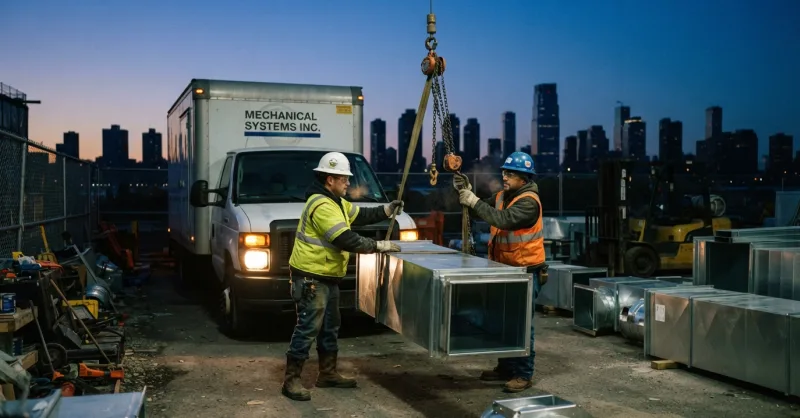
An 18-gauge G90 rectangular duct section weighs what it weighs, and no dispatch sheet changes that. What a dispatch sheet can change is whether your crew stands idle at 6:40 AM because the loading dock gate was locked and nobody from the site team answered the phone.
I run our Kearny shop off Fish House Road, and I have watched too many contractors treat early morning delivery as a freight transaction: call a vendor, get a window, hope for the best. That model fails in Hudson County because the constraint is never the truck. The constraint is site readiness, curb geometry, hoist scheduling, and whether the duct package matches the zone your foreman is actually working that morning.
So we built the operation around a different premise. Early morning delivery in Kearny works as a coordinated construction input spanning digital take-off, construction phasing, prefabricated ductwork fabrication, and confirmed Hudson County access. Our in-house fleet and 6:00 AM delivery capability are real, stated capabilities. They are not a promise that overrides site restrictions, and I will not let an account manager sell it that way.
Jobsite staging, just-in-time logistics, and construction phasing have to line up before a single truck rolls. When they do, your crews start installing at the top of the shift instead of sorting fittings in a loading zone. When they do not, you pay for crane standby and idle labor, and the delivery gets blamed for a planning gap.
Package sequencing starts with the approved take-off, not the truck schedule. Our estimators ingest your drawings and phased material list, then our production team sequences prefabricated ductwork by floor and installation zone against your construction phasing. A package that arrives before its zone is ready is not early. It is in the way.
The fabrication layer is what makes that sequencing possible. We cut SMACNA-aligned rectangular duct sections on automated CNC plasma and laser tables, form transitions on a 250-ton Accurpress brake, and hold bend allowances tight enough that field modifications stay rare. When a fitting leaves our shop matched to its drawing, your sheet metal foreman spends his morning hanging duct instead of re-cutting it.
Here is where generic supply houses diverge from a fabrication shop. Stock items carry limited coordination to construction phasing, which means the vendor ships what is on the shelf and your superintendent absorbs the mismatch on site. We build to the phase, so the package that lands on Tuesday morning is the package your crew installs on Tuesday.
Before we release anything to production, four inputs have to be locked:
That last item matters more than most estimators expect. A duct package without its hanging hardware forces a second purchase order and a second delivery, and the second delivery is the one that shows up late.
A 2-inch static pressure duct run does not care about the Newark-Jersey City Turnpike, but the truck carrying it does. Hudson County access is a practical constraint we confirm per delivery: truck approach, bridge and roadway restrictions, curb availability, loading-dock rules, site security, and hoist schedules all get checked before dispatch.
Our Kearny base sits close to NJ Turnpike and I-280 access, which helps, but proximity is not the same as permission. Corridors like Harrison Avenue, Fish House Road, and Pennsylvania Avenue carry their own curb conditions and delivery-management realities. Hudson County trucking study materials flag local freight and delivery concerns in these areas as planning context. I treat that as a reason to verify, never as proof of what a specific site will allow.
Kearny’s commercial-vehicle ordinance restricts street parking from 7:00 PM to 6:00 AM, with a service-related exception described in the ordinance. That exception is not blanket permission to park or unload. If your delivery plan depends on curbside staging, we confirm the applicable rules and your site arrangements before the truck leaves the yard.
This is where the comparison between a spot-market vendor and a coordinated fabrication shop becomes concrete:
| Delivery factor | Generic Supply House / Spot-Market Vendor | HVAC Metals CNC & Logistics Architecture |
|---|---|---|
| Package readiness | May supply stock items with limited coordination to construction phasing | Can coordinate prefabricated ductwork packages with drawings, phases, and installation zones |
| Timing and staging | Delivery window may be broad; jobsite staging is left largely to the contractor | Early morning delivery can be planned around confirmed site access, unloading, and staging needs |
| Procurement | Duct and installation hardware may require separate purchasing and coordination | One-stop procurement can bundle ductwork with requested hardware and related materials |
| Local execution | Hudson County access details may fall to the project team | Kearny-based coordination can account for Hudson County access constraints and route checks |
I have had drivers sit on Harrison Avenue for forty minutes because a gate code changed and nobody updated the delivery instructions. That is not a trucking failure. That is an information failure, and it costs the same as a fabrication error.
A 6:00 AM arrival only works if the site can receive material at 6:00 AM. We plan dispatch against the site’s approved access, unloading arrangement, and crane-hoist window, so crews can stage materials before installation begins rather than waiting on a dock that opens at seven.
Jobsite staging is where constrained urban projects live or die. Limited laydown space, phased work areas, and floor-by-floor zone staging mean a mixed package arriving before its zone is ready can obstruct access and stall the whole morning. Just-in-time logistics and construction phasing are the operational logic that prevents idle labor and avoidable handling, and they only function when the superintendent and our account manager are working from the same sequence.
Before we schedule any early delivery, the contractor needs to confirm:
An early delivery time does not itself authorize street parking or unloading. I would rather hold a truck at our dock for twenty minutes than send it into a curb situation that ties up your site and draws a summons.
One purchase order beats three. We bundle prefabricated ductwork with requested hanging hardware, sealants, and related installation materials into a single release, which removes the separate purchasing coordination that generic vendors leave on the contractor’s desk.
Material selection runs alongside that bundling. Galvanized G90 sheet covers most commercial work, cleanroom-grade 304 and 316 stainless steel handle the corrosive and sanitary environments, and aluminum and galvanneal fill out the rest of the specification range. Documented material specs ship with the package, so your project manager can close out submittals without chasing certificates.
SMACNA requirements apply to the specified fabrication, meaning gauge, reinforcement, and seam details are built to the standard your drawings call out. Delivery timing does not establish code compliance. Those are separate workstreams, and I keep them separate on purpose, because a truck arriving at 6:00 AM says nothing about whether the duct meets the specified pressure class.
Dedicated account management and scalable production are the enterprise criteria that hold this together across a multi-phase job. Your account manager knows the phase schedule, the hardware list, and the site contact, and our shop can toggle between a high-volume multi-phase run and an emergency short-run without resetting the whole production calendar.
A commercial mechanical contractor on a multi-phase office project near the Jersey City Waterfront came to us with a sequencing problem, not a fabrication problem. Their initial plan sent mixed duct packages to a constrained site before the installation zones were ready. Limited laydown space and a scheduled morning hoist created a real risk of obstructed access and crew waiting, and the superintendent was already losing sleep over it.
We diagnosed the gap quickly. The packages were built correctly but released in the wrong order, and the delivery instructions were incomplete enough that the truck approach and unloading permissions had never been confirmed against the site’s actual conditions. Hudson County trucking study materials identify local freight and delivery-management concerns around Kearny and Harrison, which we used as planning context for the route check, not as proof of a specific restriction on this project.
The rebuild started with the approved take-off. We sequenced prefabricated ductwork by floor and installation phase, bundled the requested hardware with each package, and had the account manager coordinate early morning delivery, jobsite staging, and just-in-time logistics directly with the superintendent. Hudson County access, truck approach, unloading permissions, and the hoist slot all got confirmed before each dispatch, and SMACNA requirements were applied to the specified fabrication without any implication that delivery timing established code compliance.
What the site team got was a clearer opportunity to receive material before the crew’s work window, which reduced avoidable handling. I will not tell you the project ran with zero delays, because it did not. The crane hoist got rescheduled twice, one access change forced a re-route, and delivery variance showed up on a package that arrived forty minutes behind plan. The sequence absorbed those events instead of collapsing under them, and that is the honest measure of a logistics plan.
The next phase starts with drawings, not a phone call to a dispatcher. Send your Kearny or Hudson County HVAC drawings for a phased ductwork take-off and delivery-plan review, and we will map the package sequence against your construction phasing before anything goes to production.
If the specification is still open, review duct specifications, material selections, and SMACNA requirements with an account manager before release. Getting the gauge and pressure class right at that stage costs nothing. Getting them wrong costs a re-fabrication cycle and a schedule slip.
When you are ready to deploy, request a fabrication and early-morning delivery plan covering package sequence, site access, unloading, and jobsite staging. Before the next Jersey City or Hudson County installation phase, check truck access, receiving readiness, and hoist timing against your proposed 6 AM delivery. And keep one rule in front of the whole team: an early delivery time does not itself authorize street parking or unloading.
Four pathways, depending on where you sit in the cycle:
Our shop is at HVAC Metals, LLC, Kearny, NJ, and the fleet rolls early. Bring us the drawings and the phase schedule, and we will build the sequence around them. Learn more about how we operate and our fabrication capabilities.
Written by: Arthur Dabrowski
Owner & CEO, HVAC Metals, LLC (Kearny, NJ)
(201) 991-2206