
 CALL NOW
Short version: more than most fabricators are set up to deliver. New Jersey’s building stock runs the full spectrum, from pre-war brick walk-ups in Jersey City’s Journal Square to sprawling pharmaceutical campuses in Middlesex County, and the ductwork specs shift dramatically depending on which project you’re standing in front of. After more than a decade of running CNC fabrication lines out of our shop at 181-183 Garfield Ave, Kearny, NJ 07032, I’ve watched mechanical contractors get squeezed from every angle, tight job site windows, code-dense municipal inspectors, and material deliveries that show up at 10:00 AM when the crew clocked in at 7:00.
That gap between what contractors need and what the broader market delivers is exactly the friction HVAC Metals, LLC was built to eliminate.
If you’re managing a retrofit in a 1930s brownstone in Newark’s Ironbound neighborhood, you already know what I’m talking about. Ceiling cavities that measure 3 inches on the architectural drawing but 2.5 inches in reality. Plaster walls that crumble if you look at them wrong. And every municipal inspector in Essex County seemingly running a different interpretation of the state fire code for damper placement in multi-story residential.
That’s not an exaggeration. I’ve seen a project on Chestnut Street in Newark get kicked back twice because the flex connector spec didn’t align with the city’s adopted version of SMACNA standards. The contractor lost almost four days of scheduling. The ductwork itself wasn’t wrong, the paperwork trail was just incomplete.
What does this mean practically? New Jersey’s dense urban corridors require fabricators who build to exact spec, not “close enough for field adjustment.” When our team processes a take-off at the Kearny facility, blueprint dimensions are treated as absolute law. If your trunk line has to navigate a 48-inch ceiling cavity through a Hudson County mixed-use building, we’re fabricating to that tolerance, not adding an eighth of an inch of assumed field margin.
(Most shops won’t tell you that “standard” tolerances are really just code for “your crew figures it out on the deck.” That labor cost lands on you.)
New Jersey’s climate creates a genuine selection problem for mechanical contractors. North Jersey summers run humid and sticky. Coastal jobs from Monmouth County down through Cape May deal with salt-laden air year-round. A galvanized duct system that performs perfectly in a Bergen County office building might start corroding within 18 months on a rooftop unit in Asbury Park.
At our facility, we process:
Choosing wrong here isn’t a minor spec error. It’s a warranty claim, a callback, and a conversation you don’t want to have with a facilities manager in six months.
What HVAC ductwork material should New Jersey contractors specify for commercial kitchen exhaust systems? For commercial kitchen exhaust in NJ, heavy-gauge stainless steel is the standard. Grease exhaust systems in food-service environments face extreme thermal cycling and grease accumulation. Stainless resists corrosion, tolerates high-temperature exposure, and satisfies most municipal health and fire code requirements across the state. Standard galvanized steel is not appropriate for this application. You can read more about how top contractors select commercial ductwork materials for different project environments.
Look, a lot of fabricators will tell you they run precision CNC equipment. Fewer will tell you what that actually means in production context.
At HVAC Metals, we run automated CNC plasma cutting tables alongside CNC laser profiling for complex geometries. For bending and shearing, we operate a 250-ton Accurpress system with capacity up to 1/4-inch material thickness at 10-foot lengths. That’s not a flex, it’s a capability statement. It means when a mechanical contractor in Trenton sends us architectural files for a multi-zone commercial retrofit, we can ingest that take-off digitally and return a fabrication-ready estimate within 4 to 24 hours.
Older shops using manual take-off workflows and analog measuring are taking 3 to 5 business days to return a quote. By the time you get their number, you’ve potentially already missed the bid window. That’s not a knock on anyone personally, it’s just a structural problem with shops that haven’t updated their estimating infrastructure.
A lot of contractors default to rectangular duct because it’s familiar. But spiral round duct and oval configurations often make more sense depending on ceiling clearance, static pressure requirements, and aesthetics in exposed-ceiling commercial spaces. We fabricate all four primary geometries at volume:
Single-wall and double-wall insulated systems are both in scope. For a cold-storage or pharmaceutical application in Somerset County, double-wall is typically non-negotiable. For a standard rooftop-served office floor in downtown New Brunswick, single-wall galvanized with external insulation wrap often checks every box at a lower installed cost.
We also fabricate custom roof curbs, curb adapters engineered to transition between legacy curbs and new RTUs, equipment rails, plenums, transitions, and offsets. The curb adapter piece is worth flagging specifically because it’s a pain point that comes up constantly on rooftop unit replacement projects. If the footprint of the new RTU doesn’t match the existing curb, you’re either modifying the deck or you’re ordering a custom adapter. Custom curb adapters for RTU replacements are something we build regularly for contractors across all 21 New Jersey counties.
SMACNA standards govern duct construction pressure classifications, joint integrity, hanger spacing, and sealing requirements. New Jersey inspectors, especially in commercial and multi-family projects, reference SMACNA as the baseline. If your fabricated ductwork doesn’t meet the pressure class for the system it’s serving, you’re looking at a failed inspection and a re-fabrication order.
Every piece that leaves our Kearny facility is manufactured to SMACNA compliance standards and aligned with regional New Jersey and New York state municipal building codes. That’s not a marketing claim. It’s a production requirement that we build into the process from the take-off stage forward.
How do SMACNA standards apply to HVAC ductwork in New Jersey multi-family buildings? In NJ multi-family residential projects, SMACNA standards determine duct construction class based on static pressure, require specific joint sealing levels (typically Seal Class A or B), and govern hanger spacing and structural support intervals. Fire damper placement is governed separately by the NJ Uniform Construction Code, but fabricated duct dimensions and pressure ratings must align with SMACNA’s HVAC Duct Construction Standards before inspection approval.
Here’s something that doesn’t show up in product specs but absolutely destroys labor margins: materials arriving mid-morning.
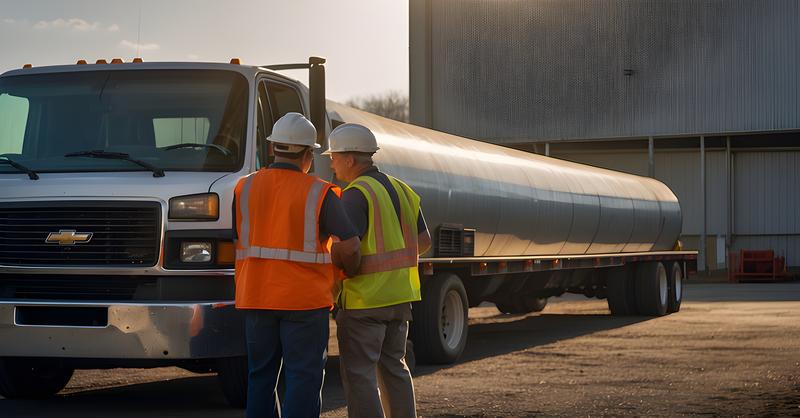
Your installation crew shows up at 7:00 AM. The delivery truck gets caught in the predictable gridlock on the Pulaski Skyway or sits in a freight queue at a loading dock in Newark. Materials hit the deck at 10:30 AM. You’ve just burned three and a half hours of journeyman labor time on a crew that was standing around waiting. Multiply that across a project timeline and you’ve eaten your margin.
Our corporate fleet of box trucks operates to guarantee job site delivery as early as 6:00 AM. That means your crew walks onto the deck and the material is already staged. Morning installation velocity stays intact. It’s not complicated, it’s just logistics discipline that most fabricators don’t have the infrastructure to execute because they’re relying on third-party freight carriers with their own scheduling priorities.
Beyond that, we operate as a complete supply chain node, not just a metal shop. Custom-fabricated ductwork ships bundled with installation hardware, sealants, line sets, and hanging materials in a single procurement loop. One purchase order. One delivery. No sourcing duct from one vendor and hardware from another and hoping the timelines sync up.
Yes, within the constraints of the fabrication queue and project complexity. Straightforward geometries in standard gauges can move quickly through production. Complex specialty configurations, welded assemblies, or dual-wall insulated systems take longer. The honest answer is that our compressed 4-to-24-hour estimation window is a real advantage when you’re working a tight bid schedule, but “emergency fabrication” for a custom 40-foot spiral duct run still takes time to do right.
If you have a genuinely urgent situation, the fastest path is a direct call. We’re not going to promise what we can’t deliver.
I’ve talked to enough PMs across Bergen, Passaic, Morris, and Mercer counties to see the same pattern repeat itself. The job gets bid and won. The ductwork order goes to a shop that seemed competitive on price. Then one of a few things happens:
None of these are catastrophic individually. Stacked together across a 10-week project, they quietly drain 8 to 12 percent of projected margin. That’s real money.
The fabrication relationship matters. Cheap upfront cost that creates downstream field friction isn’t actually cheap. Why Tri-State contractors need a reliable metal fabrication shop isn’t a philosophical question, it’s a math problem.
How do New Jersey mechanical contractors verify a ductwork fabricator’s quality before placing a large order? Request a sample fabrication run on a standard rectangular section in your specified gauge. Check seam integrity, dimensional accuracy against the submitted drawing, and joint sealing consistency. Ask specifically about their SMACNA compliance process and whether their estimation workflow can ingest digital take-off files. A shop that can’t return a detailed quote within 24 hours of receiving your architectural files is likely using manual workflows that will create problems downstream.
HVAC Metals, LLC isn’t trying to be everything to everyone. We serve mechanical contractors, project managers, and commercial HVAC firms operating across New Jersey’s 21 counties, the five boroughs of New York City, and Eastern Pennsylvania’s industrial corridors. Our B2B manufacturing and logistics model is purpose-built for the professional who needs precision-fabricated metal on the deck at dawn, not a showroom consultation.
Our Kearny headquarters sits in Hudson County, which puts us within a practical logistics radius of every major New Jersey market. Jersey City, Hoboken, Newark, Elizabeth, Paterson, Trenton, and the entire Route 1 pharmaceutical corridor in Middlesex County are all reachable before most construction sites hit full crew strength. That geographic positioning wasn’t accidental.
Does HVAC Metals, LLC serve all New Jersey counties for custom ductwork fabrication? Yes. HVAC Metals operates across all 21 New Jersey counties from its facility at 181-183 Garfield Ave, Kearny, NJ 07032. The in-house fleet logistics system covers the full state, with early-morning delivery capability to the New York metro area and Eastern Pennsylvania.
If you want to see what we fabricate and how we operate, our custom ductwork service page walks through the full capability scope. And if you’re ready to submit a take-off or talk through a project, the contact page is the fastest path to getting a real number back within the day.
Follow our work and stay current on what’s moving through the shop on Facebook and LinkedIn. We post regularly about fabrication projects, material specs, and the occasional reality check on what actually happens in the field versus what gets written into project specs.
Written by: Arthur Dabrowski
HVAC Metals, LLC
(201) 991-2206